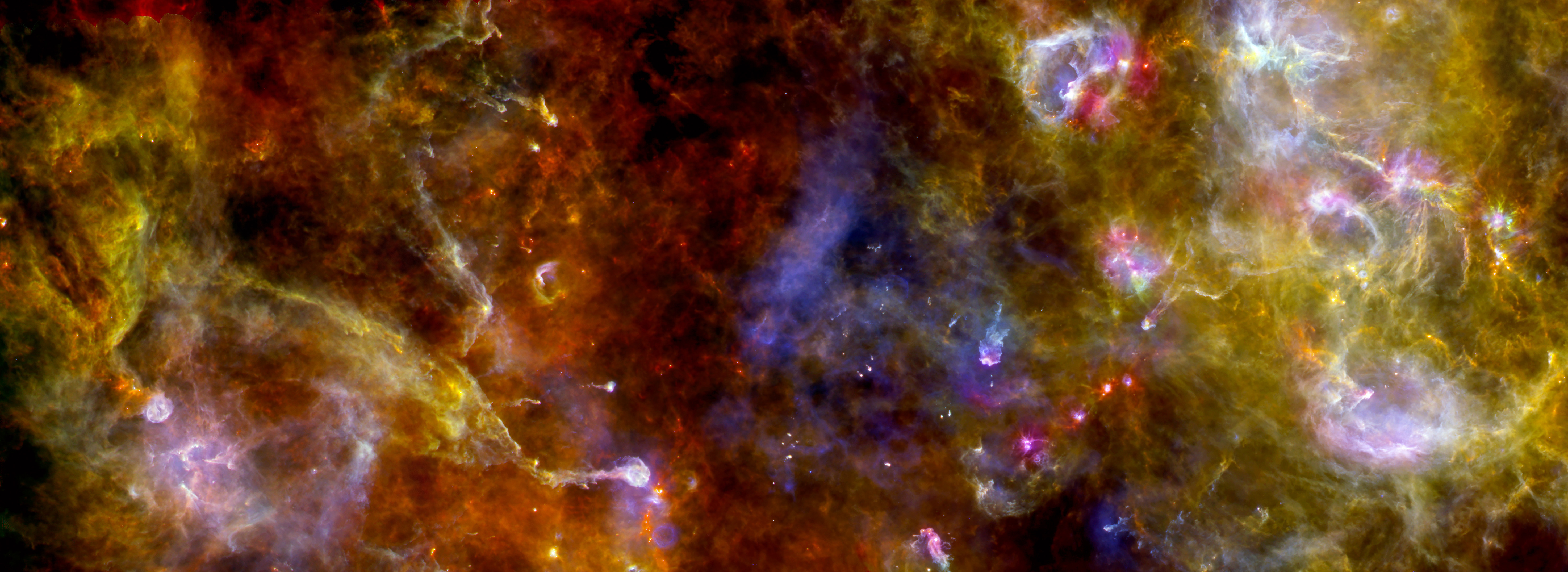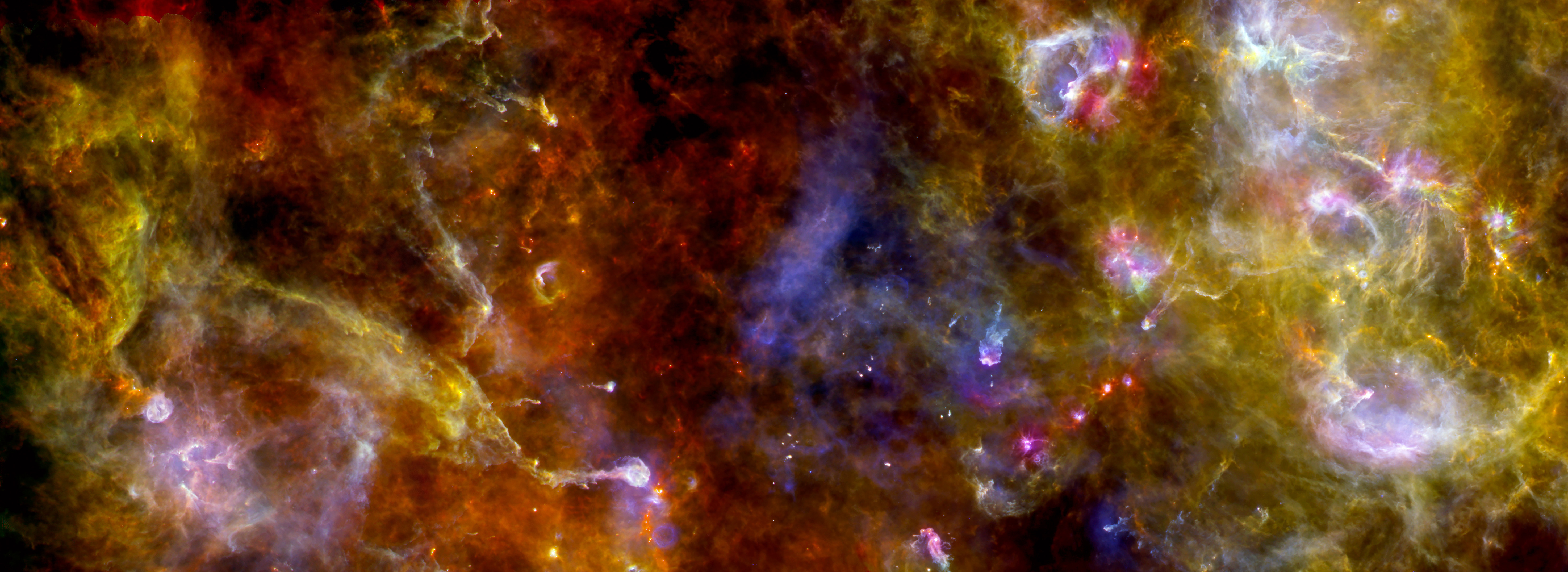
The Herschel Space Observatory's infrared view of Cygnus X spans some 6x2 degrees across one of the closest, massive star forming regions in the plane of our Milky Way galaxy. In fact, the rich stellar nursery already holds the massive star cluster known as the Cygnus OB2 association. But those stars are more evident by the region cleared by their energetic winds and radiation near the bottom center of this field, and are not detected by Herschel instruments operating at long infrared wavelengths. Herschel does reveal the region's complex filaments of cool gas and dust that lead to dense locations where new massive stars are forming. Cygnus X lies some 4500 light-years away toward the heart of the northern constellation of the Swan. At that distance this picture would be almost 500 light-years wide.
La vista en infrarrojo del Observatorio Espacial Herschel de Cisne X abarca unos 6x2 grados a través de una de las regiones más cercanas y masivas de formación estelar en el plano de nuestra galaxia Vía Láctea. De hecho, el rico nido estelar ya contiene el cúmulo de estrellas masivas conocido como la asociación Cisne OB2. Pero esas estrellas son más evidentes por la región que han limpiado con sus vientos y radiación energéticos cerca del centro inferior de este campo, y no son detectadas por los instrumentos de Herschel que operan en longitudes de onda infrarrojas largas. Herschel sí revela las complejas fibras de gas y polvo frío de la región que conducen a ubicaciones densas donde se forman nuevas estrellas masivas. Cisne X se encuentra a unos 4500 años luz hacia el corazón de la constelación norteña del Cisne. A esa distancia, esta imagen tendría casi 500 años luz de ancho.