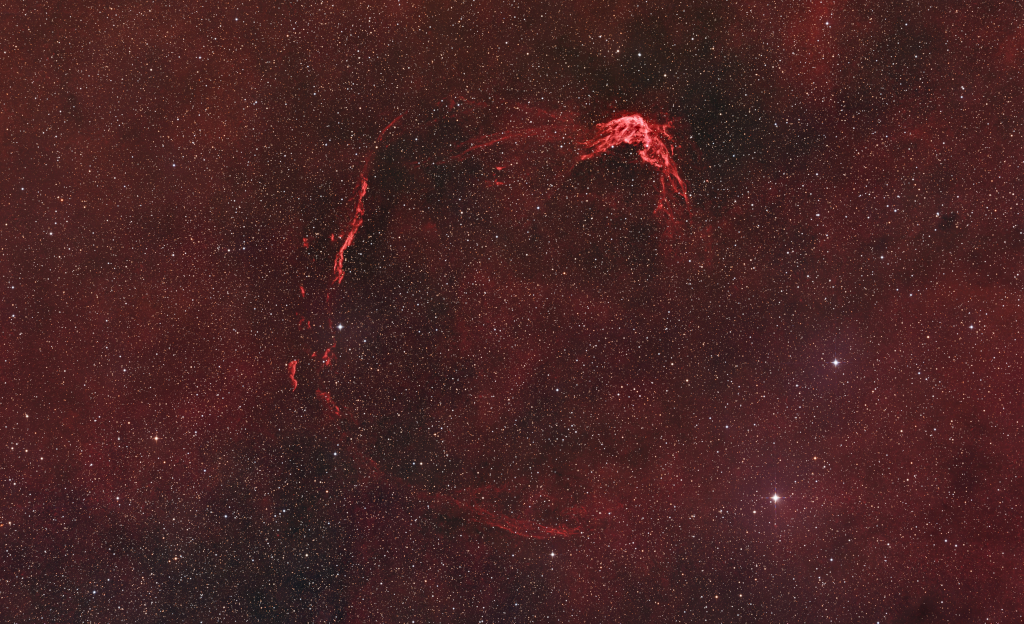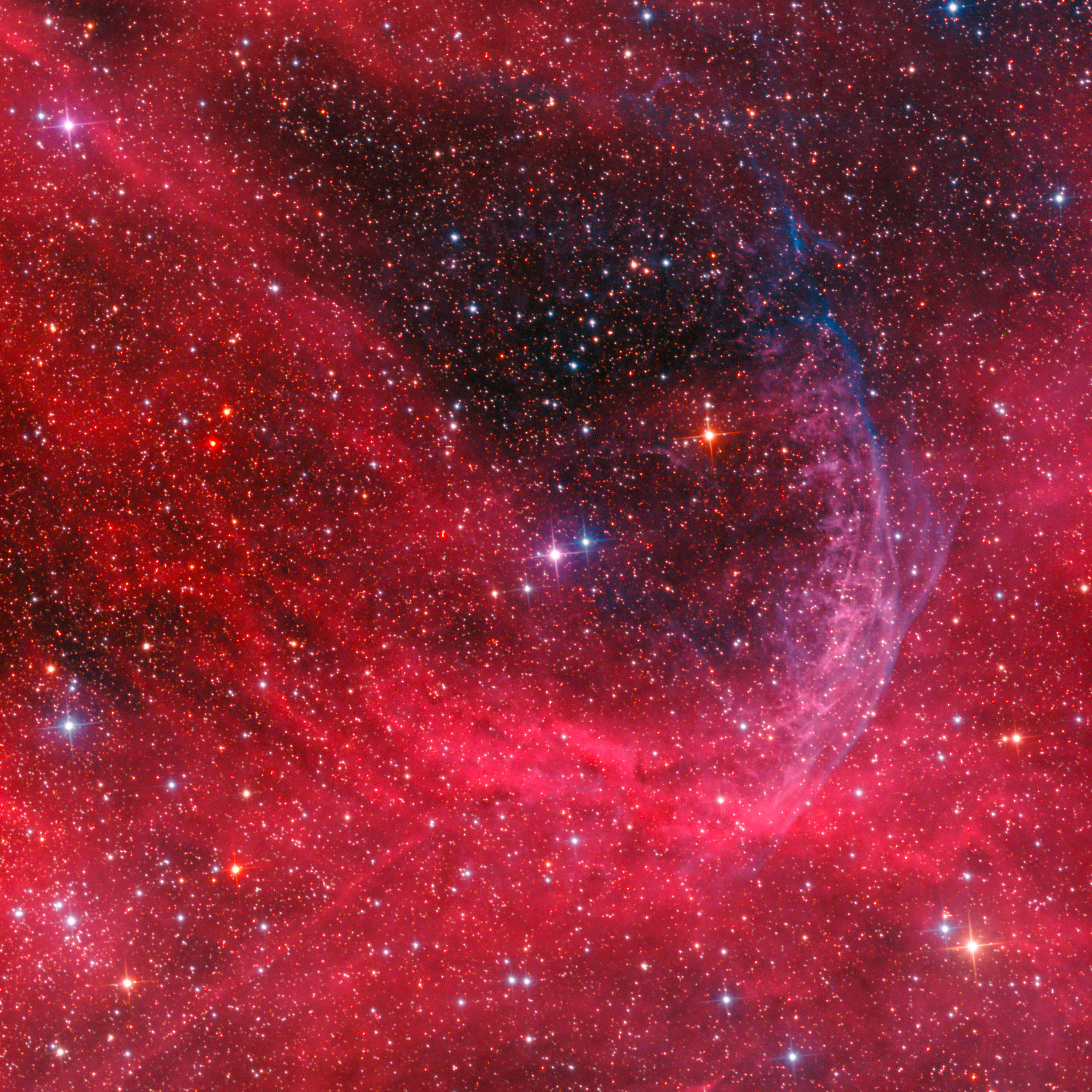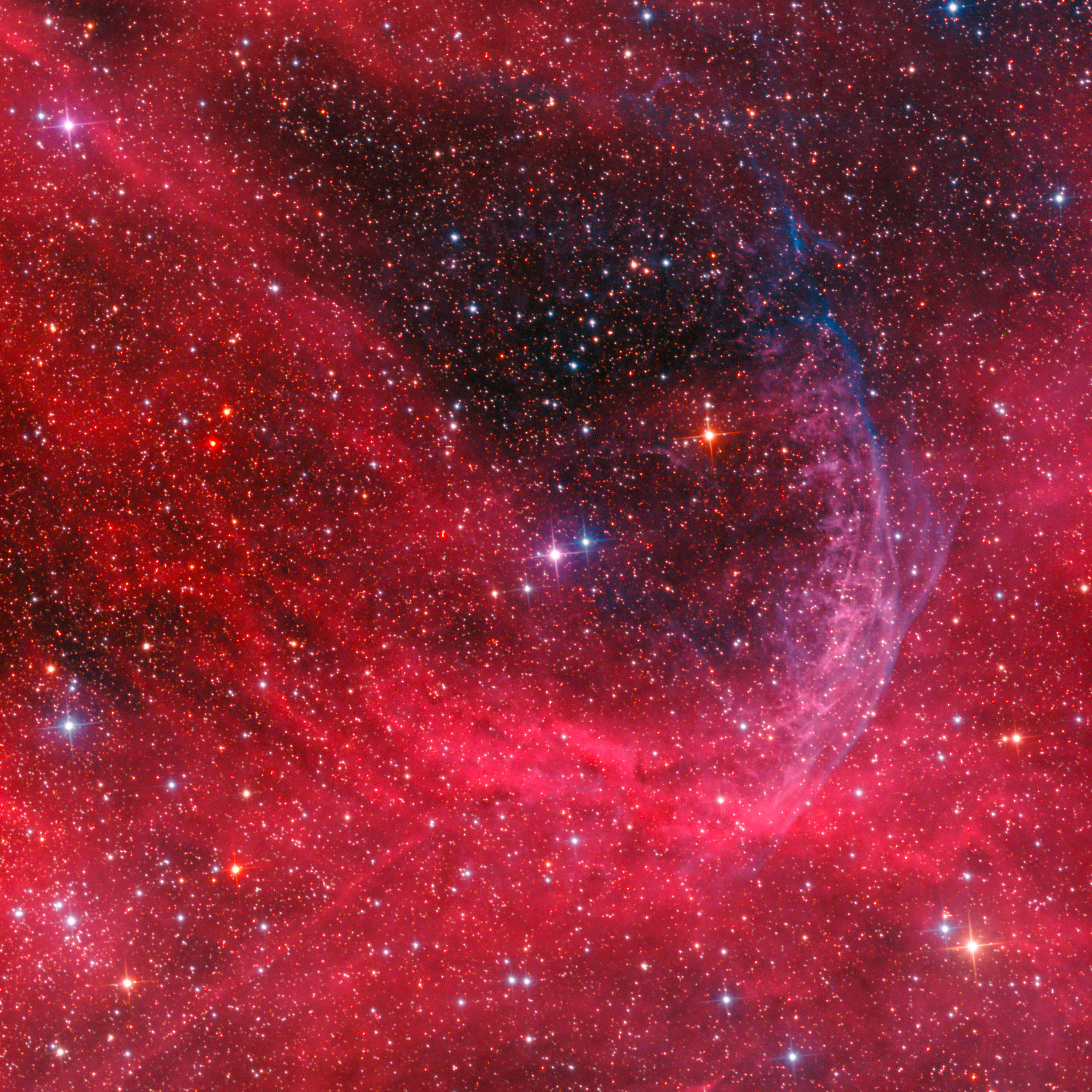
Made with narrow and broad band filters, this colorful cosmic snap shot covers a field of view about the size of the full Moon within the boundaries of the constellation Cygnus. It highlights the bright edge of a ring-like nebula traced by the glow of ionized hydrogen and oxygen gas. Embedded in the region's interstellar clouds of gas and dust, the complex, glowing arcs are sections of bubbles or shells of material swept up by the wind from Wolf-Rayet star WR 134, brightest star near the center of the frame. Distance estimates put WR 134 about 6,000 light-years away, making the frame over 50 light-years across. Shedding their outer envelopes in powerful stellar winds, massive Wolf-Rayet stars have burned through their nuclear fuel at a prodigious rate and end this final phase of massive star evolution in a spectacular supernova explosion. The stellar winds and final supernovae enrich the interstellar material with heavy elements to be incorporated in future generations of stars.
Crédito: NASA, CGRO SSC Esta colorida imagen cósmica, capturada con filtros estrechos y anchos, abarca un campo de visión aproximadamente del tamaño de la Luna llena dentro de los límites de la constelación de Cisne. Destaca el borde brillante de una nebulosa en forma de anillo, trazada por el brillo del gas de hidrógeno y oxígeno ionizados. Incrustadas en las nubes interestelares de gas y polvo de la región, las arcos luminosos y complejos son secciones de burbujas o capas de material recogido por el viento estelar de la estrella Wolf-Rayet WR 134, la estrella más brillante cerca del centro del marco. Las estimaciones de distancia sitúan a WR 134 a unos 6000 años luz de distancia, lo que hace que el marco tenga más de 50 años luz de ancho. Al perder sus envoltorios externos en vientos estelares poderosos, las estrellas masivas de tipo Wolf-Rayet han quemado su combustible nuclear a un ritmo prodigioso y terminan esta fase final de la evolución de las estrellas masivas en una explosión supernova espectacular. Los vientos estelares y las supernovas finales enriquecen el material interestelar con elementos pesados que serán incorporados en futuras generaciones de estrellas.