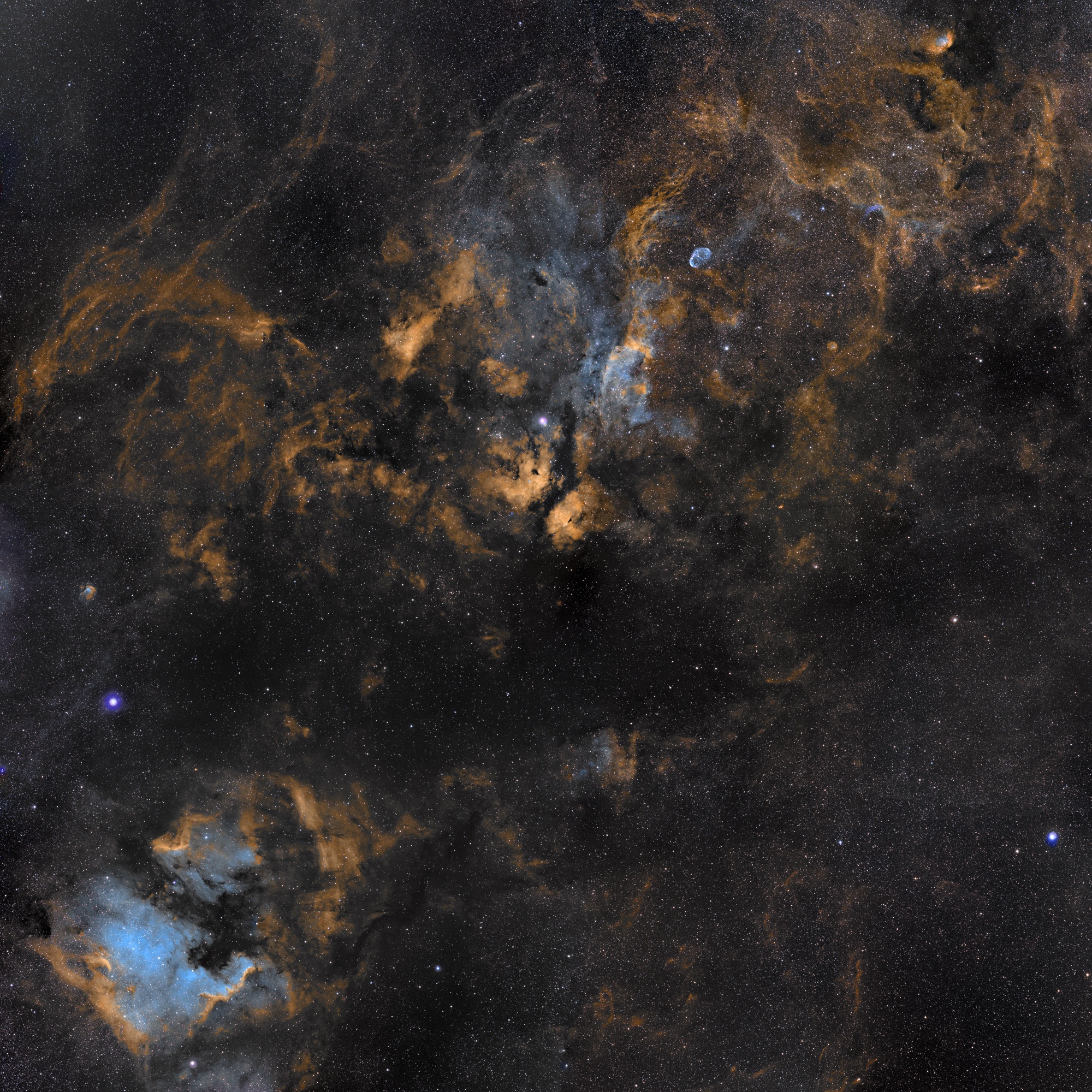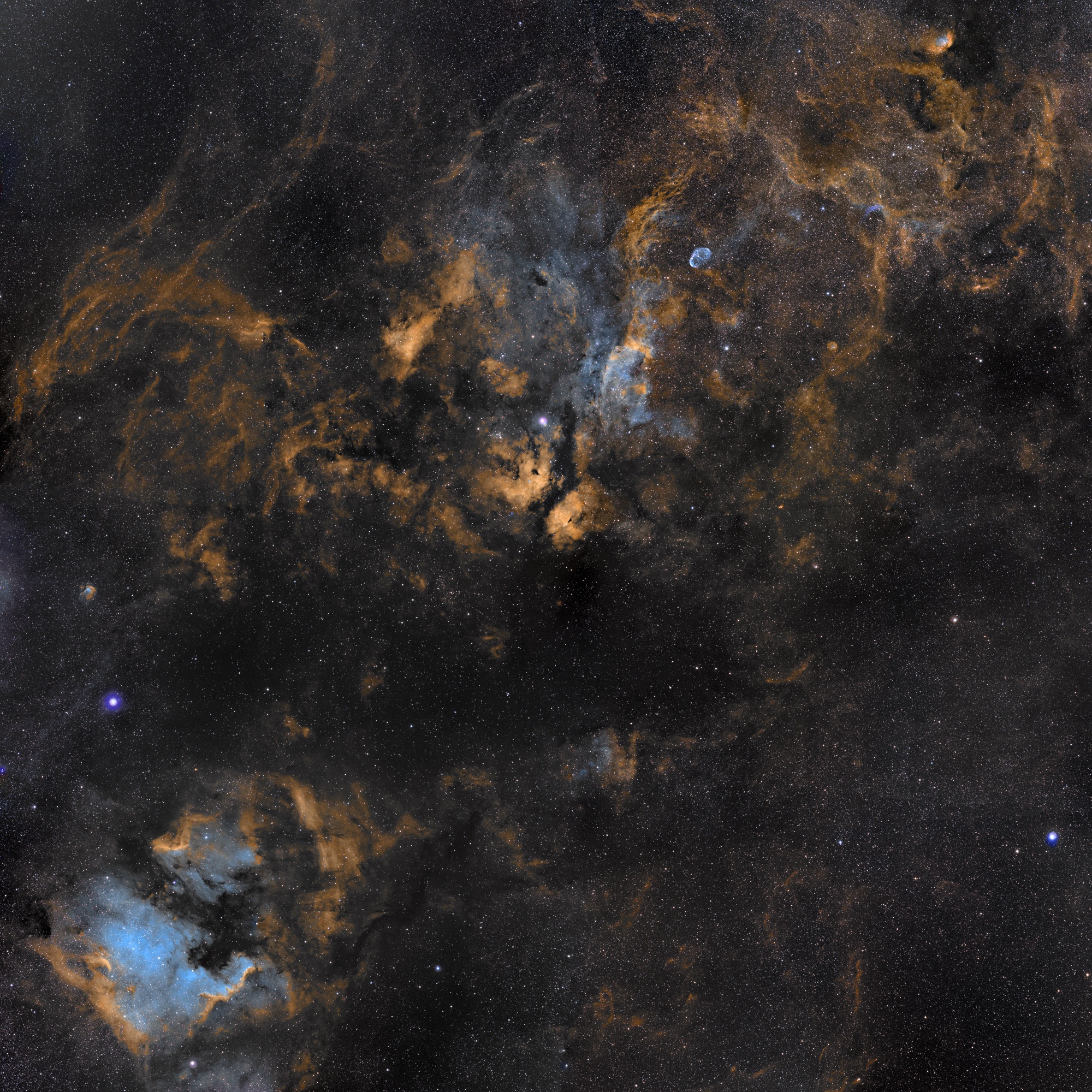
Cosmic clouds of gas and dust drift across this magnificent mosaic covering a 12x12 degree field within the high flying constellation Cygnus. The collaborative skyscape, a combination of broad and narrow band image data presented in the Hubble palette, is anchored by bright, hot, supergiant star Deneb, below center near the left edge. Alpha star of Cygnus, Deneb, is the top of the Northern Cross asterism and is seen here next to the dark void known as the Northern Coal Sack. Below Deneb are the recognizable North America and Pelican nebulae (NGC 7000 and IC 5070). Another supergiant star, Sadr (Gamma Cygni) is near the center of the field just above the bright wings of the Butterfly Nebula. A line continuing up and right will encounter the more compact Crescent Nebula and finally the Tulip Nebula near the top of the frame. Most of these complex nebulosities are located about 2,000 light-years away. Along with the Sun, they lie in the Orion spiral arm of our Milky Way galaxy.
Nubes cósmicas de gas y polvo flotan a través de esta magnífica mosaico que cubre un campo de 12x12 grados dentro de la constelación de Cisne, que vuela alta en el cielo. El paisaje celeste colaborativo, una combinación de datos de imágenes en banda ancha y estrecha presentados en la paleta de Hubble, está anclado por la estrella supergigante brillante y caliente Deneb, ubicada cerca del borde izquierdo, abajo del centro. Deneb, la estrella alfa de Cisne, es la parte superior de la constelación asterismal de la Cruz del Norte y se ve aquí junto al vacío oscuro conocido como el Cepo de Carbón del Norte. Debajo de Deneb se encuentran las reconocibles nebulosas América del Norte y Pelícano (NGC 7000 e IC 5070). Otra estrella supergigante, Sadr (Gamma Cygni), se encuentra cerca del centro del campo, justo encima de las alas brillantes de la Nebulosa Mariposa. Una línea que continúe hacia arriba y a la derecha encontrará la más compacta Nebulosa Creciente y finalmente la Nebulosa Tulipán cerca de la parte superior del marco. La mayoría de estas complejas nebulosidades se encuentran a unos 2000 años luz de distancia. Junto con el Sol, se encuentran en el brazo espiral de Orión de nuestra galaxia Vía Láctea.