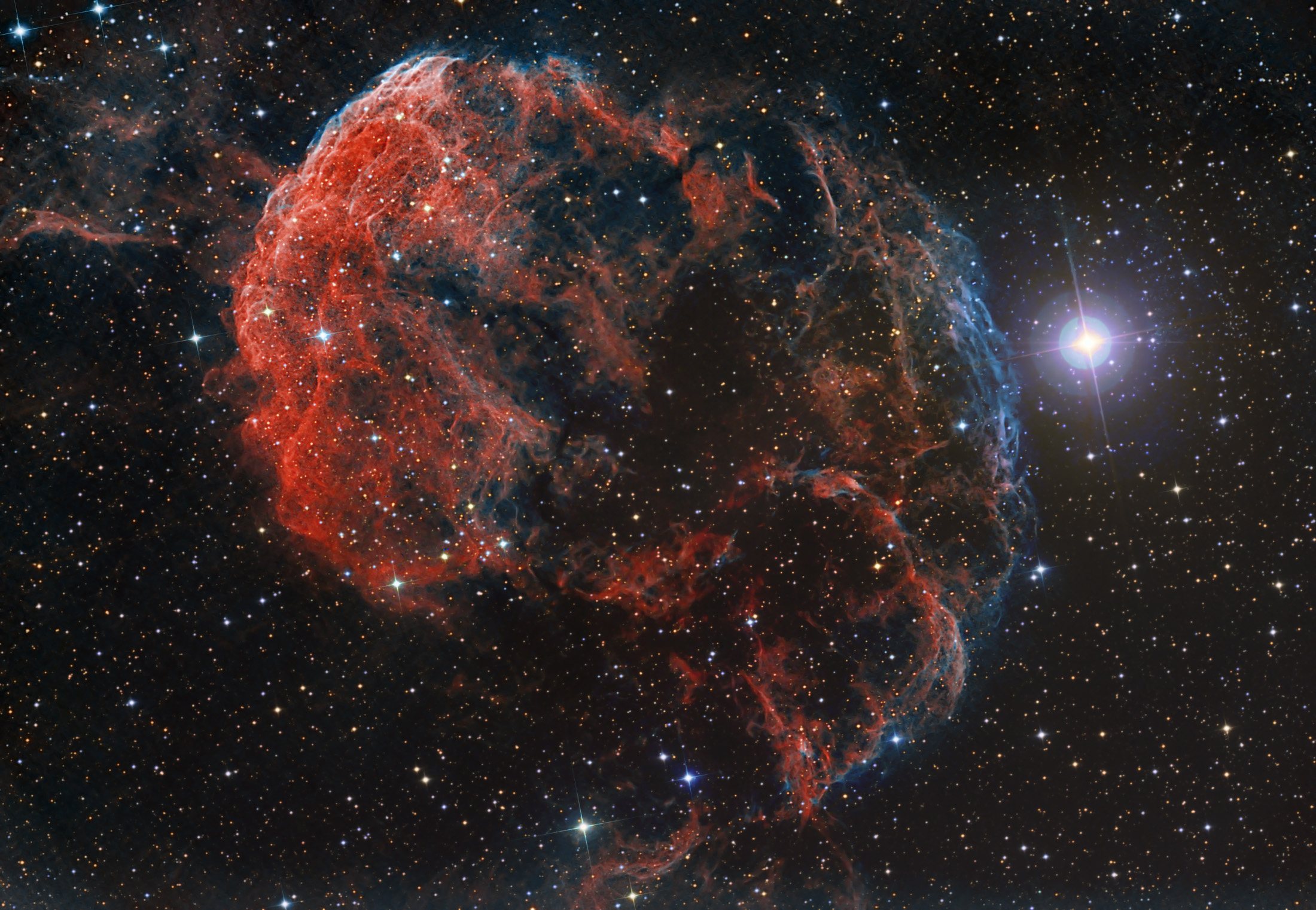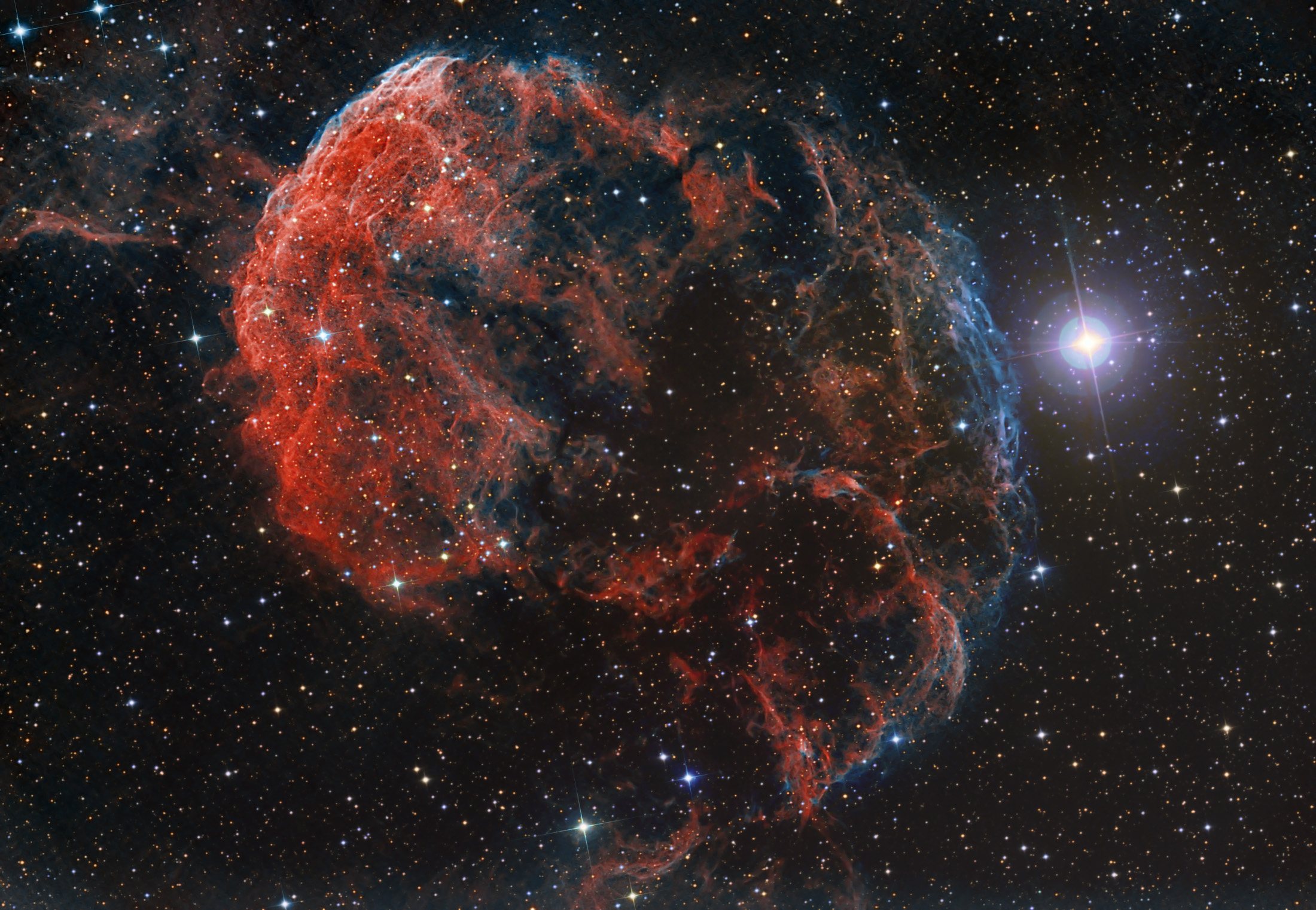
Normally faint and elusive, the Jellyfish Nebula is caught in this alluring telescopic view. Drifting near bright star Eta Geminorum, at the foot of a celestial twin, the Jellyfish Nebula is seen dangling tentacles from the bright arcing ridge of emission left of center. In fact, the cosmic jellyfish is part of bubble-shaped supernova remnant IC 443, the expanding debris cloud from a massive star that exploded. Light from the explosion first reached planet Earth over 30,000 years ago. Like its cousin in astrophysical waters the Crab Nebula supernova remnant, IC 443 is known to harbor a neutron star, the remnant of the collapsed stellar core. The Jellyfish Nebula is about 5,000 light-years away. At that distance, this image would be about 100 light-years across. Best of APOD 2012: Download a free 2013 APOD Calendar
Normalmente tenue y elusiva, la Nebulosa Medusa se captura en esta atractiva imagen obtenida con un telescopio. Flotando cerca de la brillante estrella Eta Geminorum, en el pie de un gemelo celeste, la Nebulosa Medusa se ve colgando tentáculos desde el brillante arco de emisión ubicado a la izquierda del centro. De hecho, la medusa cósmica forma parte del remanente de supernova en forma de burbuja IC 443, la nube de escombros en expansión proveniente de una estrella masiva que explotó. La luz de la explosión llegó por primera vez a la Tierra hace más de 30,000 años. Al igual que su primo en el ámbito astrofísico, el remanente de supernova de la Nebulosa Cangrejo, IC 443 es conocido por albergar una estrella de neutrones, el remanente del núcleo estelar colapsado. La Nebulosa Medusa se encuentra a unos 5,000 años luz de distancia. A esa distancia, esta imagen abarcaría aproximadamente 100 años luz.