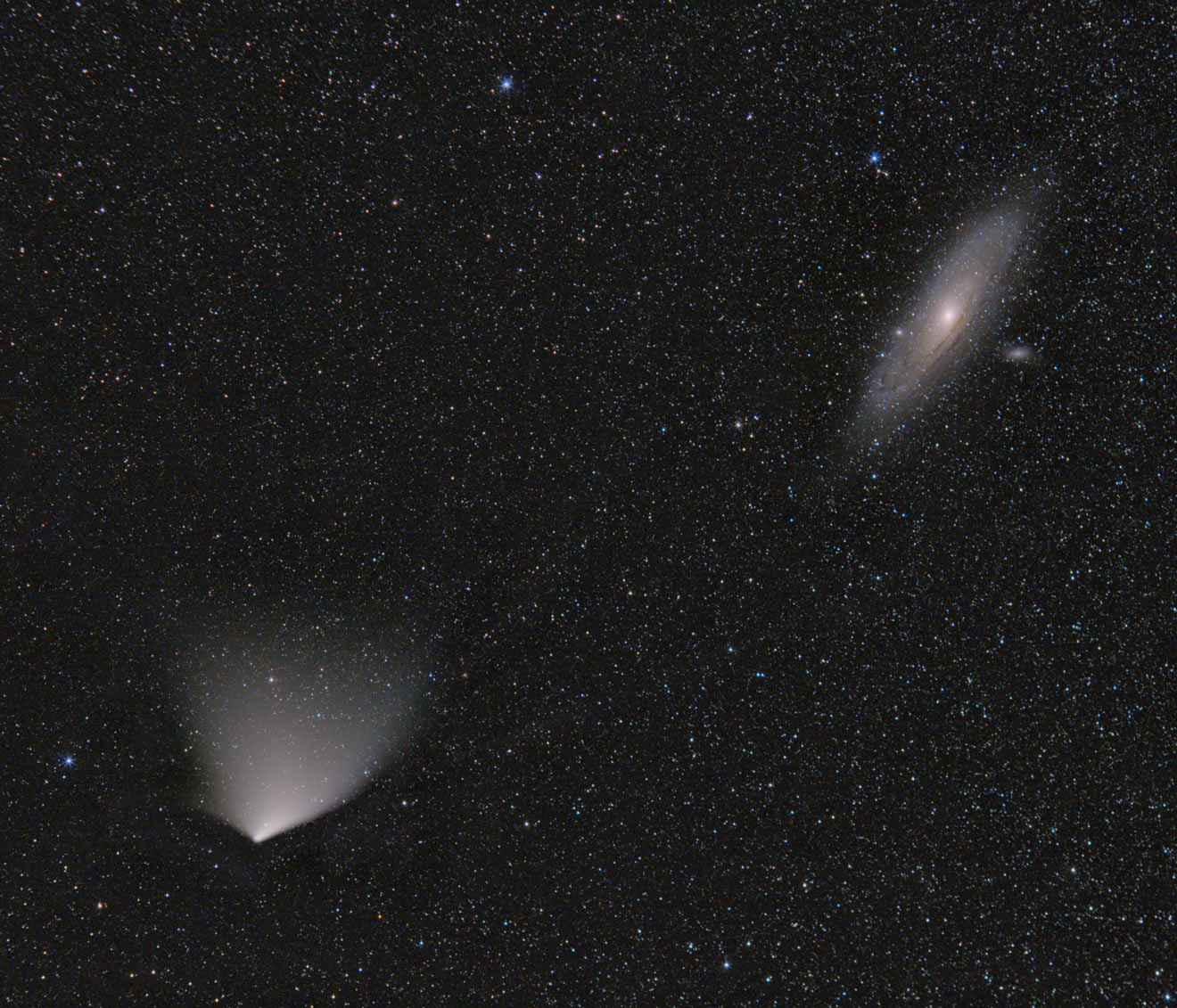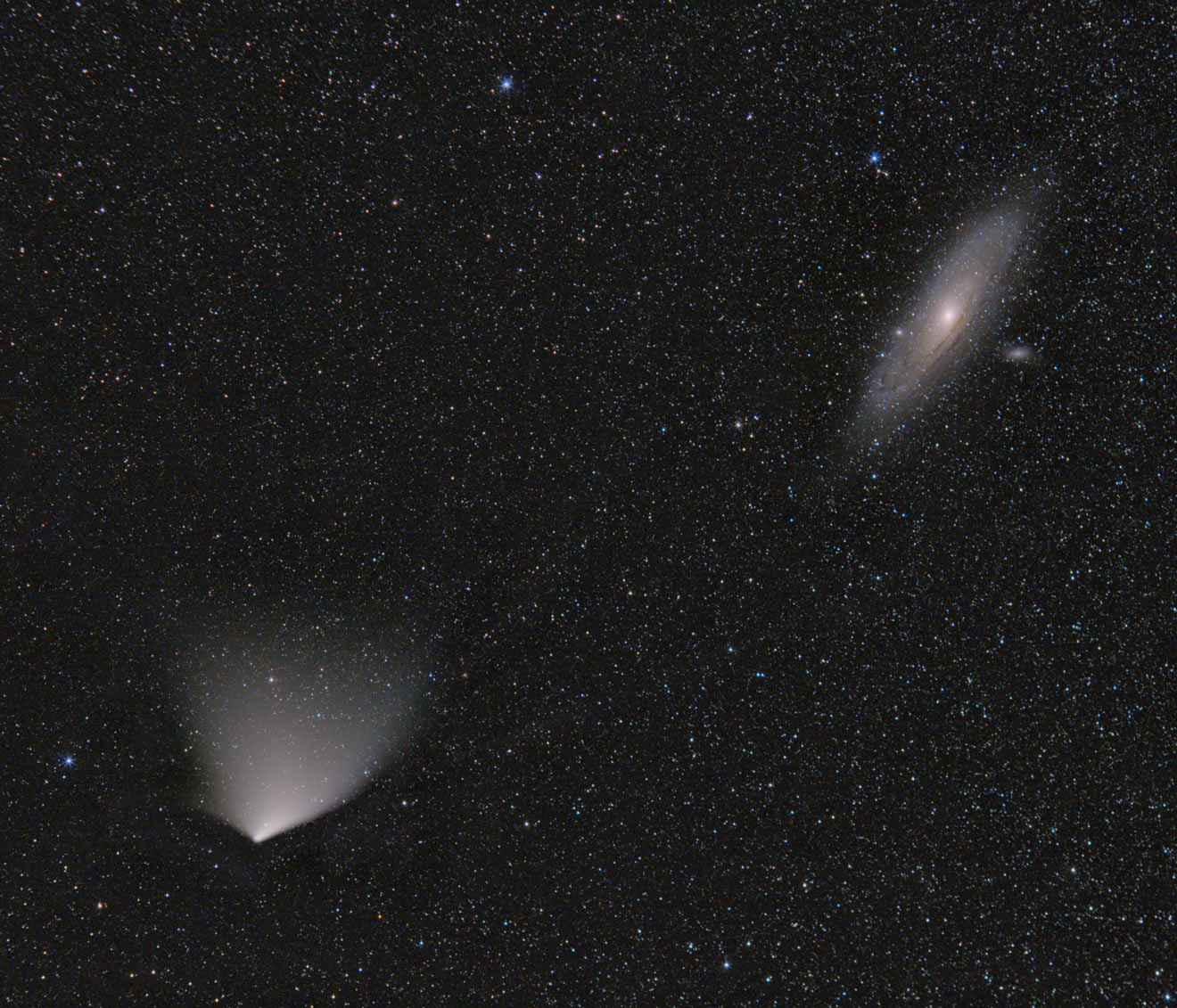
Currently, comet PANSTARRS is passing nearly in front of the galaxy Andromeda. Coincidentally, both comet and galaxy appear now to be just about the same angular size. In physical size, even though Comet PANSTARRS is currently the largest object in the Solar System with a tail spanning about 15 times the diameter of the Sun, it is still about 70 billion times smaller than the Andromeda galaxy (M31). The above image was captured on March 30, near Syktyvkar, Russia. As C/2011 L4 (PANSTARRS) on the lower left recedes from the Sun and dims, it is returning to the northerly direction whence it came. When the comet will return is currently unknown, although humans may have merged with computers by then. Gallery: Comet PANSTARRS
Actualmente, el cometa PANSTARRS está pasando casi frente a la galaxia Andrómeda. Coincidientemente, tanto el cometa como la galaxia aparecen ahora con aproximadamente el mismo tamaño angular. En tamaño físico, aunque el cometa PANSTARRS es actualmente el objeto más grande del Sistema Solar, con una cola que abarca aproximadamente 15 veces el diámetro del Sol, sigue siendo aproximadamente 70 mil billones de veces más pequeño que la galaxia Andrómeda (M31). La imagen anterior fue capturada el 30 de marzo, cerca de Syktyvkar, Rusia. Mientras que el cometa C/2011 L4 (PANSTARRS), ubicado en la parte inferior izquierda, se aleja del Sol y se vuelve más tenue, regresa hacia la dirección norte de donde vino. Cuando el cometa regresará actualmente es desconocido, aunque es posible que los humanos ya se hayan fusionado con las computadoras para entonces.