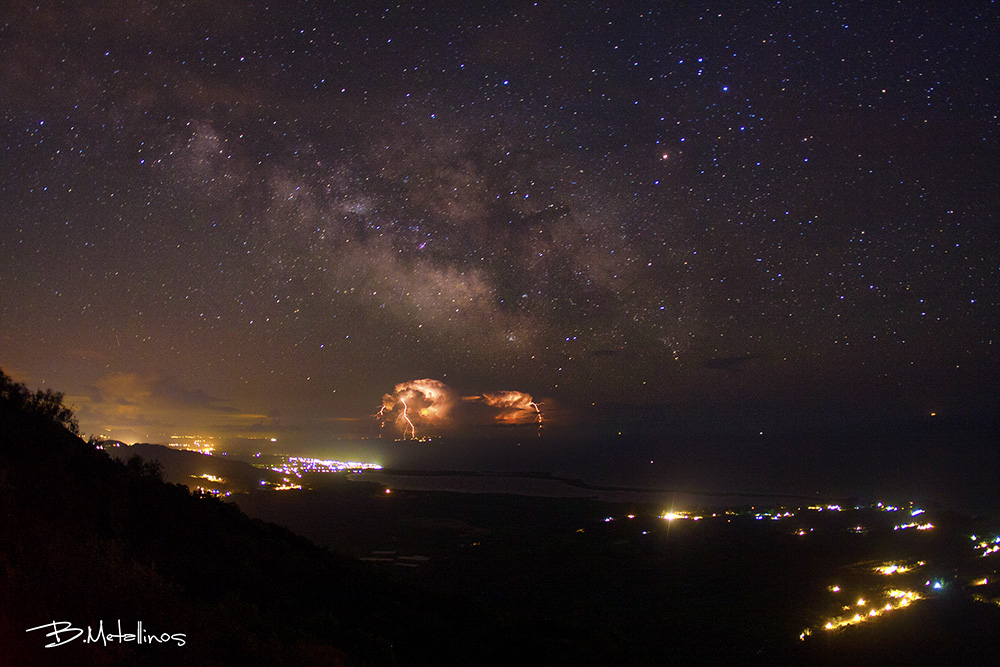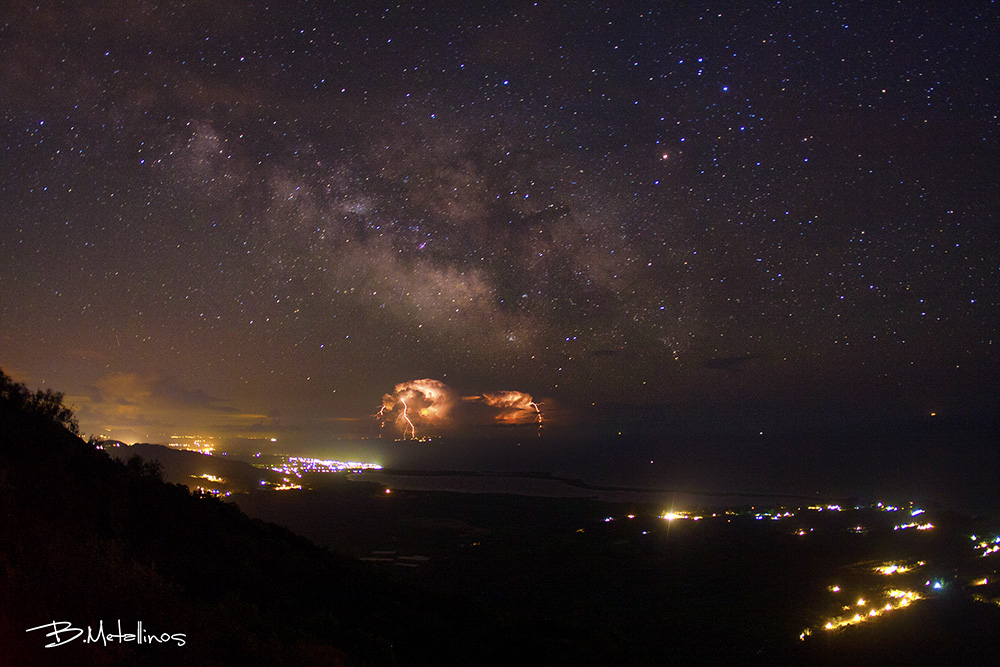
It may appear, at first, like the Galaxy is producing the lightning, but really it's the Earth. In the foreground of the above picturesque nighttime landscape is the Greek Island of Corfu, with town lights surrounding Lake Korrision. Visible farther in the distance are lights from the town of Preveza on the Greek mainland. In the more distant sky a thunderstorm is threatening, with two lightning strokes caught together during this 45 second wide-angle exposure taken in mid-May. The lightning branch on the left appears to be striking near Preveza, whereas the lightning strike on the right appears to be striking near Mount Ainos on the Greek Island of Cephalonia. Much farther in the distance, strewn about the sky, are hundreds of stars in the neighborhood of our Sun in the Milky Way Galaxy. Furthest away, arching over the entire panorama, are billions of stars that together compose the central band of our Milky Way. News: YouTube video of yesterday's Russian rocket explosion
Puede parecer, a primera vista, que la Galaxia está produciendo los relámpagos, pero en realidad es la Tierra. En primer plano de la anteriormente mencionada escena nocturna pintoresca se encuentra la isla griega de Corfú, con luces de la ciudad alrededor del lago Korrision. Más lejos, a distancia, se ven luces de la ciudad de Preveza en la península griega. En el cielo más distante, una tormenta eléctrica amenaza, con dos descargas de relámpago capturadas juntas durante esta exposición de 45 segundos realizada a mediados de mayo. La rama de relámpago a la izquierda parece golpear cerca de Preveza, mientras que el rayo a la derecha parece golpear cerca del Monte Ainos en la isla griega de Cefalonia. Mucho más lejos, esparcidas por el cielo, se ven cientos de estrellas en las cercanías de nuestro Sol en la Galaxia de la Vía Láctea. Lo más lejos, arqueándose sobre todo el panorama, se encuentran billones de estrellas que juntas componen la banda central de nuestra Vía Láctea.