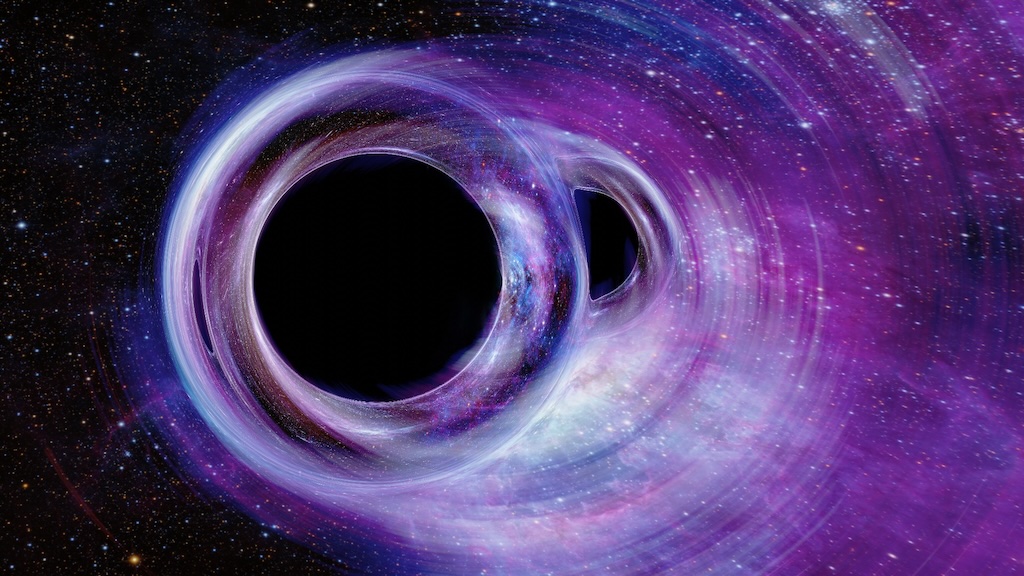
What would it look like to go right up to a black hole? One particularly interesting place near a black hole is its photon sphere, where photons can orbit in circles, a sphere 50 percent further out than the event horizon. Were you to look out from the photon sphere of a black hole, half of the sky would appear completely black, half of the sky would appear unusually bright, and the back of your head would appear across the middle. The above computer-animated video depicts this view from the photon sphere. The reason that the lower region, as shown, appears black is because all light paths from this dark region comes up from the black hole -- which classically emits no light. The upper half of the sky now appears unusually bright, blueshifted, and shows increasingly many complete sky images increasingly close to the dark-light divide across the middle. That dark-light divide is the photon sphere -- your location -- and since photons can do circles there, light from the back of your head can circle the black hole and come to your eye. No place on the sky is hidden from you -- stars that would normally pass behind the black hole now appear to zip quickly around an Einstein ring, a ring that appears above as a horizontal line about a quarter of the way down from the video top. The above video is part of a sequence of videos visually exploring the space near a black hole's event horizon. (Disclosure: Video creator Robert Nemiroff is an editor for APOD.)
¿Qué se vería al acercarse directamente a un agujero negro? Un lugar particularmente interesante cerca de un agujero negro es su esfera de fotones, donde los fotones pueden orbitar en círculos, una esfera ubicada un 50 por ciento más allá que el horizonte de sucesos. Si se mirara desde la esfera de fotones de un agujero negro, la mitad del cielo aparecería completamente negra, la otra mitad del cielo aparecería inusualmente brillante, y la parte posterior de tu cabeza aparecería a través del centro. El video animado por computadora mostrado arriba representa esta vista desde la esfera de fotones. La razón por la que la región inferior, como se muestra, aparece negra es porque todas las trayectorias de la luz de esta región oscura provienen del agujero negro — que clásicamente no emite luz. La mitad superior del cielo ahora aparece inusualmente brillante, azul desplazada, y muestra cada vez más imágenes completas del cielo cada vez más cercanas al límite entre la oscuridad y la luz a través del centro. Ese límite entre la oscuridad y la luz es la esfera de fotones — tu ubicación — y ya que los fotones pueden hacer círculos allí, la luz de la parte posterior de tu cabeza puede rodear el agujero negro y llegar a tus ojos. No hay lugar en el cielo que esté oculto para ti — las estrellas que normalmente pasarían detrás del agujero negro ahora parecen moverse rápidamente alrededor de un anillo de Einstein, un anillo que aparece arriba como una línea horizontal aproximadamente una cuarta parte de la distancia desde la parte superior del video. El video mostrado arriba forma parte de una secuencia de videos que exploran visualmente el espacio cercano al horizonte de sucesos de un agujero negro. (Revelación: El creador del video, Robert Nemiroff, es un editor para APOD.)