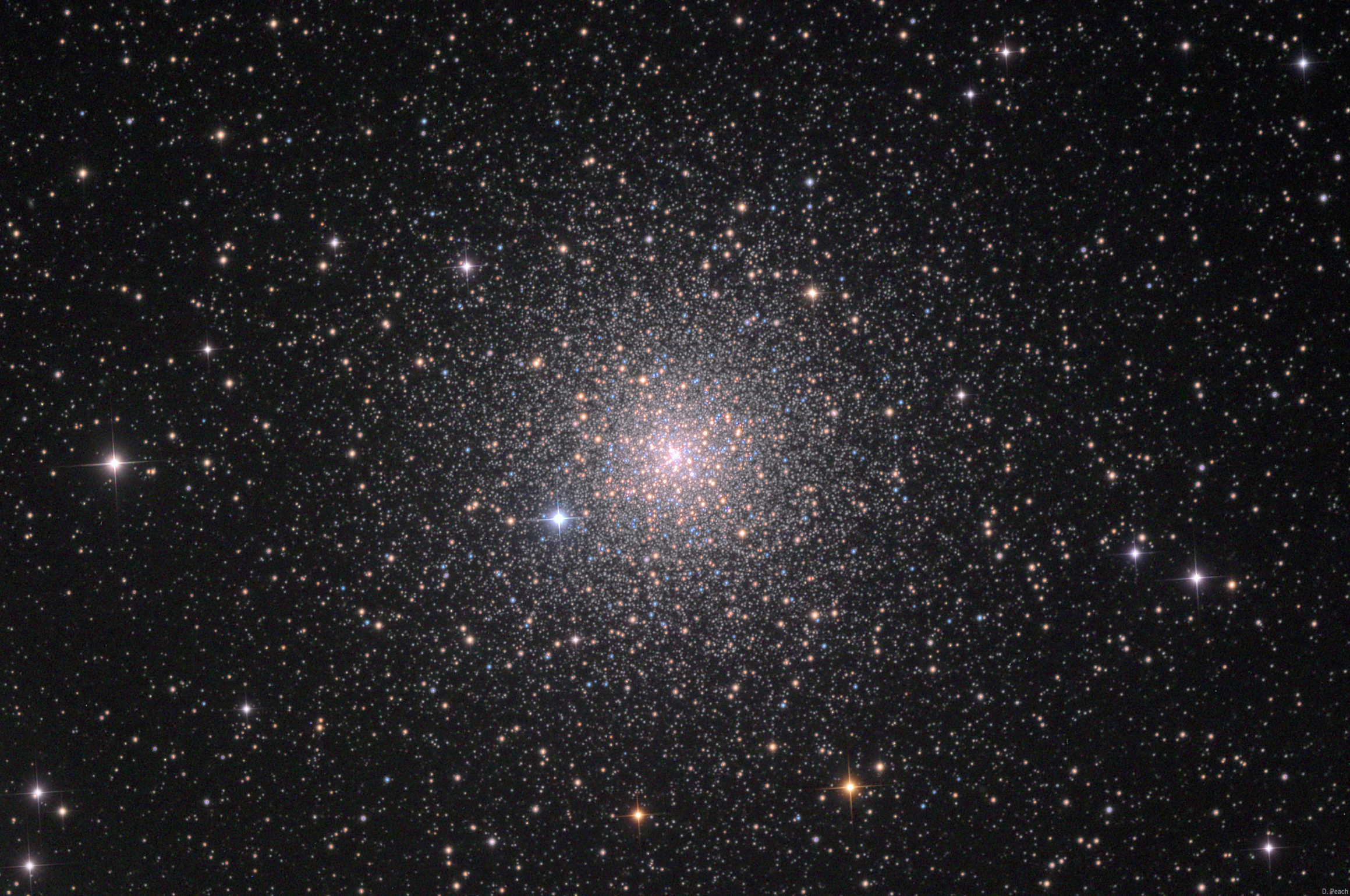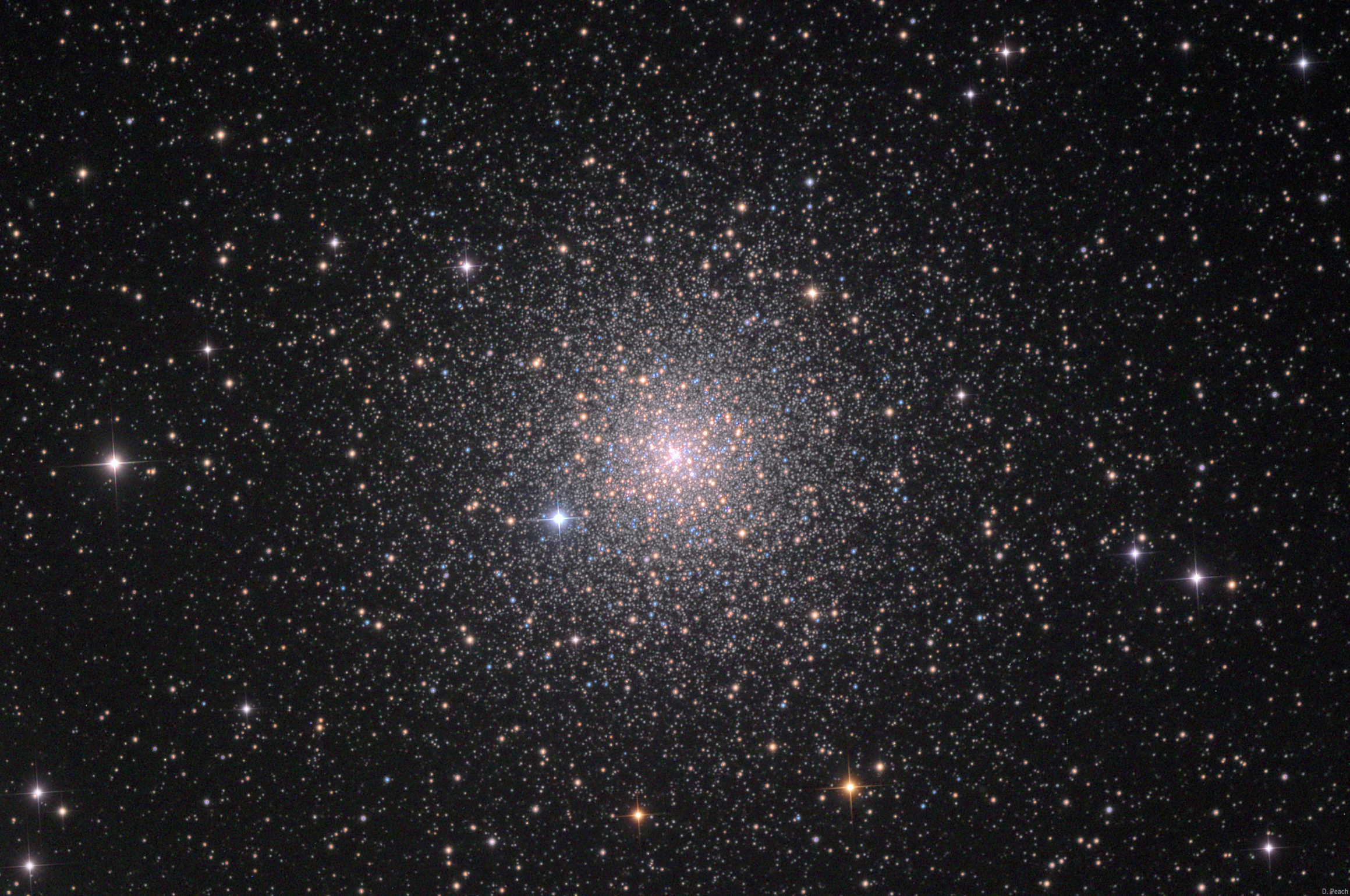
Some 13,000 light-years away toward the southern constellation Pavo, the globular star cluster NGC 6752 roams the halo of our Milky Way galaxy. Over 10 billion years old, NGC 6752 follows clusters Omega Centauri and 47 Tucanae as the third brightest globular in planet Earth's night sky. It holds over 100 thousand stars in a sphere about 100 light-years in diameter. Telescopic explorations of the NGC 6752 have found that a remarkable fraction of the stars near the cluster's core, are multiple star systems. They also reveal the presence of blue straggle stars, stars which appear to be too young and massive to exist in a cluster whose stars are all expected to be at least twice as old as the Sun. The blue stragglers are thought to be formed by star mergers and collisions in the dense stellar environment at the cluster's core. This sharp color composite also features the cluster's ancient red giant stars in yellowish hues.
A unos 13 000 años luz de distancia, hacia la constelación austral Pavo, el cúmulo estelar globular NGC 6752 se mueve en el halo de nuestra galaxia Vía Láctea. Con más de 10 000 millones de años de edad, NGC 6752 sigue a los cúmulos Omega Centauri y 47 Tucanae como el tercer cúmulo globular más brillante en el cielo nocturno terrestre. Contiene más de 100 000 estrellas en una esfera de aproximadamente 100 años luz de diámetro. Exploraciones telescopicas del NGC 6752 han revelado que una fracción notable de las estrellas cercanas al núcleo del cúmulo son sistemas estelares múltiples. También muestran la presencia de estrellas estraglers azules, estrellas que parecen ser demasiado jóvenes y masivas para existir en un cúmulo cuyas estrellas se espera que tengan al menos el doble de la edad del Sol. Se cree que las estrellas estraglers azules se formaron mediante fusiones y colisiones estelares en el entorno estelar denso del núcleo del cúmulo. Esta composición de color nítida también destaca las antiguas estrellas gigantes rojas del cúmulo en tonos amarillentos.