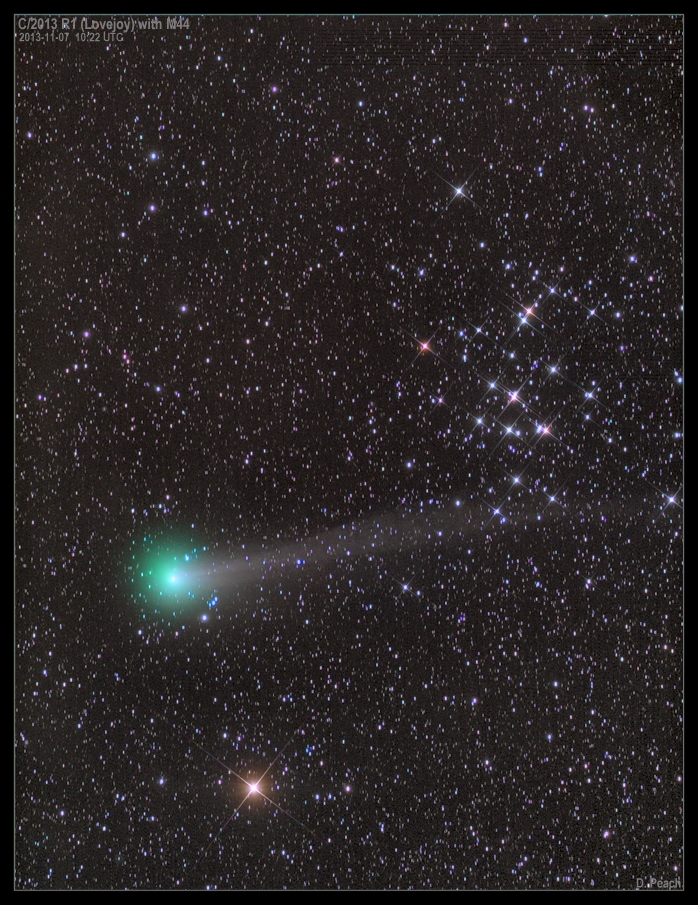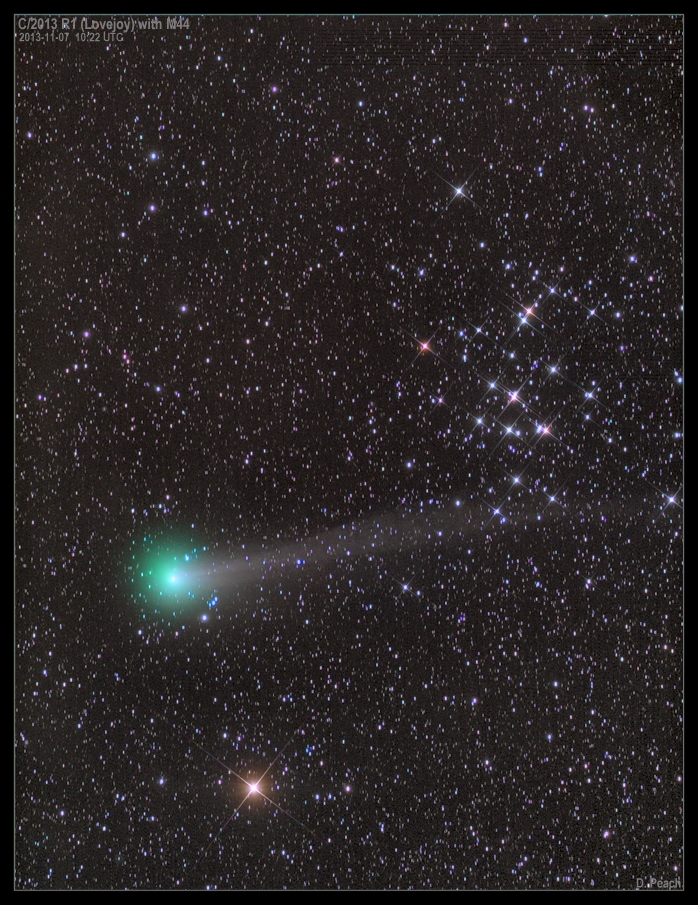
While anxiously waiting for Comet ISON to brighten further as it falls toward the Sun, northern skygazers can also find three other bright comets in the east before dawn. In fact, Comet Lovejoy C/2013 R1 is currently the morning sky's brightest. Only discovered in September and not a sungrazing comet, this Comet Lovejoy is nearing the edge of naked-eye visibility and might be spotted from very dark sky sites. Sporting a greenish coma and tail in this telescopic view taken on November 7, Comet Lovejoy is about 0.5 AU from our fair planet and 1.2 AU from the Sun. The comet is having a photogenic Messier moment, sweeping past well known star cluster M44, the Beehive in Cancer. Yellowish bright star Delta Cancri is near the bottom of the frame.
Mientras se espera ansiosamente que el Cometa ISON se vuelva más brillante a medida que se acerca al Sol, los observadores del norte también pueden encontrar tres otros cometas brillantes en el este antes del amanecer. De hecho, el Cometa Lovejoy C/2013 R1 es actualmente el más brillante del cielo matutino. Solo descubierto en septiembre y no es un cometa que se acerque al Sol, este Cometa Lovejoy se está acercando al límite de visibilidad a simple vista y podría ser observado desde lugares con cielos muy oscuros. En esta imagen telescópica tomada el 7 de noviembre, el Cometa Lovejoy muestra una coma y una cola de color verde, y se encuentra a aproximadamente 0,5 AU de nuestro planeta y a 1,2 AU del Sol. El cometa está teniendo un momento fotogénico al pasar junto al conocido cúmulo estelar M44, la Colmena en Cáncer. La estrella amarillenta Delta Cancri se encuentra cerca de la parte inferior del marco.