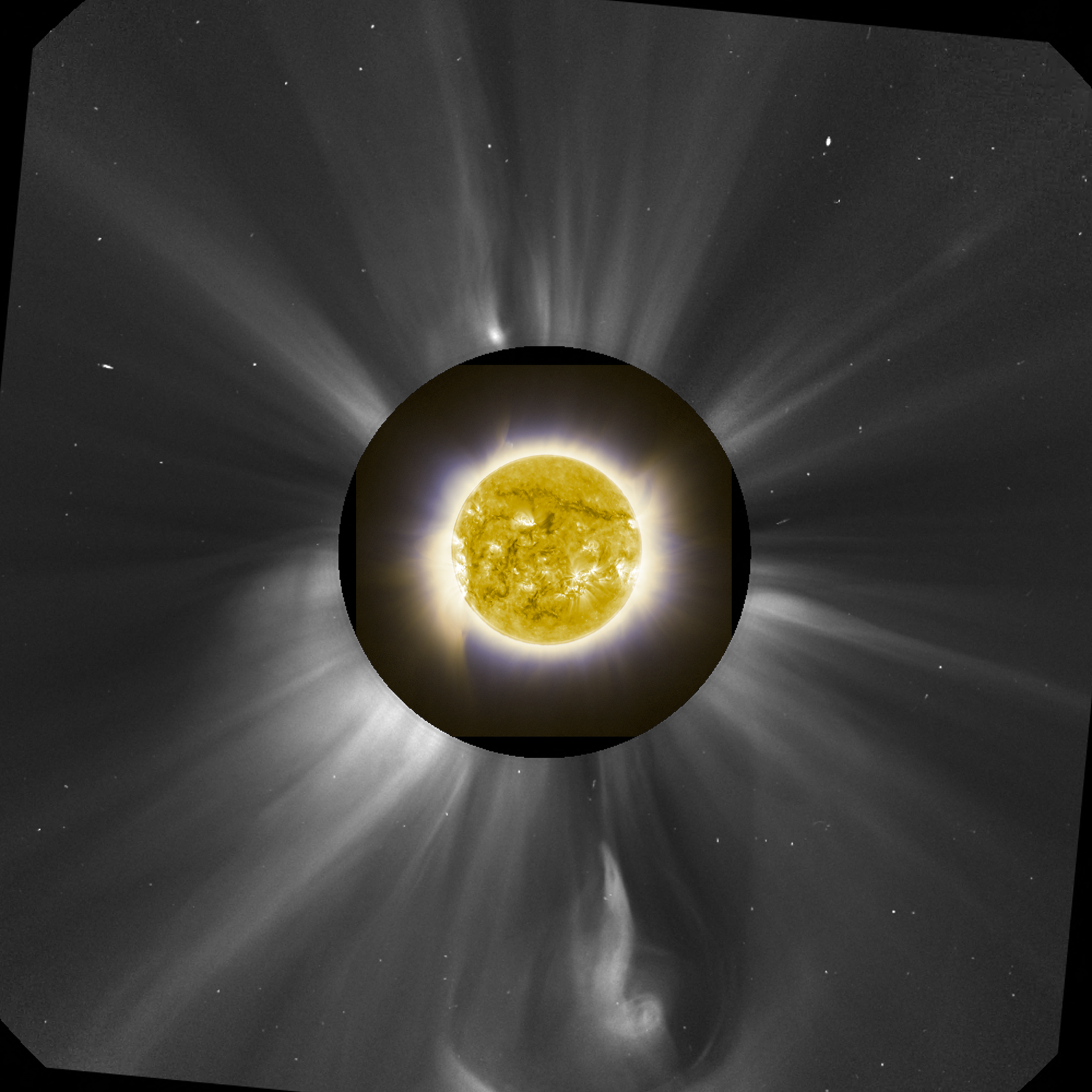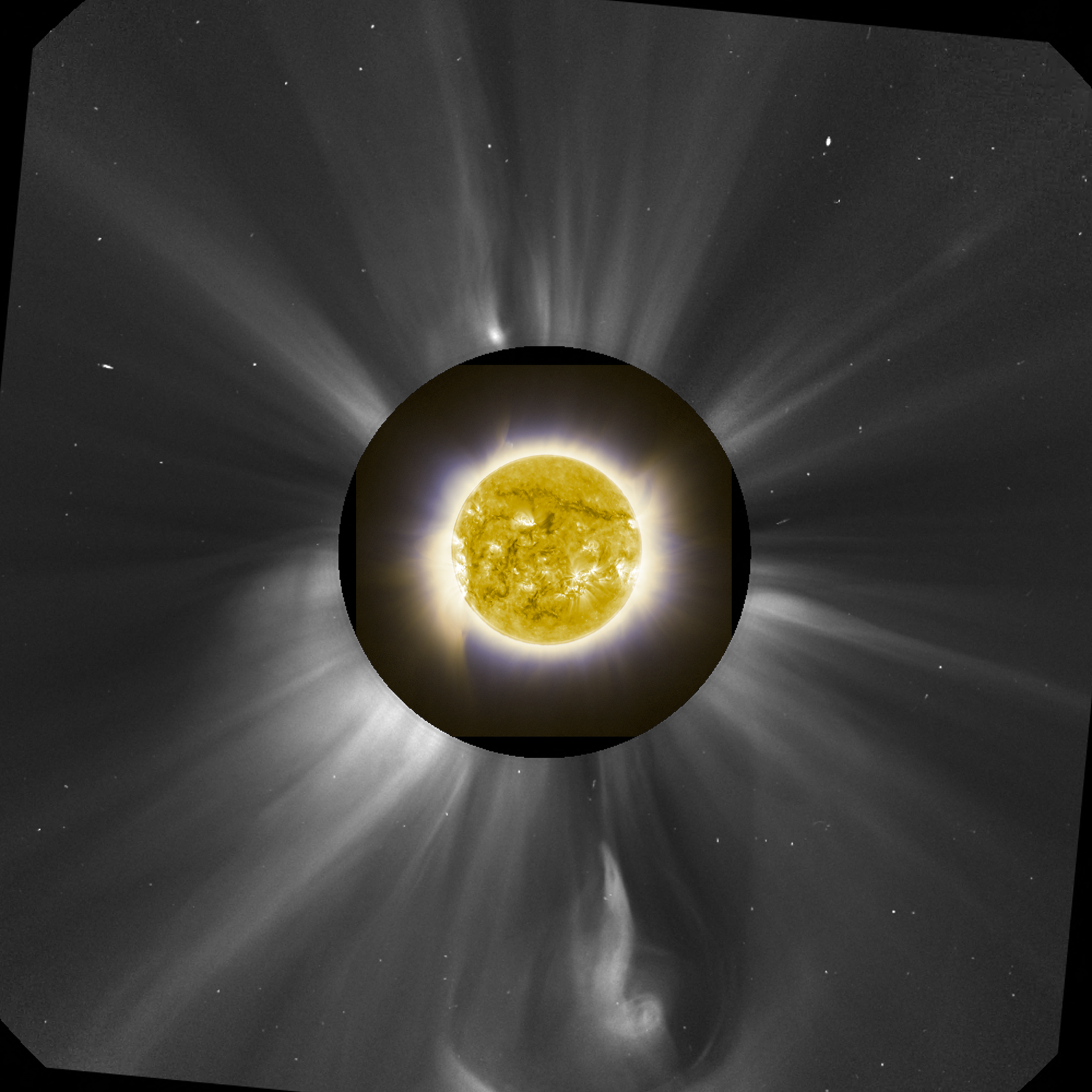
Sometimes, a total eclipse of the Sun is an opportunity. Taking advantage of such, the above image shows the solar eclipse earlier this month as covered and uncovered by several different solar observatories. The innermost image shows the Sun in ultraviolet light as recorded over a few hours by the SWAP instrument aboard the PROBA2 mission in a sun-synchronous low Earth orbit. This image is surrounded by a ground-based eclipse image, reproduced in blue, taken from Gabon. Further out is a circularly blocked region used to artificially dim the central sun by the LASCO instrument aboard the Sun-orbiting SOHO spacecraft. The outermost image -- showing the outflowing solar corona -- was taken by LASCO ten minutes after the eclipse and shows an outflowing solar corona. Over the past few weeks, our Sun has been showing an unusually high amount of sunspots, CMEs, and flares -- activity that was generally expected as the Sun is currently going through Solar Maximum -- the busiest part of its 11 year solar cycle. The above resultant image is a picturesque montage of many solar layers at once that allows solar astronomers to better match up active areas on or near the Sun's surface with outflowing jets in the Sun's corona. Free lecture: APOD editor to speak in NYC on Jan. 3
A veces, un eclipse total del Sol representa una oportunidad. Aprovechando esta oportunidad, la imagen anterior muestra el eclipse solar de hace poco, capturado y revelado por varios observatorios solares diferentes. La imagen más interna muestra al Sol en luz ultravioleta, registrada durante unas pocas horas por el instrumento SWAP a bordo de la misión PROBA2, que orbita la Tierra en una órbita sincrónica con el Sol. Esta imagen está rodeada por una imagen de eclipse terrestre, reproducida en azul, tomada desde Gabón. Más allá de ella se encuentra una región circular bloqueada que se utilizó para disminuir artificialmente la luminosidad del Sol central, capturada por el instrumento LASCO a bordo del satélite SOHO, que orbita alrededor del Sol. La imagen más externa, que muestra el flujo de la corona solar, fue capturada por LASCO diez minutos después del eclipse y muestra la corona solar en expansión. Durante las últimas semanas, nuestro Sol ha mostrado una cantidad inusualmente alta de manchas solares, eyecciones de masa coronal (CME) y llamaradas — actividad que generalmente se esperaba, ya que el Sol actualmente está atravesando el Máximo Solar, la parte más activa de su ciclo solar de 11 años. La imagen resultante es un montaje pictórico de varias capas solares a la vez, lo que permite a los astrónomos solares relacionar mejor las áreas activas en o cerca de la superficie del Sol con los chorros en expansión en la corona solar.