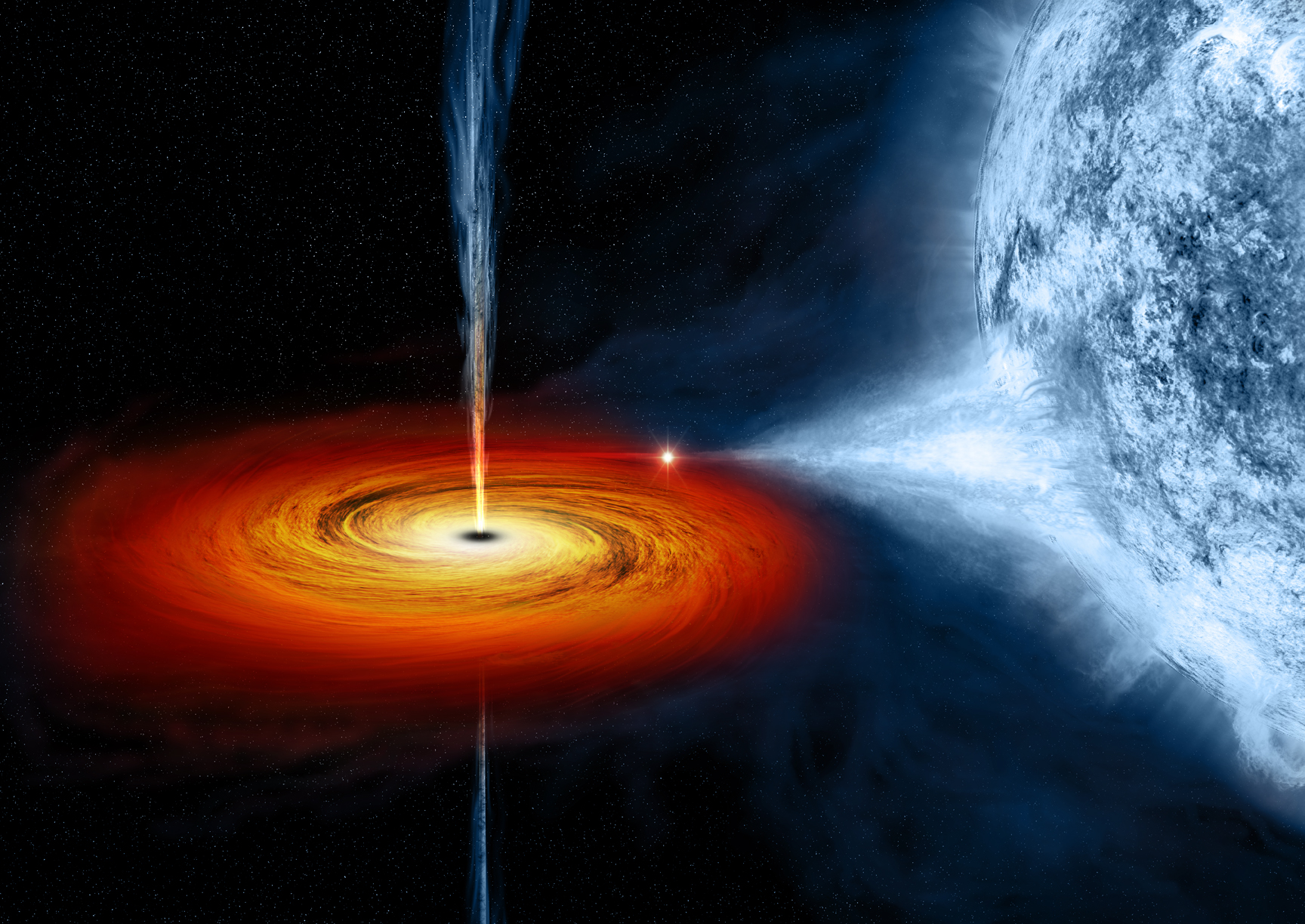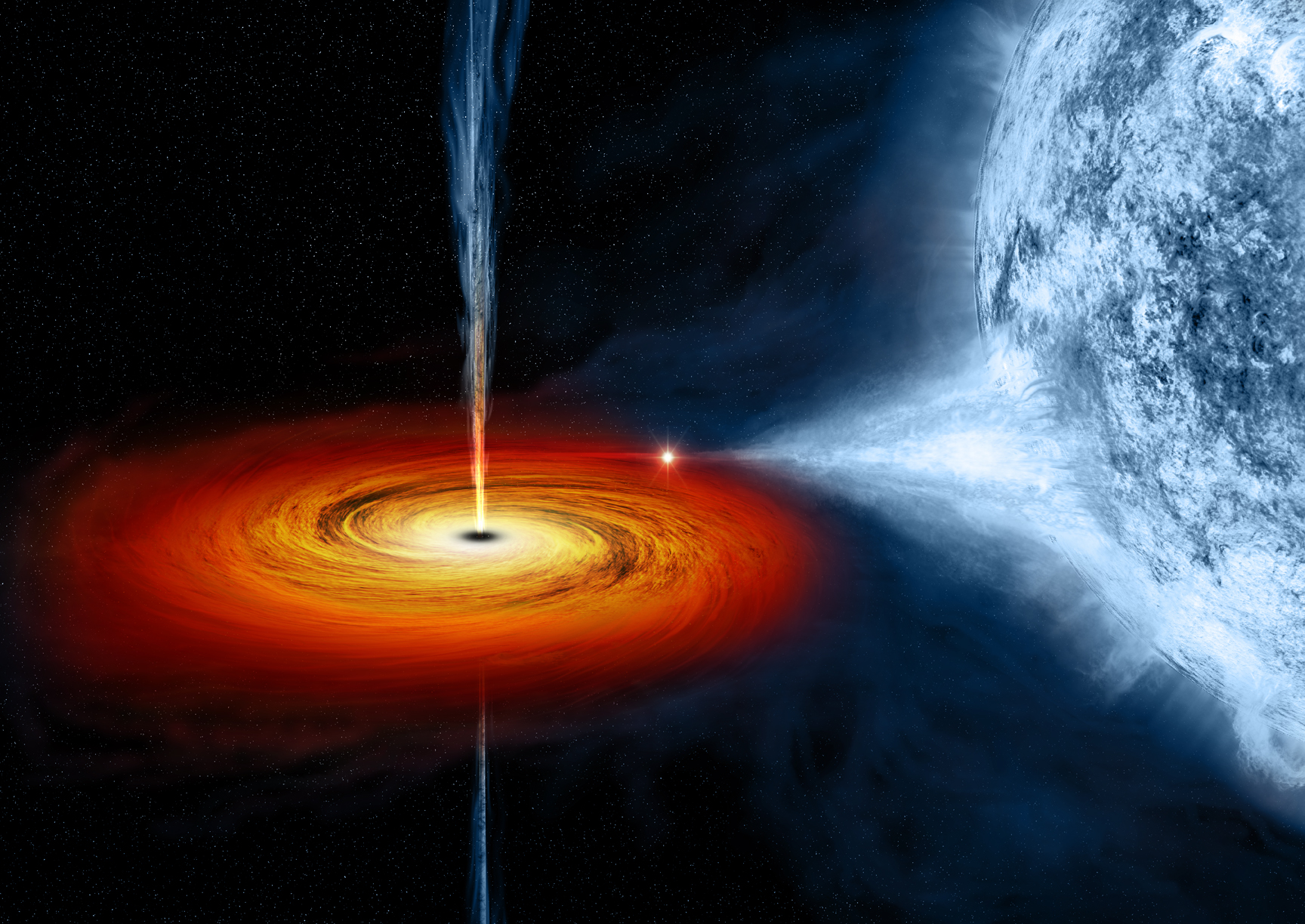
What are black hole jets made of? Many black holes in stellar systems are surely surrounded by disks of gas and plasma gravitationally pulled from a close binary star companion. Some of this material, after approaching the black hole, ends up being expelled from the star system in powerful jets emanating from the poles of the spinning black hole. Recent evidence indicates that these jets are composed not only electrons and protons, but also the nuclei of heavy elements such as iron and nickel. The discovery was made in system 4U1630-47 using CSIRO�s Compact Array of radio telescopes in eastern Australia, and the European Space Agency's Earth-orbiting XMM-Newton satellite. The 4U1630-47 star system is depicted above in an artist's illustration, with a large blue star on the right and jets emanating from a black hole in the center of the accretion disc on the left. Although the 4U1630-47 star system is thought to contain only a small black hole -- a few times the mass of our Sun -- the implications of the results may be larger: that black holes of larger sizes might also be emitting jets of massive nuclei into the cosmos. Click Hyperspace: Random APOD Generator
¿De qué están hechos los chorros de agujeros negros? Muchos agujeros negros en sistemas estelares seguramente están rodeados por discos de gas y plasma atraídos gravitacionalmente desde una estrella compañera en un sistema binario cercano. Parte de este material, tras acercarse al agujero negro, termina siendo expulsado del sistema estelar en poderosos chorros que emergen de los polos del agujero negro en rotación. Recientes evidencias indican que estos chorros no están compuestos solo por electrones y protones, sino también por los núcleos de elementos pesados como el hierro y el níquel. El descubrimiento se realizó en el sistema estelar 4U1630-47 utilizando el Compact Array de telescopios de radio de CSIRO en el este de Australia, y el satélite XMM-Newton de la Agencia Espacial Europea en órbita terrestre. El sistema estelar 4U1630-47 se muestra arriba en una ilustración artística, con una gran estrella azul a la derecha y chorros emergiendo de un agujero negro en el centro del disco de acreción a la izquierda. Aunque se cree que el sistema estelar 4U1630-47 contiene solo un pequeño agujero negro — varias veces la masa de nuestro Sol — las implicaciones de los resultados pueden ser mayores: que agujeros negros de mayor tamaño también podrían estar emitiendo chorros de núcleos masivos al cosmos.