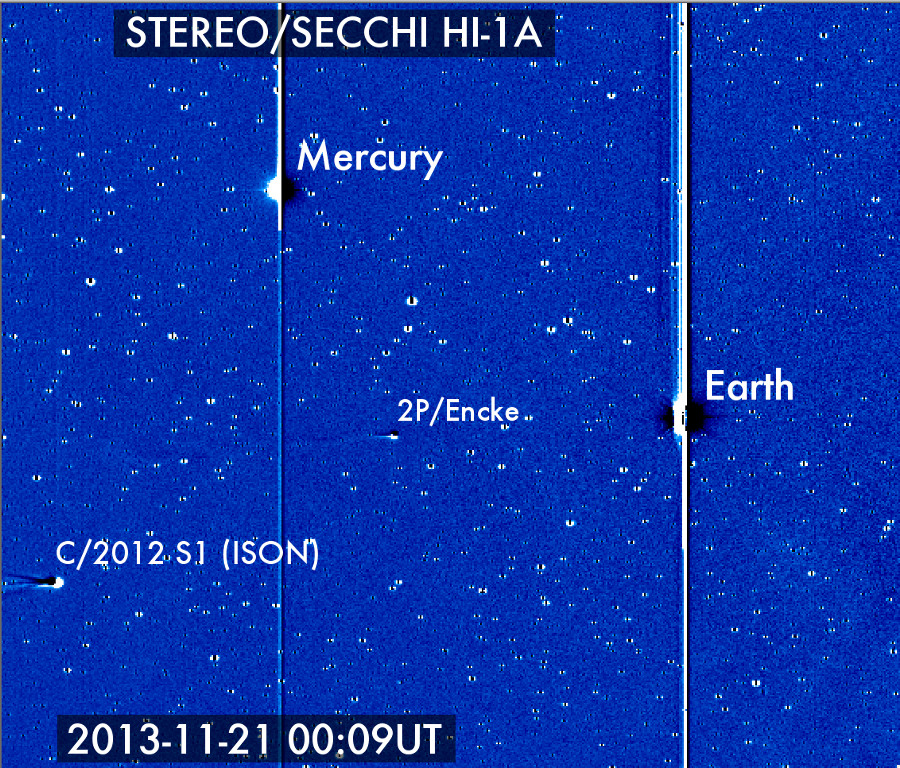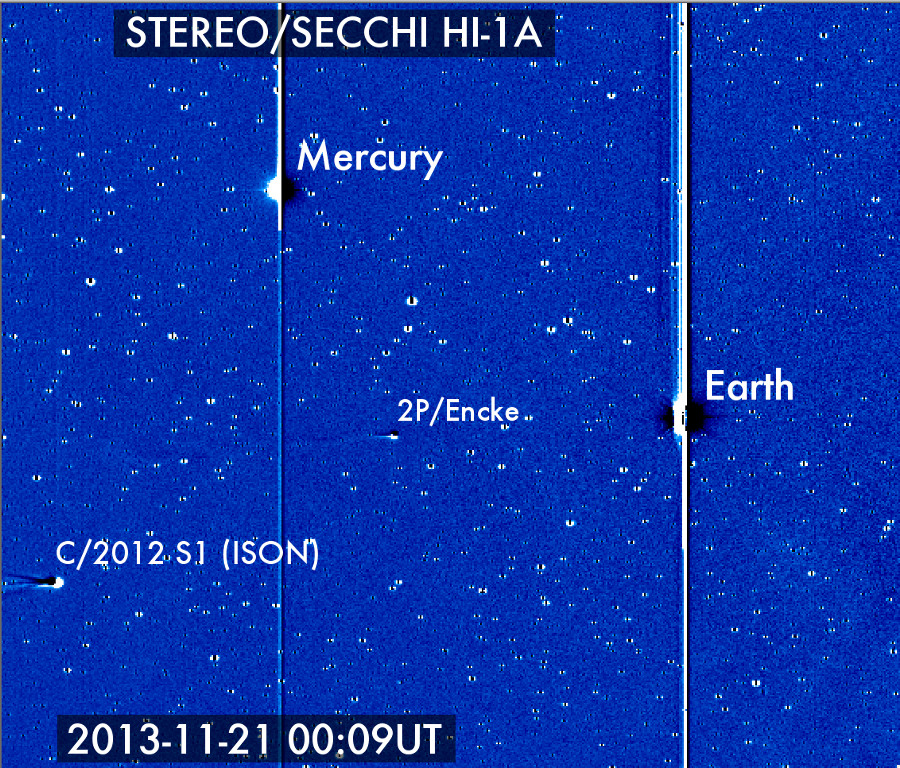
Still intact, on November 21 Comet ISON (C/2012 S1) swept into this animated field of view (left) from the HI-1 camera on the STEREO-A spacecraft. The camera has also captured periodic Comet Encke, Mercury, and Earth, with the Sun cropped out of the frame at the right, the source of the billowing solar wind. From STEREO's perspective in interplanetary space, planet Earth is actually the most distant of the group, seen in its orbit beyond the Sun. Mercury is closest, but both planets are still so bright they create sharp vertical lines in the camera's detector. Both comets clearly sport substantial tails, but ISON is closer to the camera and will continue to move more rapidly through the field. Cameras on STEREO and SOHO spacecraft will be able to follow Comet ISON as it falls towards its close encounter with the Sun on November 28, even as ISON gets more difficult to see in the bright dawn skies of planet Earth.
Aún intacto, el 21 de noviembre el Cometa ISON (C/2012 S1) cruzó este campo de visión animado (izquierda), captado por la cámara HI-1 del satélite STEREO-A. La cámara también ha captado periódicamente al Cometa Encke, Mercurio y la Tierra, con el Sol recortado de la imagen a la derecha, fuente del viento solar que se extiende. Desde la perspectiva de STEREO en el espacio interplanetario, el planeta Tierra es en realidad el más distante del grupo, visto en su órbita más allá del Sol. Mercurio está más cerca, pero ambos planetas son lo suficientemente brillantes como para crear líneas verticales nítidas en el detector de la cámara. Ambos cometas muestran claramente colas sustanciales, pero ISON está más cerca de la cámara y continuará moviéndose más rápidamente a través del campo. Las cámaras de los satélites STEREO y SOHO podrán seguir al Cometa ISON mientras cae hacia su aproximación cercana al Sol el 28 de noviembre, incluso a medida que ISON se vuelva más difícil de observar en los cielos brillantes del amanecer de la Tierra.