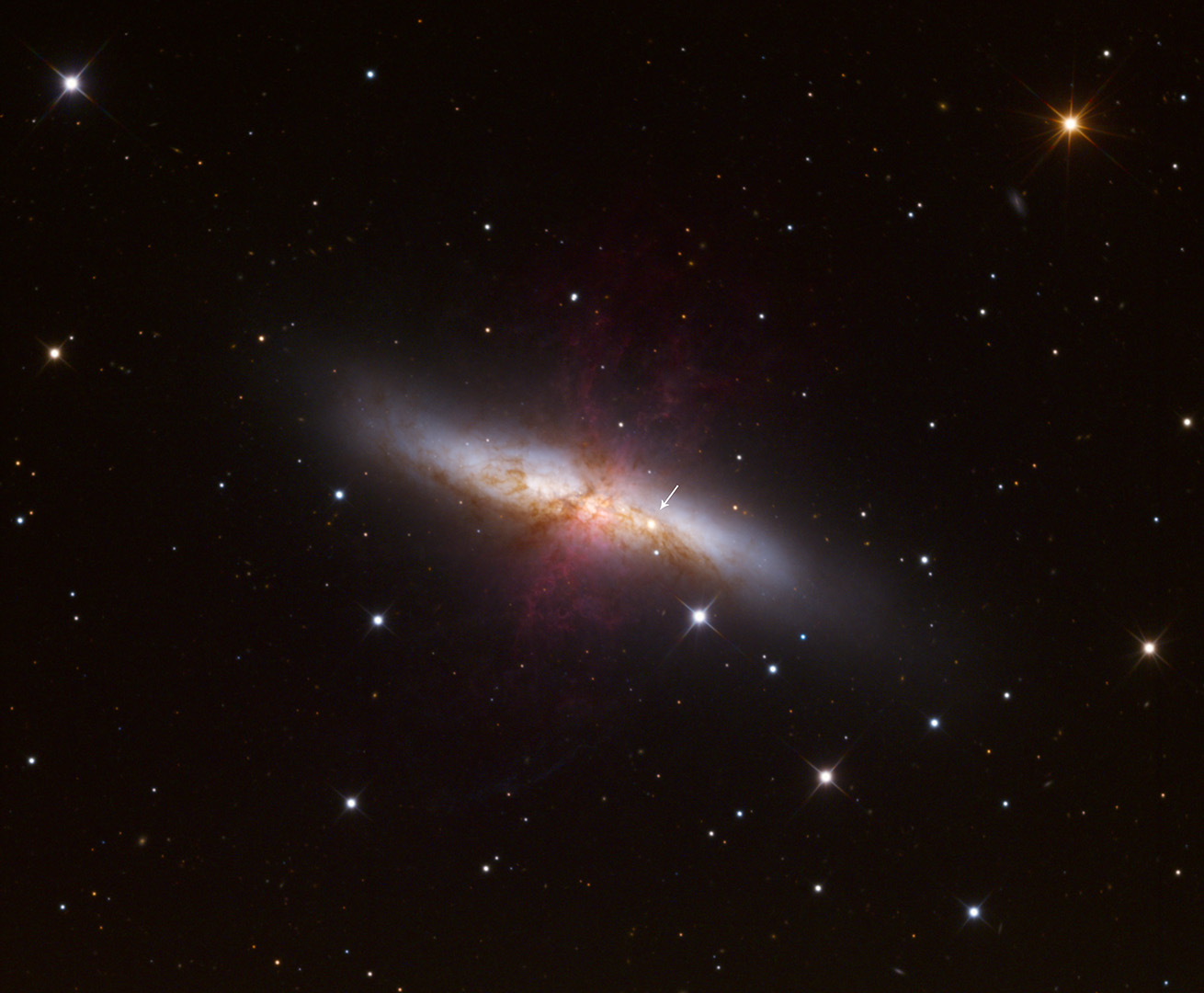
Astronomers really don't find supernovae by looking for the arrows. But in this image taken January 23rd, an arrow does point to an exciting, new supernova, now cataloged as SN 2014J, in nearby bright galaxy M82. Located near the Big Dipper in planet Earth's sky, M82 is also known as the Cigar Galaxy, a popular target for telescopes in the northern hemisphere. In fact, SN 2014J was first spotted as an unfamiliar source in the otherwise familiar galaxy by teaching fellow Steve Fossey and astronomy workshop students Ben Cooke, Tom Wright, Matthew Wilde and Guy Pollack at the University College London Observatory on the evening of January 21. M82 is a mere 12 million light-years away (so the supernova explosion did happen 12 million years ago, that light just now reaching Earth), making supernova SN 2014J one of the closest to be seen in recent decades. Spectra indicate it is a Type Ia supernova caused by the explosion of a white dwarf accreting matter from a companion star. By some estimates one week away from its maximum brightness, SN 2014J is already the brightest part of M82 and visible in small telescopes in the evening sky. Gallery: Supernova in M82
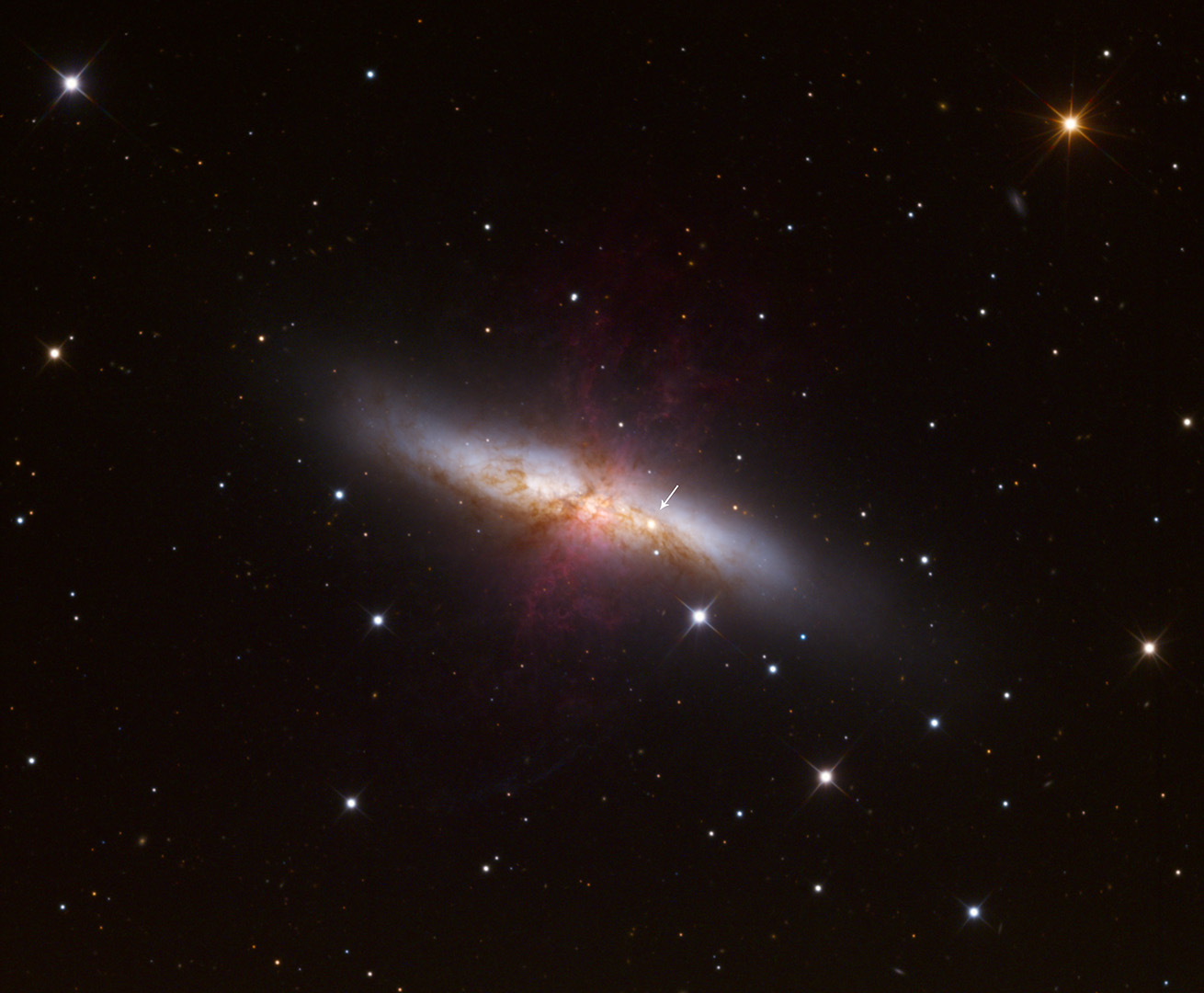
Los astrónomos realmente no encuentran supernovas buscando flechas. Pero en esta imagen tomada el 23 de enero, una flecha sí señala una emocionante y nueva supernova, ahora catalogada como SN 2014J, en la galaxia cercana y brillante M82. Ubicada cerca de la Olla Grande en el cielo terrestre, M82 también es conocida como la Galaxia Cigarro, un objetivo popular para telescopios en el hemisferio norte. De hecho, SN 2014J fue primero detectada como una fuente desconocida en una galaxia de lo contrario familiar por el profesor adjunto Steve Fossey y estudiantes del taller de astronomía Ben Cooke, Tom Wright, Matthew Wilde y Guy Pollack en la Observatorio de la Universidad College London el 21 de enero por la noche. M82 está a tan solo 12 millones de años luz de distancia (por lo tanto, la explosión de supernova ocurrió hace 12 millones de años, esa luz solo acaba de llegar a la Tierra), lo que hace que SN 2014J sea una de las más cercanas vistas en las últimas décadas. Los espectros indican que se trata de una supernova de tipo Ia causada por la explosión de una enana blanca que acumula materia de una estrella compañera. Según algunas estimaciones, SN 2014J está a solo una semana de su brillo máximo, y ya es la parte más brillante de M82 y visible en telescopios pequeños en el cielo nocturno.