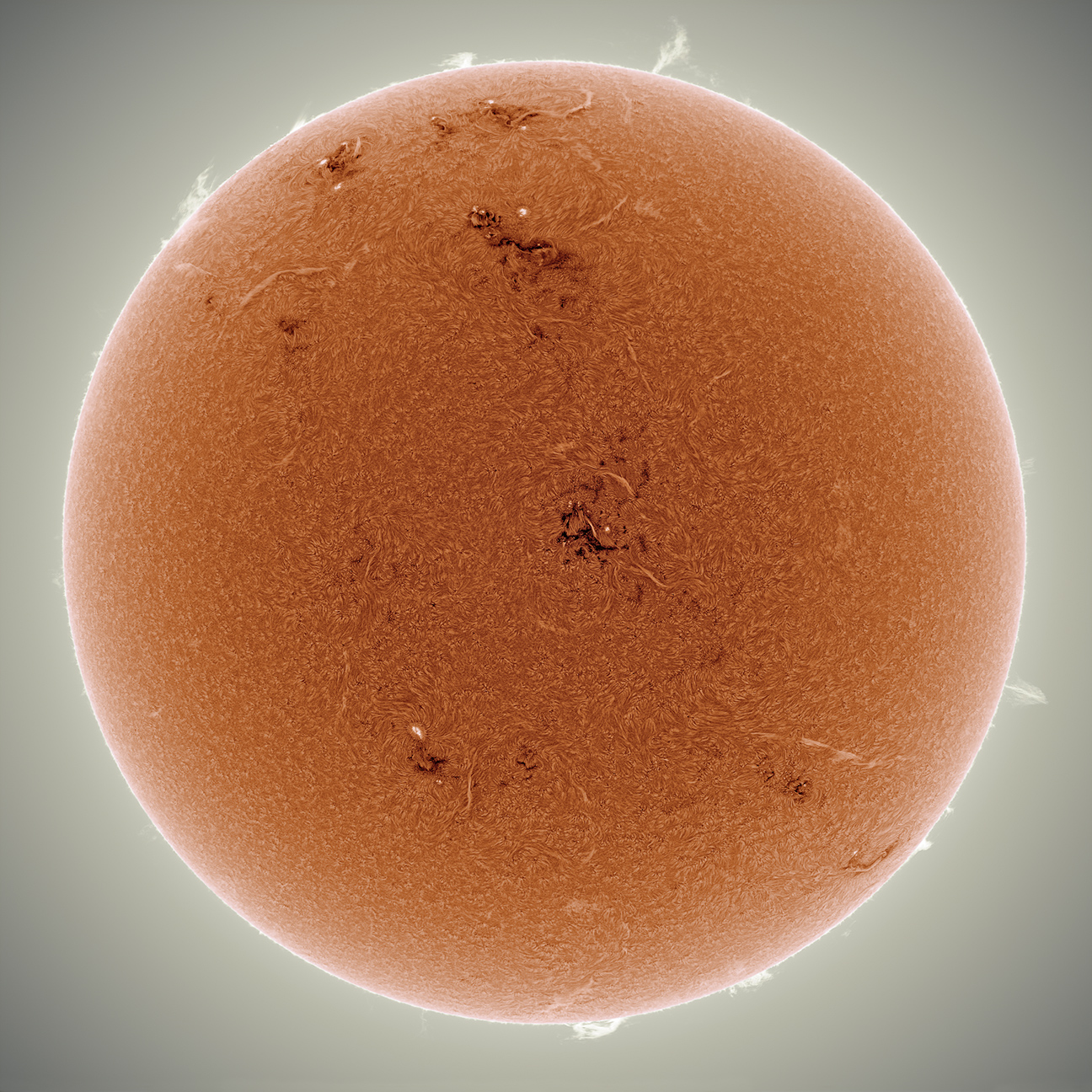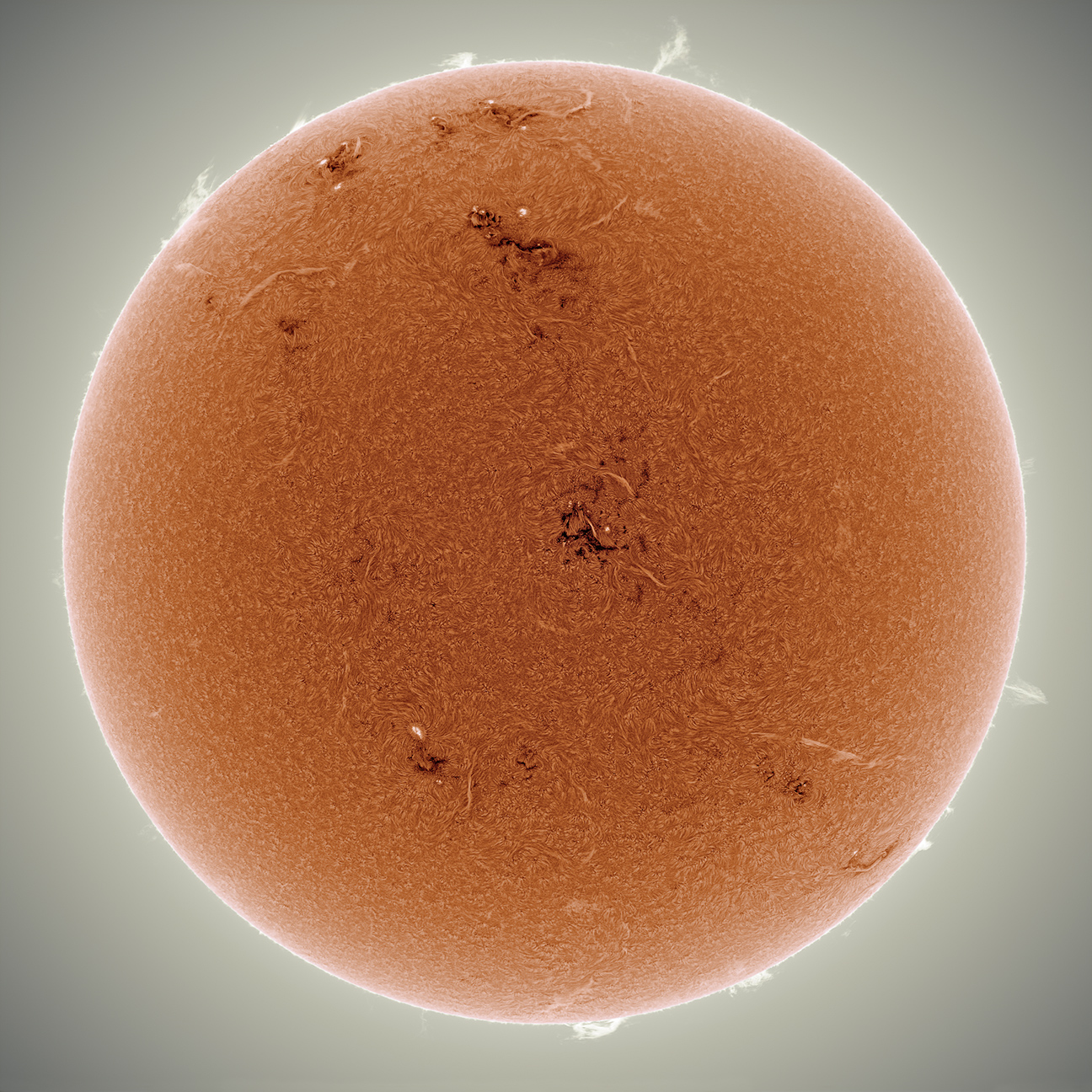
Our Sun has become quite a busy place. Taken only two weeks ago, the Sun was captured sporting numerous tumultuous regions including active sunspot regions AR 2036 near the image top and AR 2038 near the center. Only four years ago the Sun was emerging from an unusually quiet Solar Minimum that had lasted for years. The above image was recorded in a single color of light called Hydrogen Alpha, inverted, and false colored. Spicules cover much of the Sun's face like a carpet. The gradual brightening towards the Sun's edges is caused by increased absorption of relatively cool solar gas and called limb darkening. Just over the Sun's edges, several filamentary prominences protrude, while prominences on the Sun's face are seen as light streaks. Possibly the most visually interesting of all are the magnetically tangled active regions containing relatively cool sunspots, seen as white dots. Currently at Solar Maximum -- the most active phase in its 11-year magnetic cycle, the Sun's twisted magnetic field is creating numerous solar "sparks" which include eruptive solar prominences, coronal mass ejections, and flares which emit clouds of particles that may impact the Earth and cause auroras. One flare two years ago released such a torrent of charged particles into the Solar System that it might have disrupted satellites and compromised power grids had it struck planet Earth. News: Free APOD Lecture in Paris on June 17
Nuestro Sol ha convertido en un lugar bastante activo. Tomada solo hace dos semanas, la imagen captura al Sol mostrando numerosas regiones tumultuosas, incluyendo las regiones activas de manchas solares AR 2036 cerca de la parte superior de la imagen y AR 2038 cerca del centro. Solo hace cuatro años, el Sol estaba emergiendo de un mínimo solar inusualmente tranquilo que había durado varios años. La imagen anterior fue registrada en un solo color de luz llamado Hidrógeno Alfa, invertida y false color. Las espiculas cubren gran parte de la cara del Sol como una alfombra. El brillo gradual hacia los bordes del Sol se debe a una mayor absorción del gas solar relativamente frío y se llama oscurecimiento del limbo. Justo más allá de los bordes del Sol, varias prominencias filamentarias sobresalen, mientras que las prominencias en la cara del Sol se ven como rayas de luz. Posiblemente lo más visualmente interesante de todos son las regiones activas magnéticamente entrelazadas que contienen manchas solares relativamente frías, vistas como puntos blancos. Actualmente en el Máximo Solar — la fase más activa de su ciclo magnético de 11 años, el campo magnético retorcido del Sol está creando numerosas chispas solares, que incluyen prominencias solares eruptivas, eyecciones de masa coronal y llamaradas que emiten nubes de partículas que pueden impactar la Tierra y causar auroras. Una llamarada hace dos años liberó tal torrente de partículas cargadas al Sistema Solar que podría haber interrumpido satélites y comprometido redes eléctricas si hubiera golpeado la Tierra.