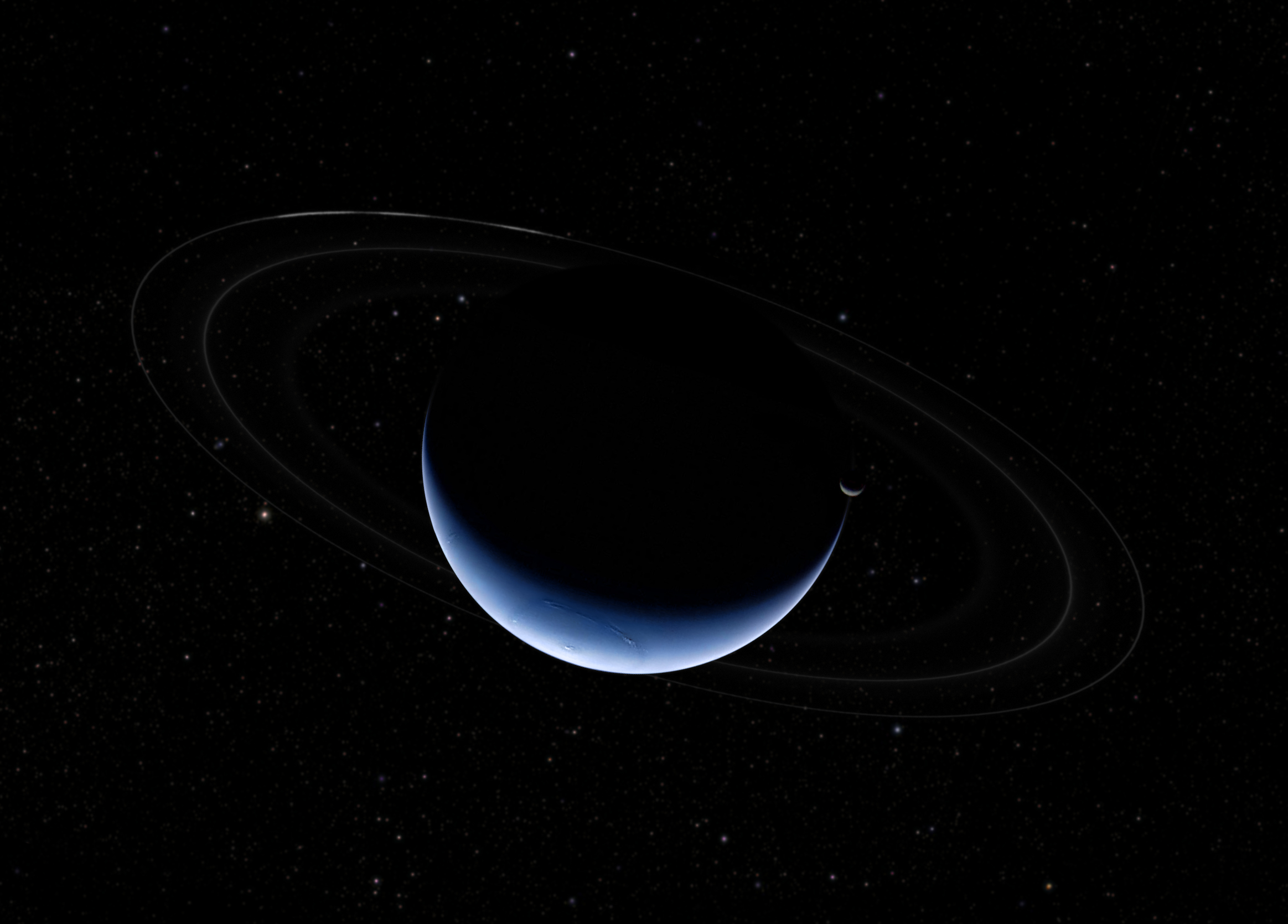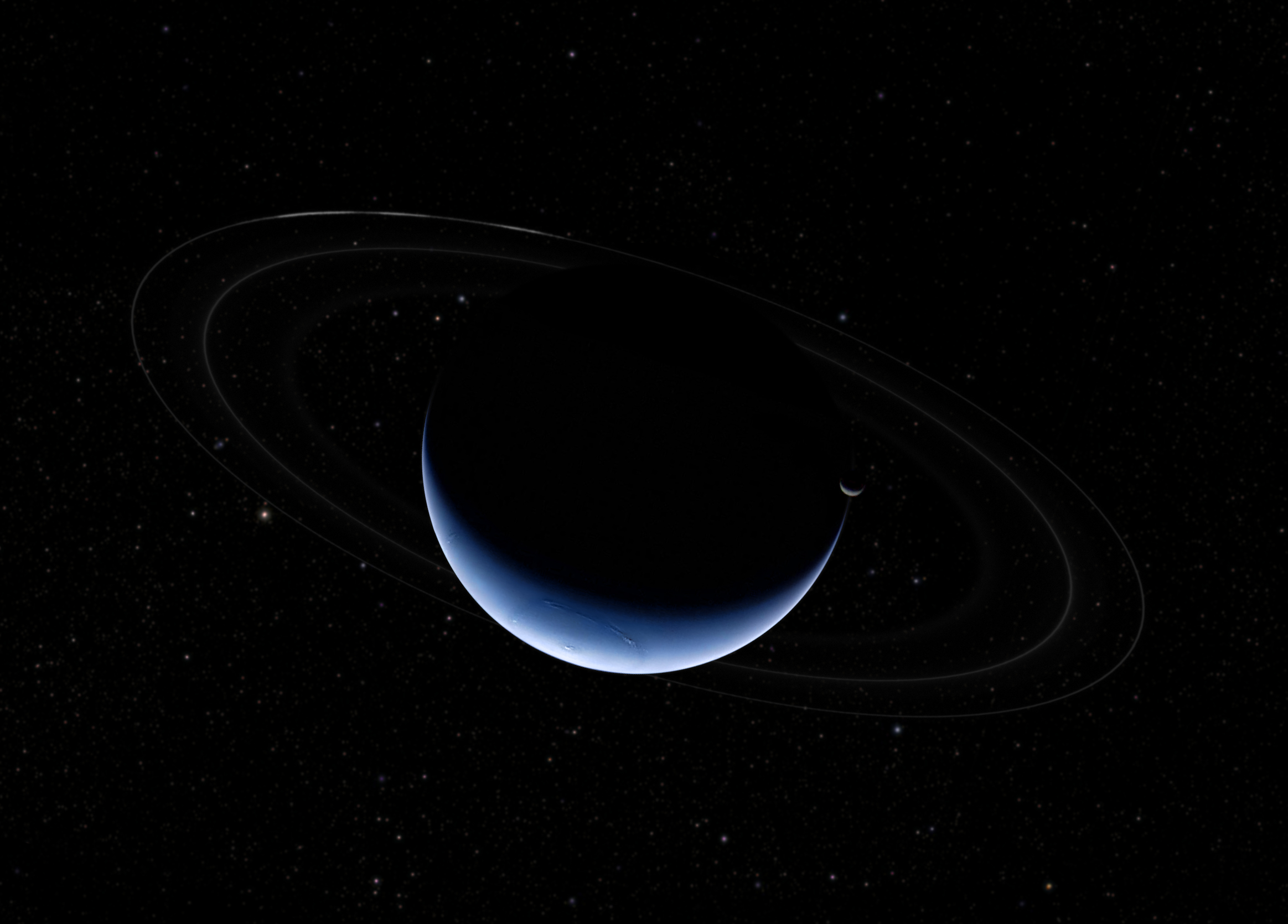
Cruising through the outer solar system, the Voyager 2 spacecraft made its closest approach to Neptune on August 25, 1989, the only spacecraft to visit the most distant ice giant planet. Based on the images recorded during its close encounter and in the following days, this inspired composited scene covers the dim outer planet, largest moon Triton, and faint system of rings. From just beyond Neptune's orbit, the interplanetary perspective looks back toward the Sun, capturing the planet and Triton as thin sunlit crescents. Cirrus clouds and a dark band circle Neptune's south polar region, with a cloudy vortex above the pole itself. Parts of the very faint ring system along with the three bright ring arcs were first imaged by Voyager during the fly-by, though the faintest segments are modeled in this composited picture. Spanning 7.5 degrees, the background starfield is composed from sky survey data centered on the constellation Camelopardalis, corresponding to the outbound Voyager's view of the magnificent Neptunian system.
Navegando a través del sistema solar exterior, la nave espacial Voyager 2 alcanzó su acercamiento más cercano a Neptuno el 25 de agosto de 1989, siendo la única nave espacial que ha visitado este planeta gigante helado más alejado. Basándose en las imágenes registradas durante su encuentro cercano y en los días siguientes, esta escena compuesta representa el planeta exterior tenue, su mayor luna, Tritón, y el tenue sistema de anillos. Desde justo más allá de la órbita de Neptuno, la perspectiva interplanetaria mira hacia atrás hacia el Sol, capturando al planeta y a Tritón como delgadas lunas iluminadas. Nubes cirros y una banda oscura rodean la región polar sur de Neptuno, con un vórtice nuboso sobre el polo mismo. Partes del sistema de anillos muy tenues, junto con los tres arcos brillantes de los anillos, fueron fotografiados por Voyager durante el sobrevuelo, aunque los segmentos más tenues se modelaron en esta imagen compuesta. Abarcando 7,5 grados, el campo estelar de fondo está compuesto a partir de datos de encuestas del cielo centradas en la constelación Camelopardalis, correspondiendo a la vista magnífica del sistema neptuniano desde la trayectoria de salida de Voyager.