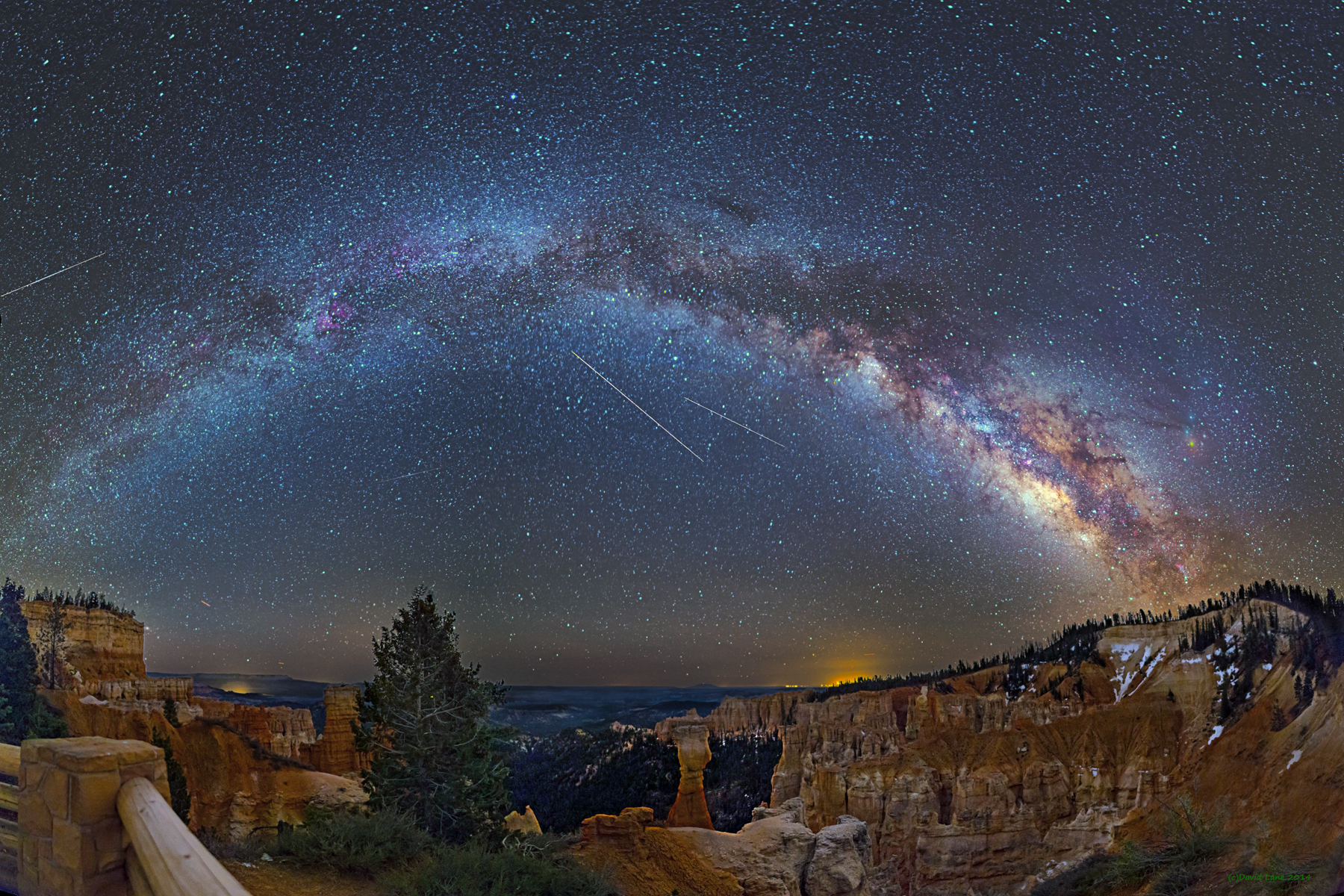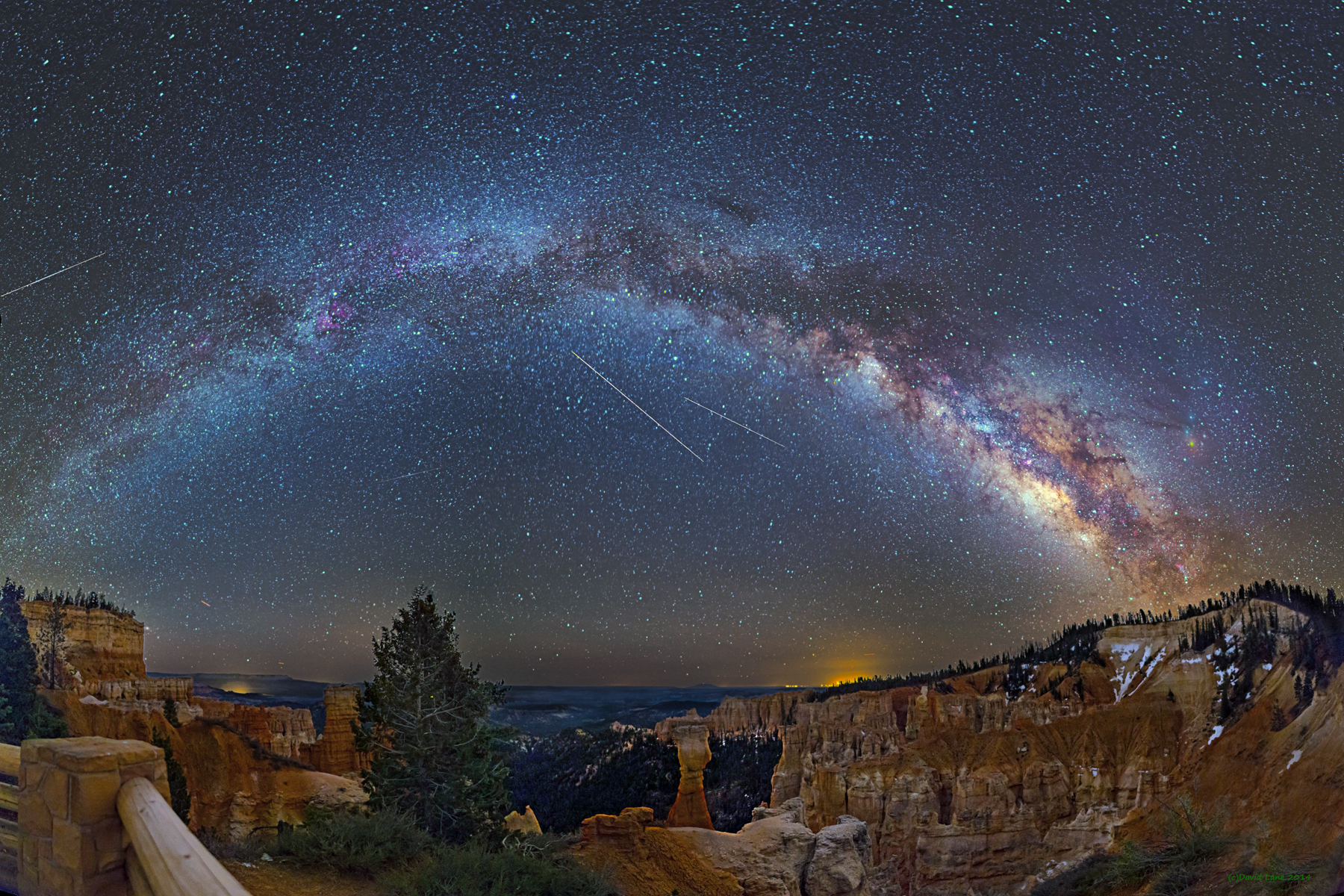
Sometimes land and sky are both busy and beautiful. The landscape pictured in the foreground encompasses Bryce Canyon in Utah, USA, famous for its many interesting rock structures eroded over millions of years. The skyscape above, photogenic in its own right, encompasses the arching central disk of our Milky Way Galaxy, streaks that include three passing airplanes and at least four Eta Aquariid meteors, and bright stars that include the Summer Triangle. The above image is a digital panorama created from 12 smaller images earlier this month on the night May 6. If you missed the recent Eta Aquariids meteor shower though, don't fret -- you may get an unexpected reprieve. Sky enthusiasts are waiting to see if a new meteor shower develops in the early morning hours of Saturday, May 24, when the Earth moves through a possibly dense cloud of dust and debris ejected by Comet 209P/LINEAR. See for yourself: Bryce Canyon National Park Astronomy Festival June 25-28 Best space images: Free APOD Lecture in Paris on June 17
A veces, tanto la tierra como el cielo están llenos de actividad y belleza. El paisaje que se muestra en primer plano abarca el Cañón de Bryce en Utah, Estados Unidos, famoso por sus numerosas estructuras rocosas interesantes erosionadas a lo largo de millones de años. El cielo sobre este paisaje, por su parte, es fotogénico en sí mismo, y muestra el disco central arqueado de nuestra Galaxia Vía Láctea, rayas que incluyen tres aviones en vuelo y al menos cuatro meteoros de la constelación de Acuario, así como estrellas brillantes que incluyen el Triángulo de Verano. La imagen anterior es un panorama digital creado a partir de 12 imágenes más pequeñas tomadas hace poco tiempo durante la noche del 6 de mayo. Si no viste la reciente lluvia de meteoros de Acuario, no te preocupes — quizás obtengas un reprieve inesperado. Los entusiastas del cielo están esperando para ver si una nueva lluvia de meteoros se desarrolla durante las horas temprano de sábado, 24 de mayo, cuando la Tierra atraviese una posible nube densa de polvo y escombros expulsados por el cometa 209P/LINEAR. Puedes verlo por ti mismo: Festival de Astronomía del Parque Nacional del Cañón de Bryce del 25 al 28 de junio. Las mejores imágenes del espacio: Conferencia gratuita de APOD en París el 17 de junio