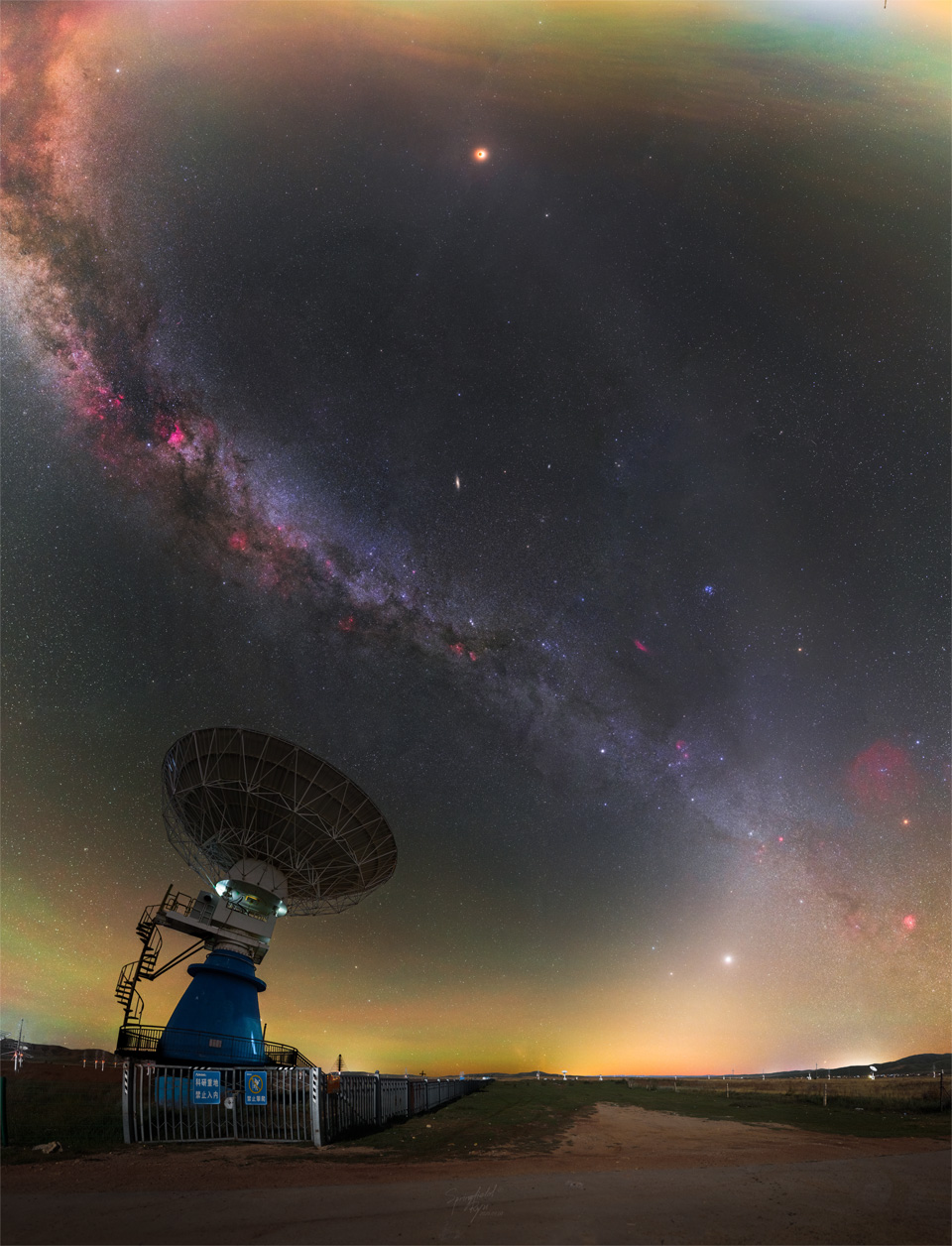
It is the most expensive and complex ground-based astronomy project ever -- what will it see tonight? The Atacama Large Millimeter Array (ALMA) project consists of 66 dishes, many the size of a small house, situated in the high altitude Atacama Desert in Northern Chile. Together, ALMA observes the skies in high-frequency radio light, a band usually used only for local communication due to considerable absorption by humid air. The thin atmosphere and low humidity above ALMA, however, enable it to see deep into our universe in new and unique ways that allow, for example, explorations of the early universe for chemicals involved in star formation, and observing local star systems for signs of disks that form planets. The above time-lapse video shows the course of four ALMA antennas over one night. The Moon sets early in the video, while three dishes repoint in unison. Background stars continually rotate up, the central band of our Milky Way Galaxy pivots around and eventually exits off to the right, while halfway through the Small and Large Magellanic Clouds -- satellite galaxies near our Milky Way -- rise up from below the horizon. Car headlights momentarily illuminate the dishes, while an occasional Earth-orbiting satellite crosses overhead. Daylight ends the video but not ALMA observations -- which typically run both all night and all day. Best space images: Free APOD Lecture in Paris on June 17
Es el proyecto de astronomía terrestre más caro y complejo jamás realizado — ¿qué verá esta noche? El proyecto Atacama Large Millimeter Array (ALMA) está compuesto por 66 antenas, muchas de ellas del tamaño de una pequeña casa, ubicadas en el desierto de Atacama, en el norte de Chile, a gran altitud. Juntas, ALMA observa el cielo en luz de radio de alta frecuencia, una banda normalmente utilizada solo para comunicaciones locales debido a la considerable absorción por el aire húmedo. Sin embargo, la atmósfera delgada y la baja humedad sobre ALMA le permiten observar el universo en nuevas y únicas formas, por ejemplo, explorar el universo temprano en busca de químicos involucrados en la formación estelar, y observar sistemas estelares locales en busca de discos que forman planetas. El video de tiempo-lapse mostrado arriba muestra el recorrido de cuatro antenas de ALMA durante una noche. La Luna se pone temprano en el video, mientras tres antenas se reorientan en sincronía. Las estrellas del fondo rotan continuamente hacia arriba, la banda central de nuestra Galaxia de la Vía Láctea gira alrededor y eventualmente se mueve hacia la derecha, mientras que a la mitad del video, las Nubes Magellánicas Pequeña y Grande — galaxias satélites cercanas a nuestra Vía Láctea — aparecen desde debajo del horizonte. Las luces de los automóviles iluminan momentáneamente las antenas, mientras que un satélite en órbita terrestre ocasionalmente cruza por encima. El día termina el video, pero no las observaciones de ALMA — que normalmente se realizan tanto de día como de noche.