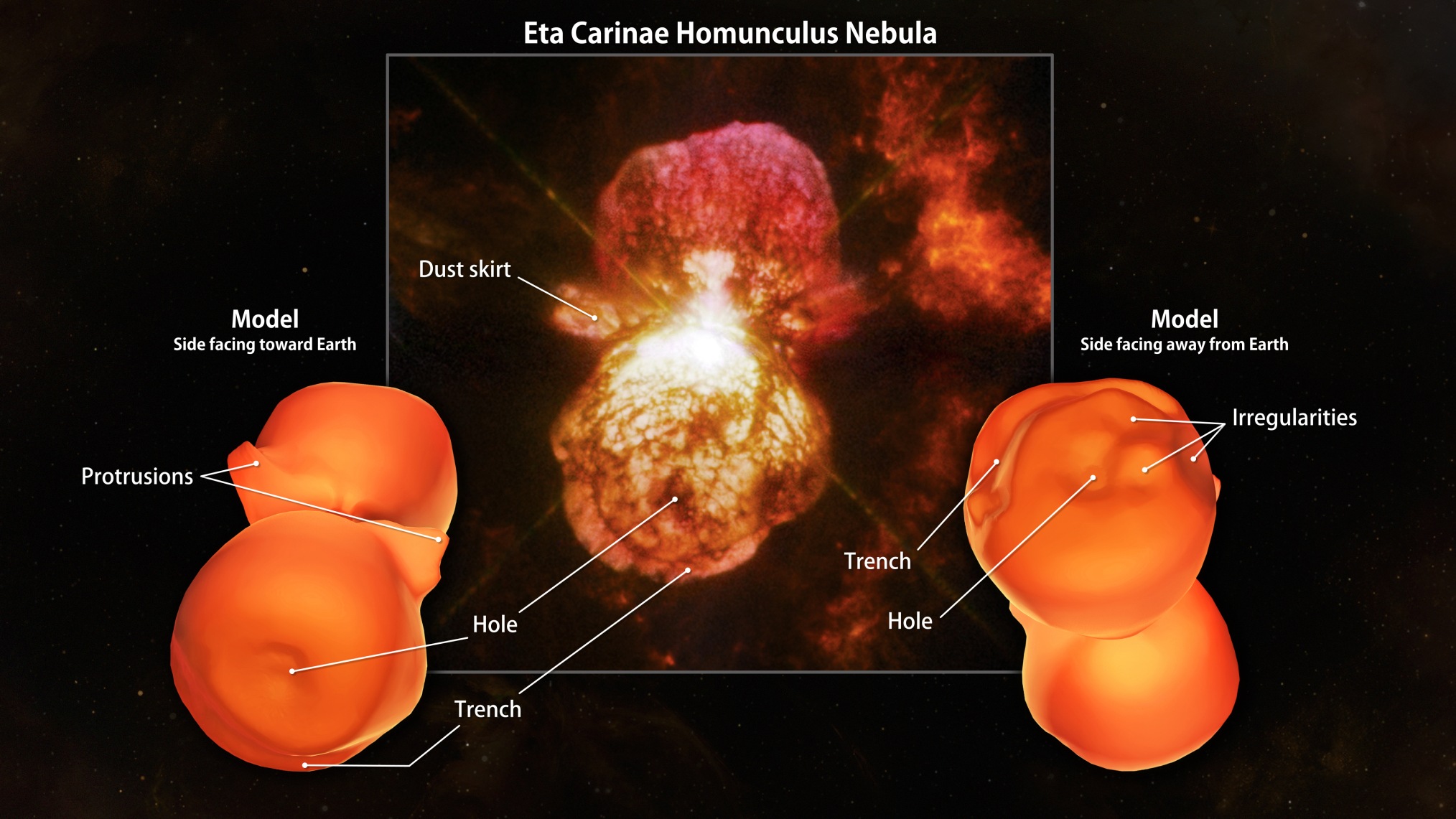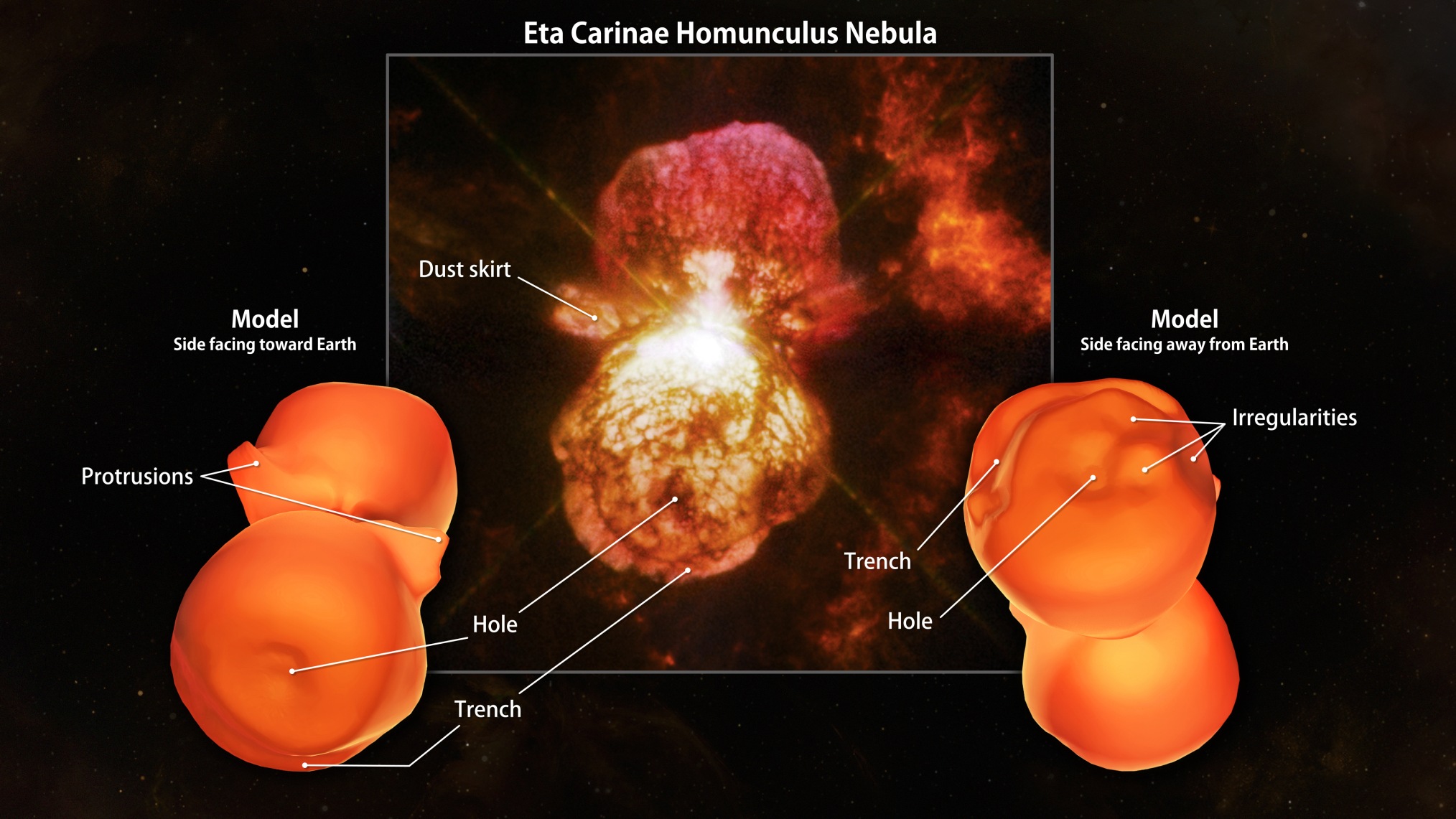
If you're looking for something to print with that new 3D printer, try out a copy of the Homunculus Nebula. The dusty, bipolar cosmic cloud is around 1 light-year across but is slightly scaled down for printing to about 1/4 light-nanosecond or 80 millimeters. The full scale Homunculus surrounds Eta Carinae, famously unstable massive stars in a binary system embedded in the extensive Carina Nebula about 7,500 light-years distant. Between 1838 and 1845, Eta Carinae underwent the Great Eruption becoming the second brightest star in planet Earth's night sky and ejecting the Homunculus Nebula. The new 3D model of the still expanding Homunculus was created by exploring the nebula with the European Southern Observatory's VLT/X-Shooter. That instrument is capable of mapping the velocity of molecular hydrogen gas through the nebula's dust at a fine resolution. It reveals trenches, divots and protrusions, even in the dust obscured regions that face away from Earth. Eta Carinae itself still undergoes violent outbursts, a candidate to explode in a spectacular supernova in the next few million years.
Si estás buscando algo para imprimir con esa nueva impresora 3D, prueba una copia de la Nebulosa Homúnculo. Esta nube cósmica polvorienta y bipolar tiene aproximadamente un año luz de diámetro, pero se ha reducido ligeramente para la impresión a unos 1/4 de nanosegundo-luz o 80 milímetros. La escala completa de la Nebulosa Homúnculo rodea a Eta Carinae, una estrella masiva famosamente inestable en un sistema binario incrustado en la extensa Nebulosa Carina, a unos 7.500 años luz de distancia. Entre 1838 y 1845, Eta Carinae experimentó la Gran Erupción, convirtiéndose en la segunda estrella más brillante del cielo nocturno de la Tierra y eyectando la Nebulosa Homúnculo. El nuevo modelo 3D de la Nebulosa Homúnculo, que aún se expande, fue creado explorando la nebulosa con el VLT/X-Shooter del Observatorio Europeo Austral. Ese instrumento es capaz de mapear la velocidad del gas molecular hidrógeno a través del polvo de la nebulosa con una alta resolución. Revela surcos, hoyos y protuberancias, incluso en las regiones de polvo que se encuentran ocultas y enfrentadas alejadas de la Tierra. Eta Carinae en sí misma aún experimenta erupciones violentas, siendo un candidato para explotar en una espectacular supernova en los próximos millones de años.