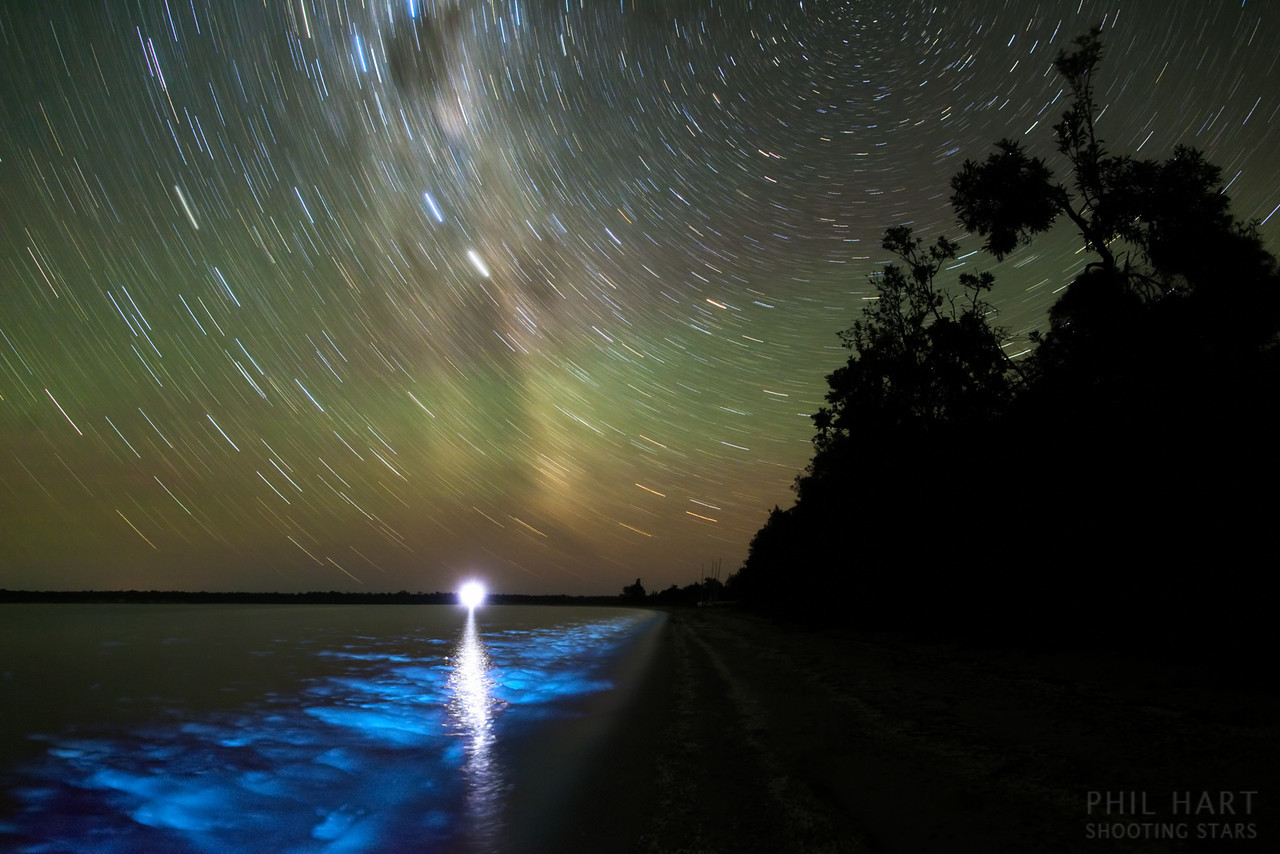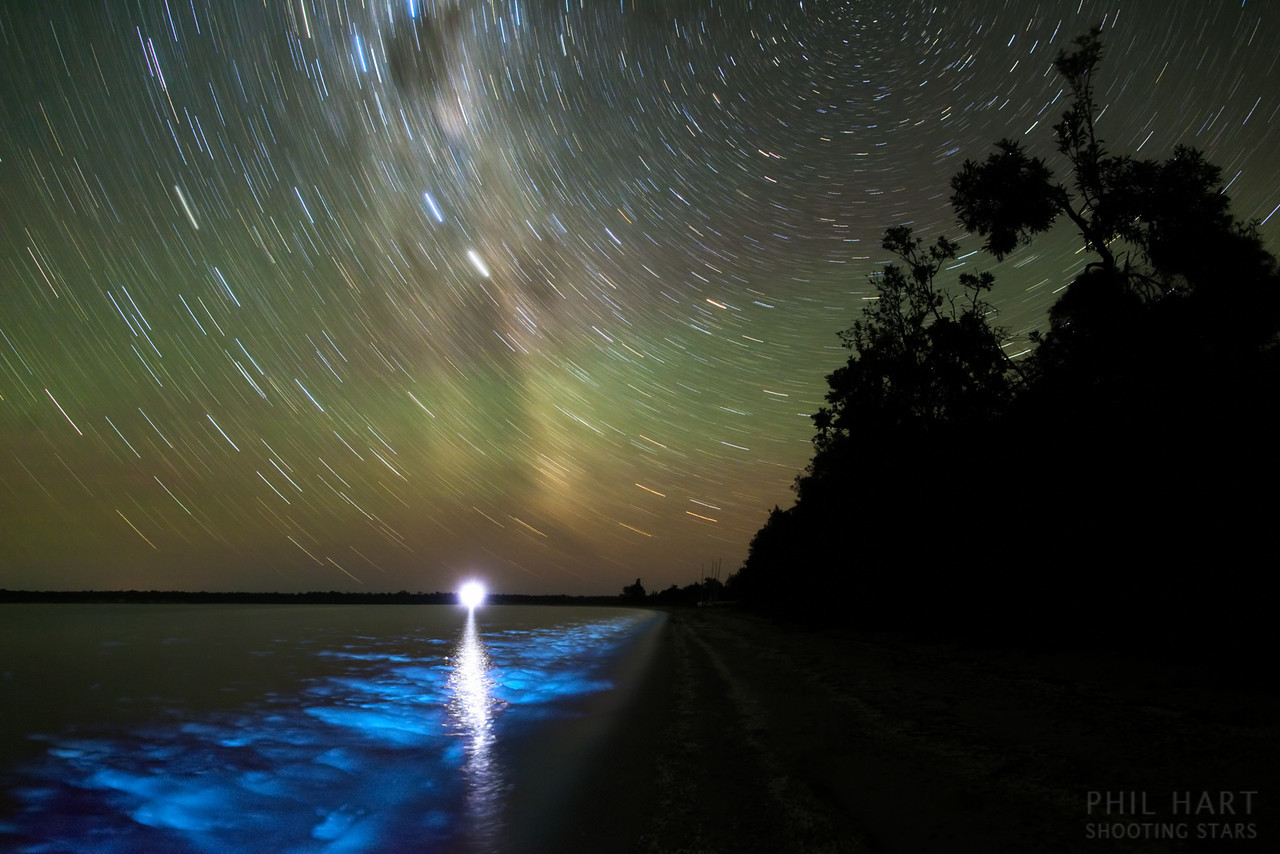
What shines in the world at night? Just visible to the eye, a rare electric blue glow spread along the shores of Victoria Lake on January 16, 2013. Against reflections of a light near the horizon, this digitally stacked long exposure recorded the bioluminescence of Noctiluca scintillans, plankton stimulated by the lapping waves. Above, the night skies of the Gippsland Lakes region, Victoria, Australia shine with a fainter greenish airglow. Oxygen atoms in the upper atmosphere, initially excited by ultraviolet sunlight, produce the more widely seen fading atmospheric chemiluminescence. Washed out by the Earth's rotation, the faint band of the southern summer Milky Way stretches from the horizon as star trails circle the South Celestial Pole. Watch: Meteors vs. Supermoon
¿Qué brilla en el mundo durante la noche? Solo visible a simple vista, un raro resplandor eléctrico azul se extiende a lo largo de las orillas del Lago Victoria el 16 de enero de 2013. Frente a las reflexiones de una luz cercana al horizonte, esta exposición larga digitalmente apilada registró la bioluminiscencia de Noctiluca scintillans, un plancton estimulado por las olas que se rompen en la orilla. Arriba, los cielos nocturnos de la región de los Lagos de Gippsland, Victoria, Australia, brillan con un tenue resplandor verde de la atmósfera. Los átomos de oxígeno en la atmósfera superior, inicialmente excitados por la luz ultravioleta del Sol, producen la más ampliamente observada quimiluminiscencia atmosférica que se desvanece con el tiempo. Enmascarada por la rotación de la Tierra, la tenue banda de la Vía Láctica del verano austral se extiende desde el horizonte, mientras las trayectorias estelares forman círculos alrededor del Polo Celeste Sur.