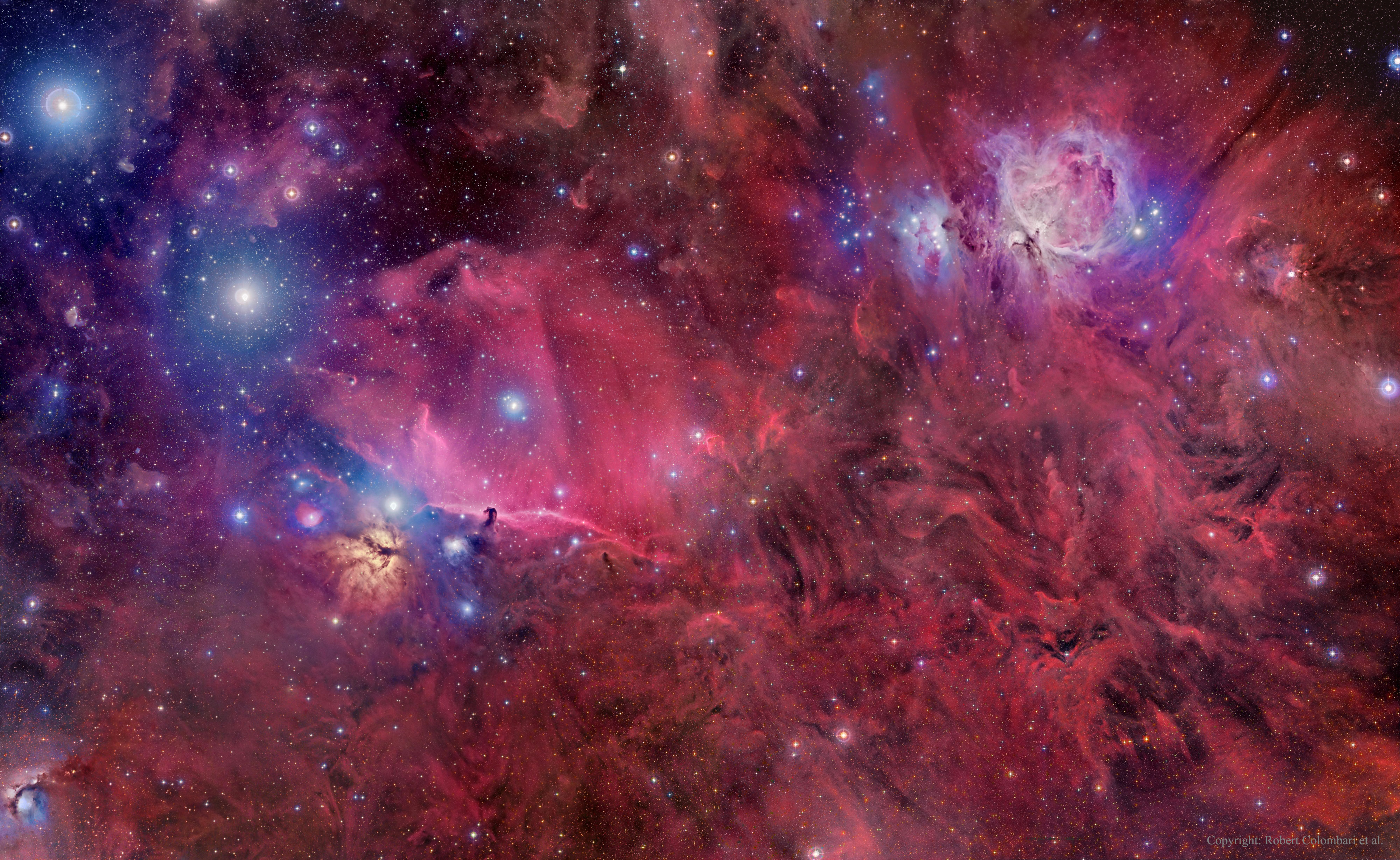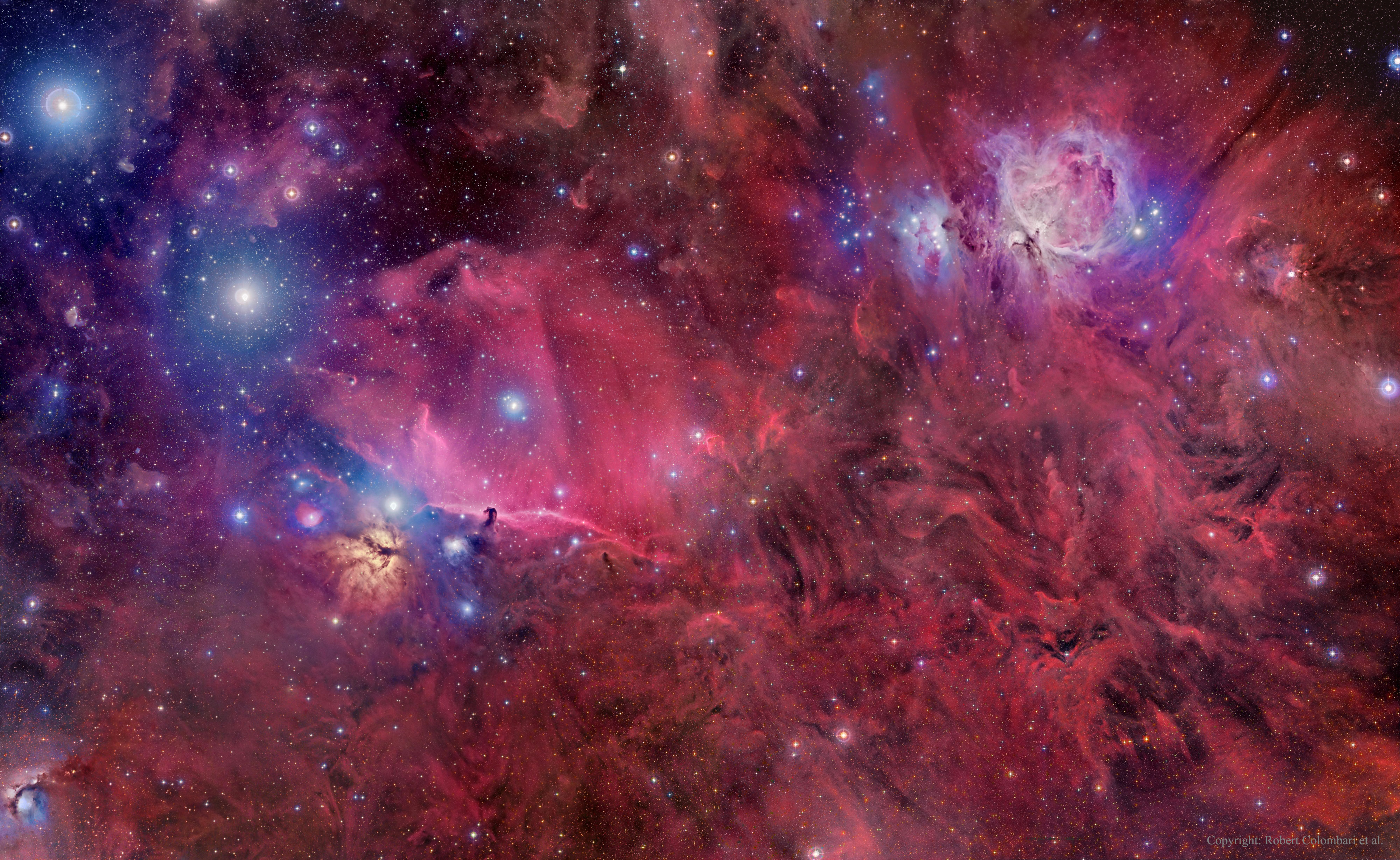
The constellation of Orion holds much more than three stars in a row. A deep exposure shows everything from dark nebulae to star clusters, all embedded in an extended patch of gaseous wisps in the greater Orion Molecular Cloud Complex. The brightest three stars on the far left are indeed the famous three stars that make up the belt of Orion. Just below Alnitak, the lowest of the three belt stars, is the Flame Nebula, glowing with excited hydrogen gas and immersed in filaments of dark brown dust. Below and left of the frame center and just to the right of Alnitak lies the Horsehead Nebula, a dark indentation of dense dust that has perhaps the most recognized nebular shapes on the sky. On the upper right lies M42, the Orion Nebula, an energetic caldron of tumultuous gas, visible to the unaided eye, that is giving birth to a new open cluster of stars. Immediately to the left of M42 is a prominent bluish reflection nebula sometimes called the Running Man that houses many bright blue stars. The featured image covers an area with objects that are roughly 1,500 light years away and spans about 75 light years.
La constelación de Orión contiene mucho más que tres estrellas alineadas. Una exposición profunda revela desde nebulosas oscuras hasta cúmulos estelares, todos incrustados en una extensa mancha de destellos gaseosos dentro del complejo de la nube molecular de Orión. Las tres estrellas más brillantes a la izquierda son efectivamente las famosas tres estrellas que forman el cinturón de Orión. Justo debajo de Alnitak, la estrella más baja del cinturón, se encuentra la Nebulosa de la Llama, que brilla con gas hidrógeno excitado e inmersa en filamentos de polvo marrón oscuro. Debajo y a la izquierda del centro de la imagen, y justo a la derecha de Alnitak, se encuentra la Nebulosa del Caballo de Troya, una indentación oscura de polvo denso que quizás tiene las formas nebulares más reconocibles del cielo. En la parte superior derecha se encuentra M42, la Nebulosa de Orión, un caldero energético de gas tumultuoso, visible a simple vista, que está dando lugar a un nuevo cúmulo estelar abierto. Inmediatamente a la izquierda de M42 se encuentra una destacada nebulosa de reflexión de color azul, a veces llamada el Hombre que Corre, que alberga muchas estrellas azules brillantes. La imagen destacada cubre un área con objetos que se encuentran a aproximadamente 1.500 años luz de distancia y abarca unos 75 años luz.