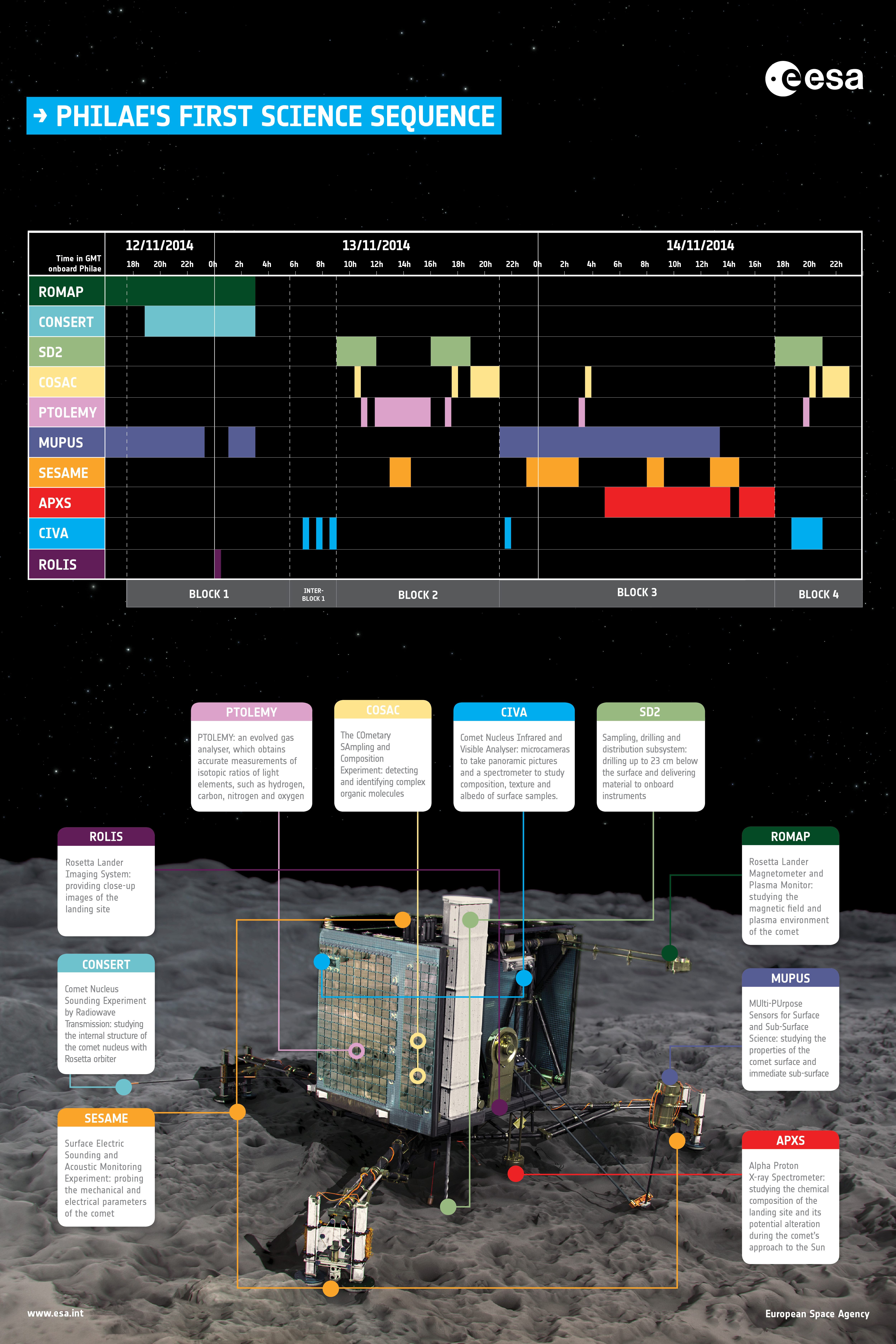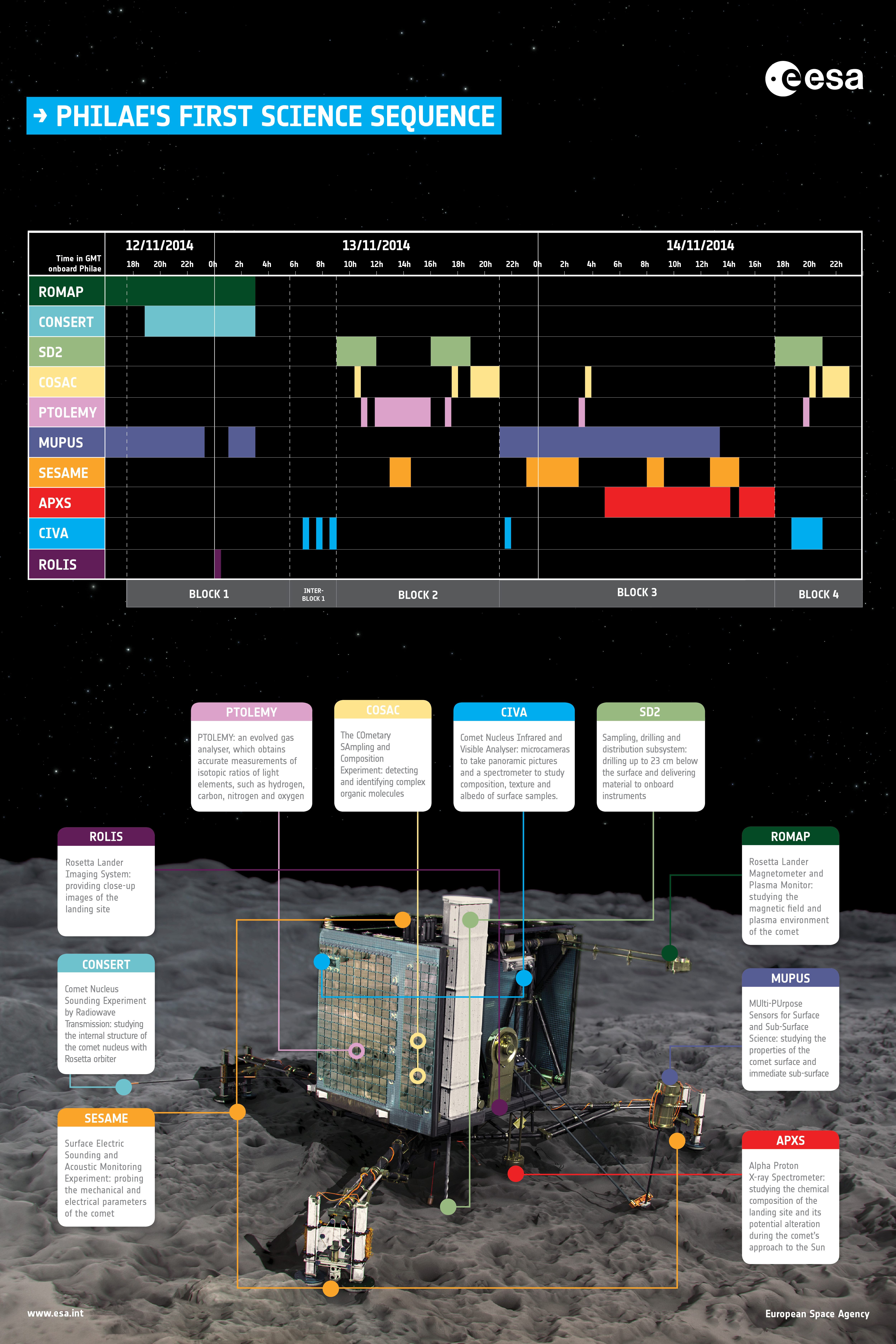
Today humanity will make its first attempt to land a probe on the nucleus of a comet. As the day progresses, the Philae (fee-LAY) lander will separate from the Rosetta spacecraft and head down to the surface of Comet 67P/Churyumov�Gerasimenko. Since the texture of the comet's surface is unknown and its surface gravity is surely low, Philae will then attempt to harpoon itself down, something that has never been done before. Featured here is an artist's illustration of dishwasher-sized Philae as it might look on Comet Churyumov�Gerasimenko's surface, along with explanation balloons detailing onboard scientific instruments. Many people on a blue planet across the Solar System will be eagerly awaiting news and updates. Whether Philae actually lands, whether it lands on a smooth patch, whether the harpoons take hold, and how far the robotic lander sinks into the surface should all become known as events unfold today. Comet lander updates: From ESA
Hoy la humanidad realizará su primer intento de aterrizar una sonda en el núcleo de un cometa. A medida que avanza el día, el módulo de aterrizaje Philae (fee-LAY) se separará de la nave espacial Rosetta y se dirigirá hacia la superficie del cometa 67P/Churyumov–Gerasimenko. Dado que se desconoce la textura de la superficie del cometa y su gravedad superficial es seguramente baja, Philae intentará clavarse con arpónes, algo que nunca se ha hecho antes. En la imagen destacada se muestra una ilustración artística del tamaño de un lavaplatos de Philae tal como podría verse en la superficie del cometa Churyumov–Gerasimenko, junto con globos de explicación que detallan los instrumentos científicos a bordo. Muchas personas en el planeta azul de todo el Sistema Solar estarán ansiosas por recibir noticias y actualizaciones. Ya sea que Philae aterrice efectivamente, si aterrizará en una superficie plana, si los arpónes se anclan y cuán profundamente se hundirá el módulo robótico en la superficie, todo esto se conocerá a medida que los eventos se desarrollen hoy. Actualizaciones del aterrizador del cometa: De ESA