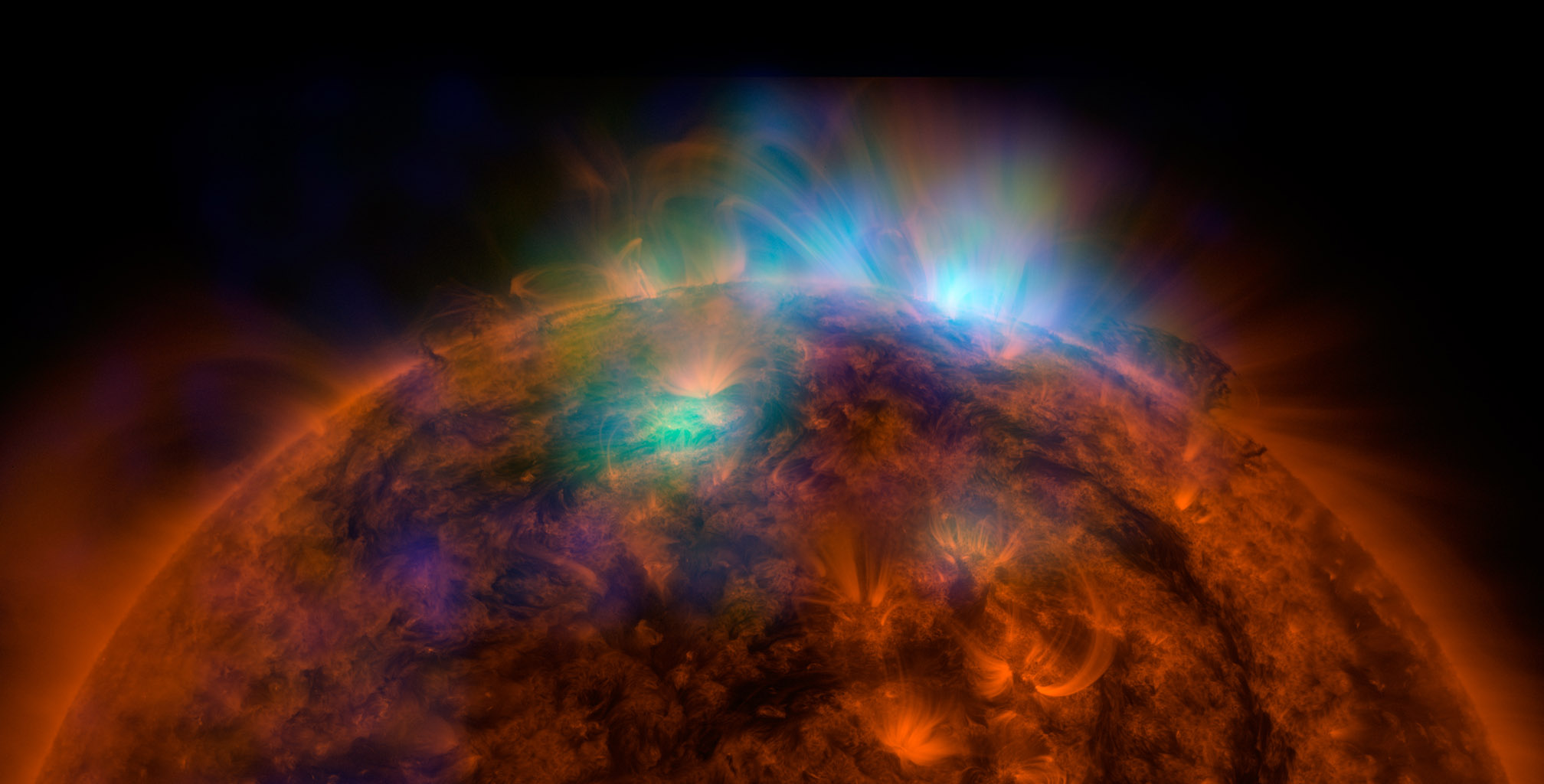
Why are the regions above sunspots so hot? Sunspots themselves are a bit cooler than the surrounding solar surface because the magnetic fields that create them reduce convective heating. It is therefore unusual that regions overhead -- even much higher up in the Sun's corona -- can be hundreds of times hotter. To help find the cause, NASA directed the Earth-orbiting Nuclear Spectroscopic Telescope Array (NuSTAR) satellite to point its very sensitive X-ray telescope at the Sun. Featured above is the Sun in ultraviolet light, shown in a red hue as taken by the orbiting Solar Dynamics Observatory (SDO). Superimposed in false-colored green and blue is emission above sunspots detected by NuSTAR in different bands of high-energy X-rays, highlighting regions of extremely high temperature. Clues about the Sun's atmospheric heating mechanisms may not only come from this initial image, but future NuSTAR images aimed at finding hypothesized nanoflares, brief bursts of energy that may drive the unusual heating.
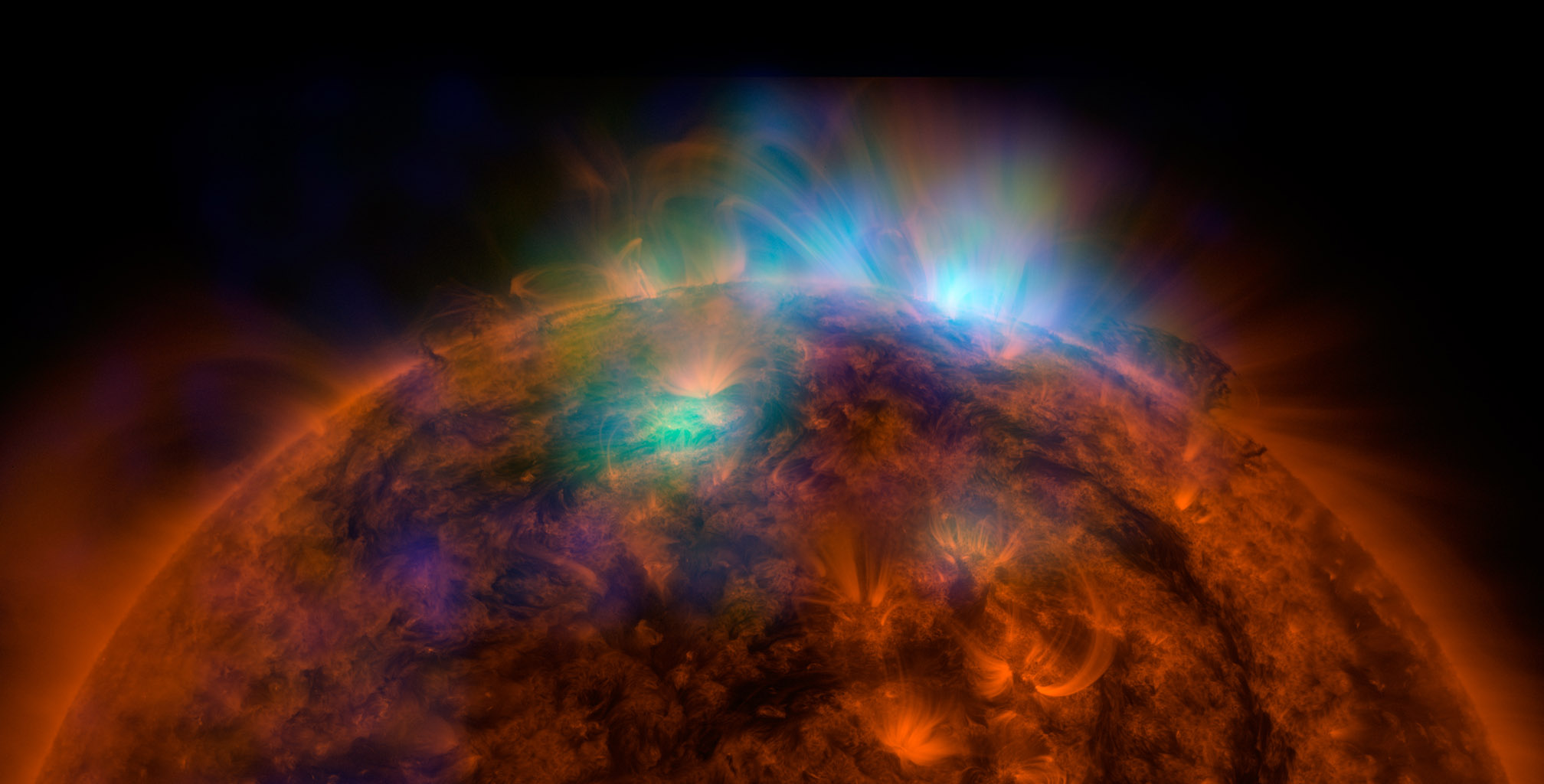
¿Por qué las regiones por encima de las manchas solares son tan calientes? Las manchas solares mismas son un poco más frías que la superficie solar circundante, ya que los campos magnéticos que las generan reducen el calentamiento convectivo. Por lo tanto, es inusual que las regiones por encima de ellas — incluso mucho más arriba en la corona solar — puedan ser cientos de veces más calientes. Para ayudar a encontrar la causa, la NASA dirigió al satélite en órbita terrestre Nuclear Spectroscopic Telescope Array (NuSTAR) para que apuntara su telescopio de rayos X muy sensible hacia el Sol. En la imagen destacada se muestra el Sol en luz ultravioleta, mostrada en un tono rojo como fue captada por el observatorio solar en órbita Solar Dynamics Observatory (SDO). Sobreimpuesta en tonos falsos de verde y azul está la emisión por encima de las manchas solares detectada por NuSTAR en diferentes bandas de rayos X de alta energía, resaltando regiones de temperatura extremadamente alta. Pistas sobre los mecanismos de calentamiento atmosférico del Sol no solo pueden provenir de esta imagen inicial, sino también de imágenes futuras de NuSTAR dirigidas a encontrar nanoflares hipotéticos, breves explosiones de energía que podrían impulsar el calentamiento inusual.