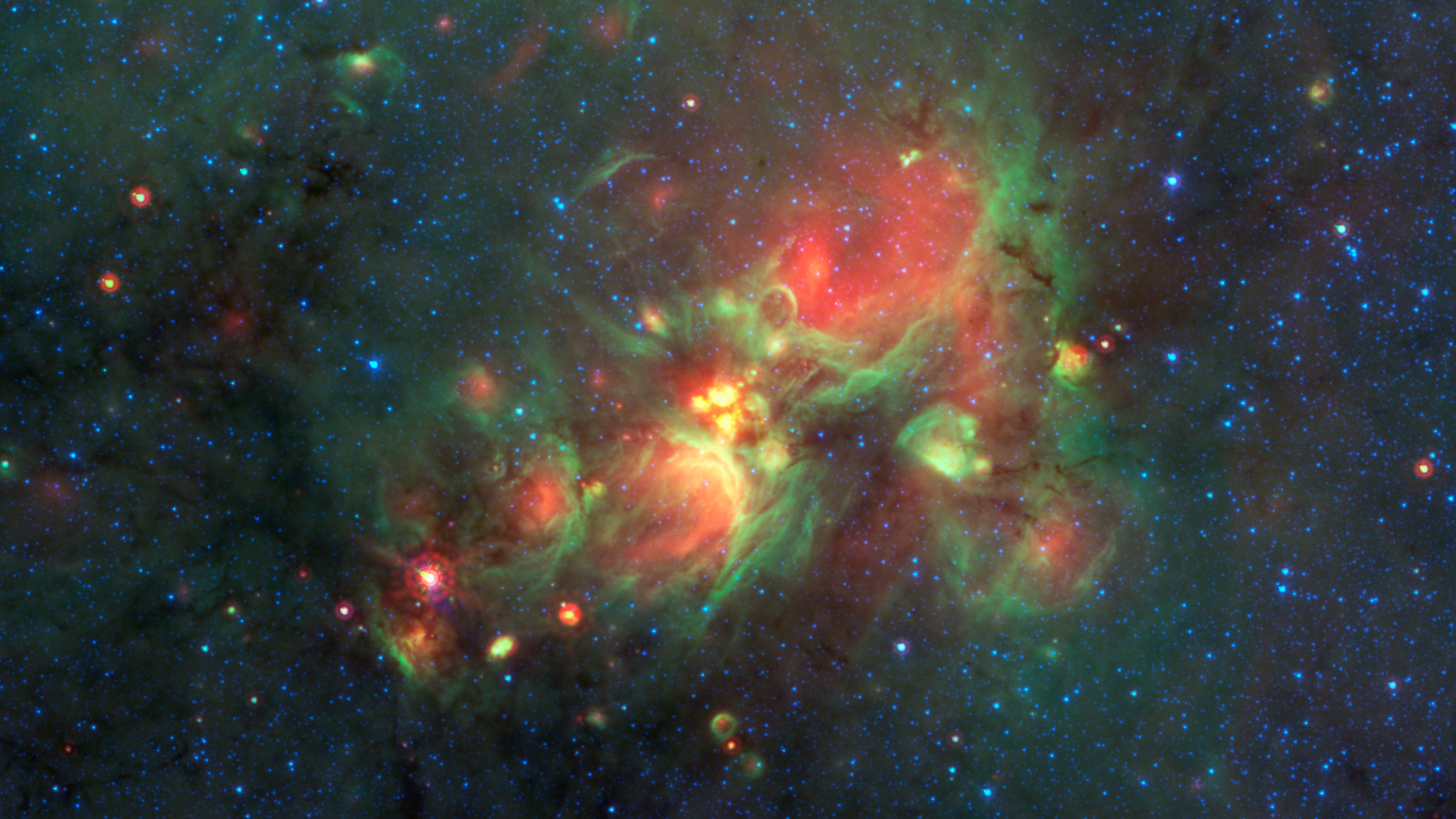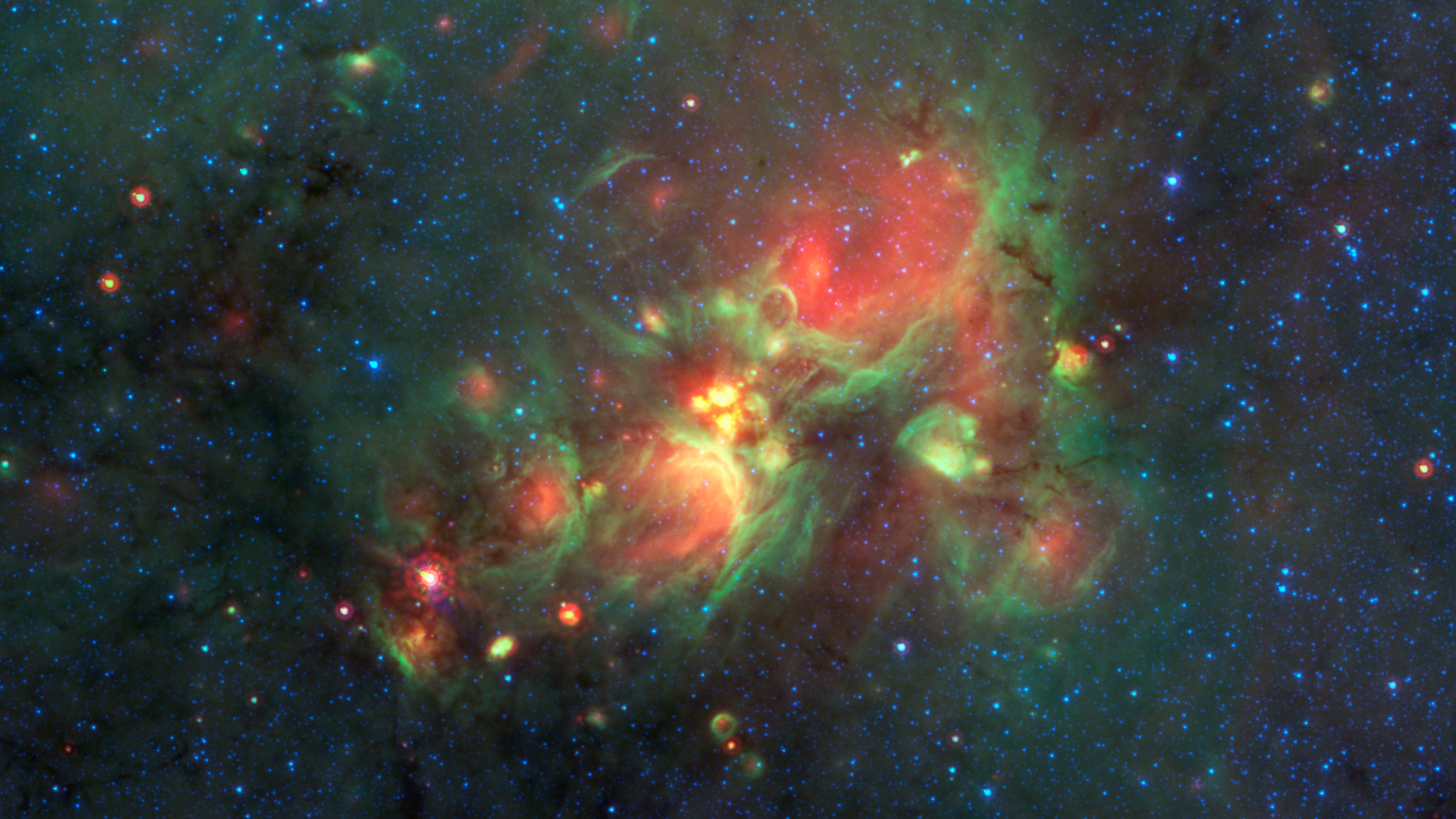
Infrared wavelengths of 3.6, 8.0, and 24.0 microns observed by the Spitzer Space Telescope are mapped into visible colors red, green, and blue in this striking image. The cosmic cloud of gas and dust is W33, a massive starforming complex some 13,000 light-years distant, near the plane of our Milky Way Galaxy. So what are all those yellow balls? Citizen scientists of the web-based Milky Way Project found the features they called yellow balls as they scanned many Spitzer images and persistently asked that question of researchers. Now there is an answer. The yellow balls in Spitzer images are identified as an early stage of massive star formation. They appear yellow because they are overlapping regions of red and green, the assigned colors that correspond to dust and organic molecules known as PAHs at Spitzer wavelengths. Yellow balls represent the stage before newborn massive stars clear out cavities in their surrounding gas and dust and appear as green-rimmed bubbles with red centers in the Spitzer image. Of course, the astronomical crowdsourcing success story is only part of the Zooniverse. The Spitzer image spans 0.5 degrees or about 100 light-years at the estimated distance of W33.
Las longitudes de onda infrarrojas de 3.6, 8.0 y 24.0 micrómetros observadas por el Telescopio Espacial Spitzer se mapean en colores visibles rojo, verde y azul en esta llamativa imagen. La nube cósmica de gas y polvo es W33, un complejo de formación estelar masivo ubicado a unos 13,000 años luz de distancia, cerca del plano de nuestra Galaxia Vía Láctea. Entonces, ¿qué son todas esas bolas amarillas? Los científicos ciudadanos del Proyecto Vía Láctea en línea identificaron las características que llamaron bolas amarillas mientras escaneaban muchas imágenes del Spitzer y persistentemente se preguntaron a los investigadores sobre su naturaleza. Ahora hay una respuesta. Las bolas amarillas en las imágenes del Spitzer se identifican como una etapa temprana de la formación estelar masiva. Aparecen amarillas porque son regiones superpuestas de rojo y verde, los colores asignados que corresponden al polvo y a moléculas orgánicas conocidas como PAHs en las longitudes de onda del Spitzer. Las bolas amarillas representan la etapa antes de que las estrellas recién nacidas limpien cavidades en su gas y polvo circundante y aparezcan como burbujas con bordes verdes y centros rojos en la imagen del Spitzer. Por supuesto, el éxito de la crowdsourcing astronómica es solo parte de Zooniverse. La imagen del Spitzer abarca 0.5 grados, o aproximadamente 100 años luz a la distancia estimada de W33.