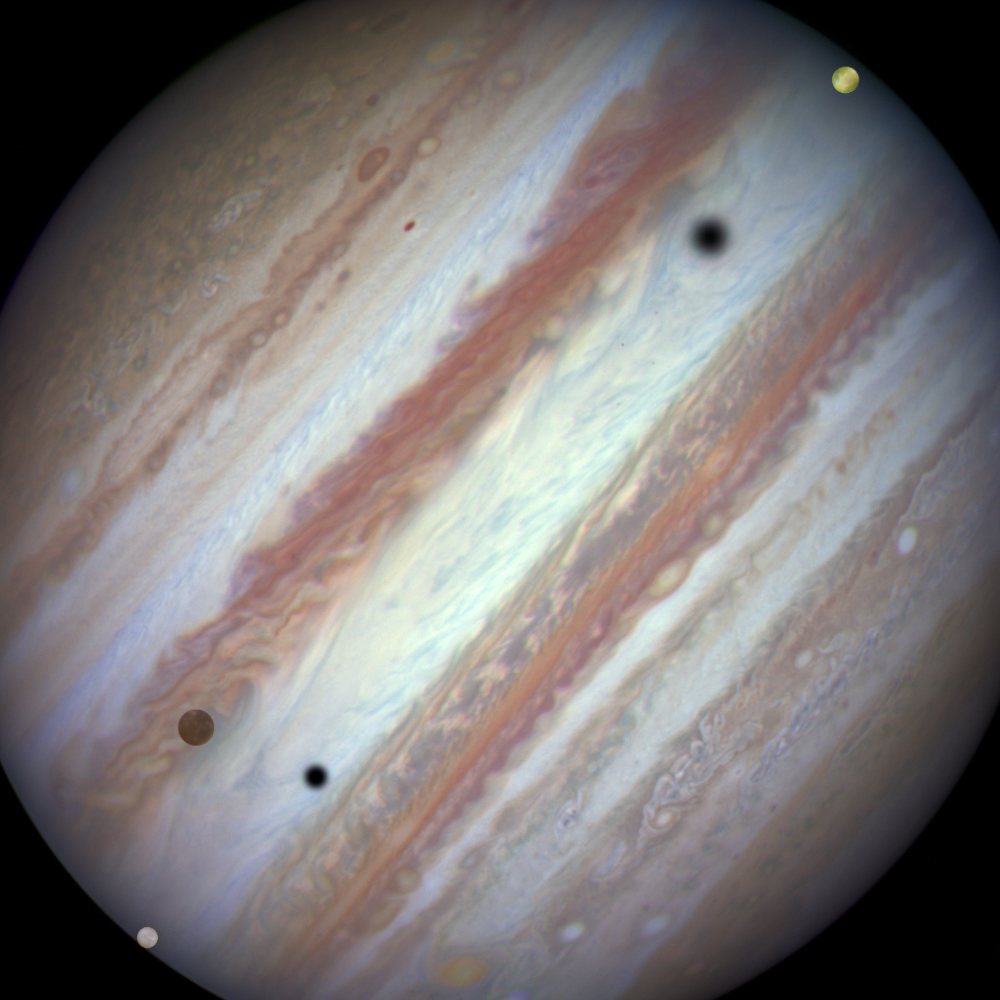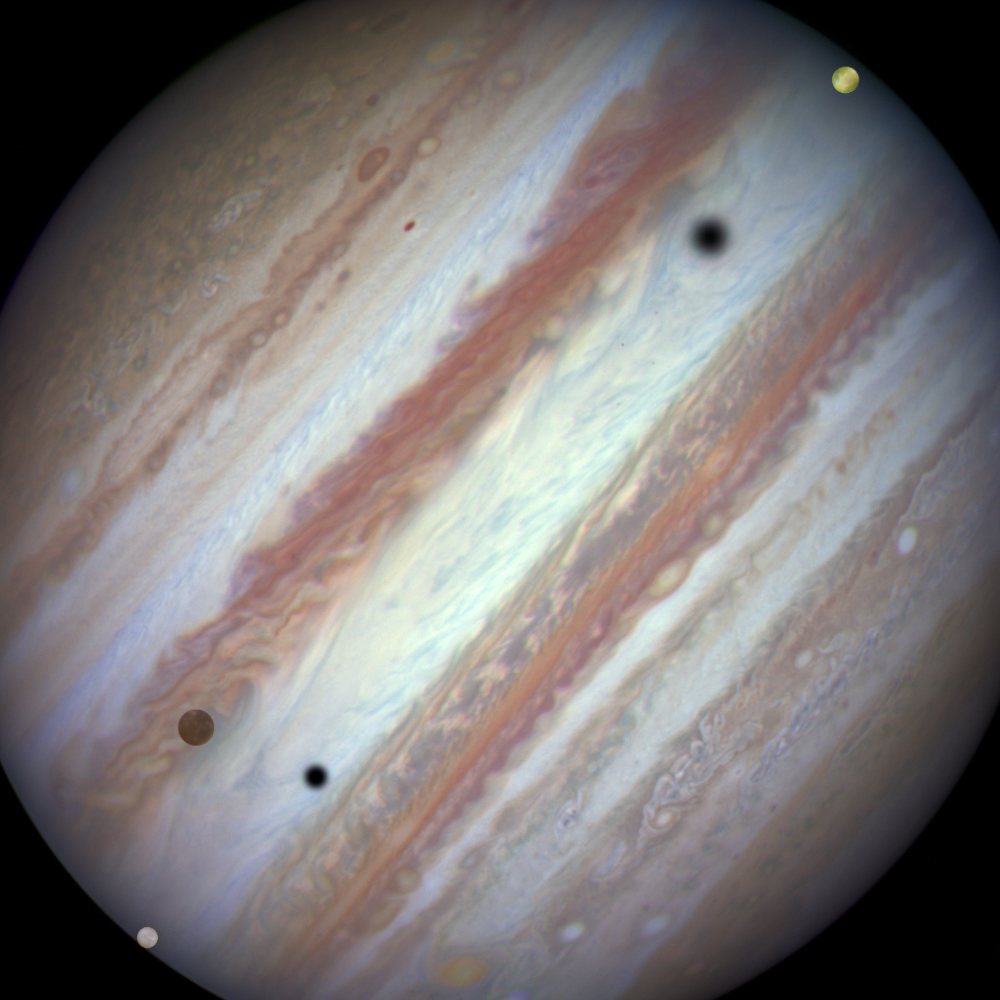
Our solar system's ruling giant planet Jupiter and 3 of its 4 large Galilean moons are captured in this single Hubble snapshot from January 24. Crossing in front of Jupiter's banded cloud tops Europa, Callisto, and Io are framed from lower left to upper right in a rare triple-moon conjunction. Distinguishable by colors alone icy Europa is almost white, Callisto's ancient cratered surface looks dark brown, and volcanic Io appears yellowish. The transiting moons and moon shadows can be identified by sliding your cursor over the image, or following this link. Remarkably, two small, inner Jovian moons, Amalthea and Thebe, along with their shadows, can also be found in the sharp Hubble view. The Galilean moons have diameters of 3,000 to 5,000 kilometers or so, comparable in size to Earth's moon. But odd-shaped Amalthea and Thebe are only about 260 and 100 kilometers across respectively.
El gigantesco planeta gobernante de nuestro sistema solar, Júpiter, y tres de sus cuatro grandes lunas galileanas aparecen capturadas en esta única imagen obtenida por el telescopio espacial Hubble el 24 de enero. Cruzando frente a las bandas nubosas de Júpiter, Europa, Calisto e Ío aparecen desde la parte inferior izquierda hasta la superior derecha en una rara conjunción triple de lunas. Solo por sus colores, Europa, cubierta de hielo, es casi blanca, la superficie antigua y craterizada de Calisto tiene un tono oscuro marrón, y Ío, volcánica, aparece amarillenta. Las lunas transitantes y sus sombras pueden identificarse desplazando el cursor sobre la imagen o siguiendo este enlace. Sorprendentemente, dos pequeñas lunas interiores de Júpiter, Amaltea y Tebe, junto con sus sombras, también pueden verse en la nítida imagen obtenida por Hubble. Las lunas galileanas tienen diámetros de unos 3.000 a 5.000 kilómetros, comparables al tamaño de la Luna terrestre. Sin embargo, Amaltea y Tebe, de formas irregulares, tienen aproximadamente 260 y 100 kilómetros de ancho respectivamente.