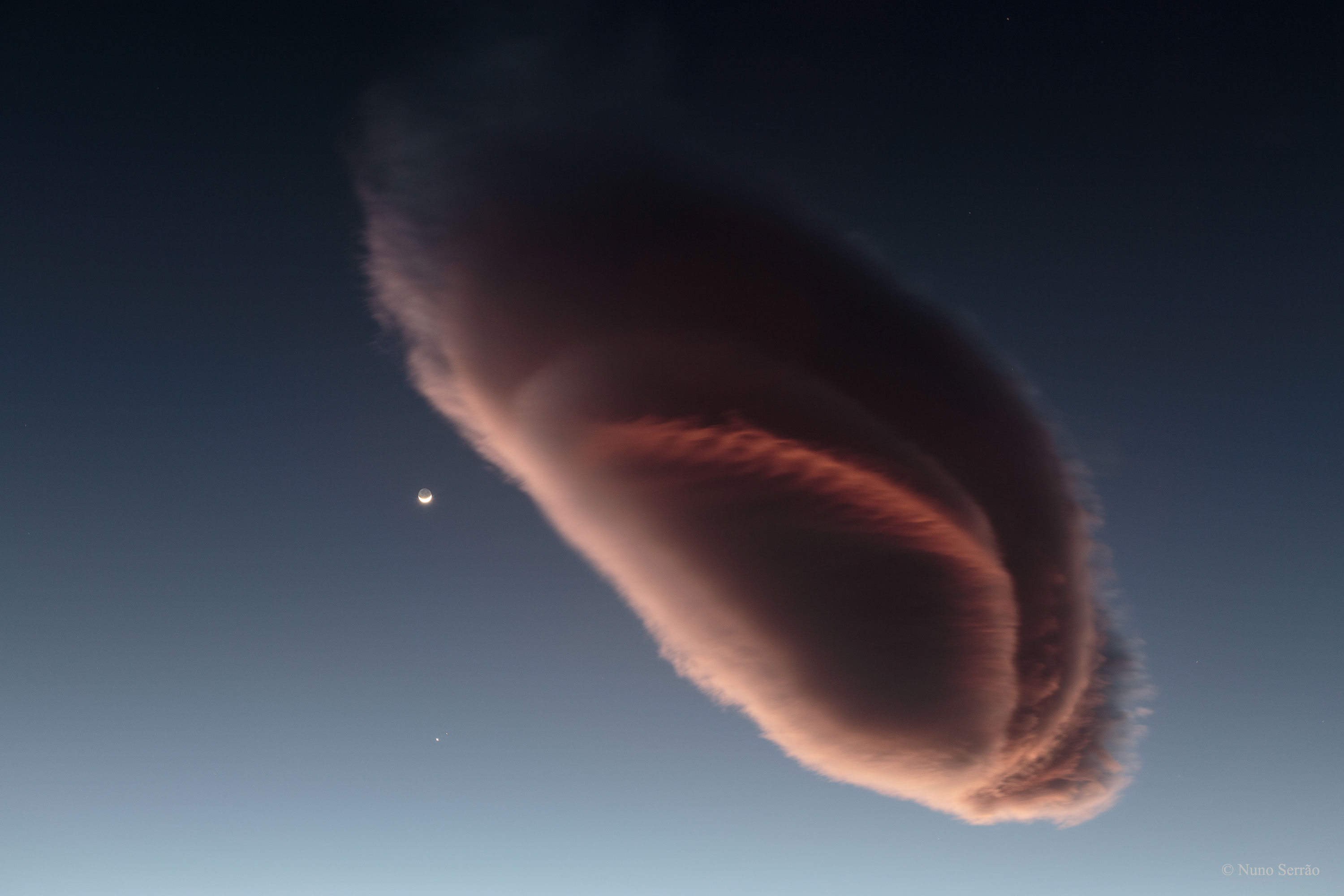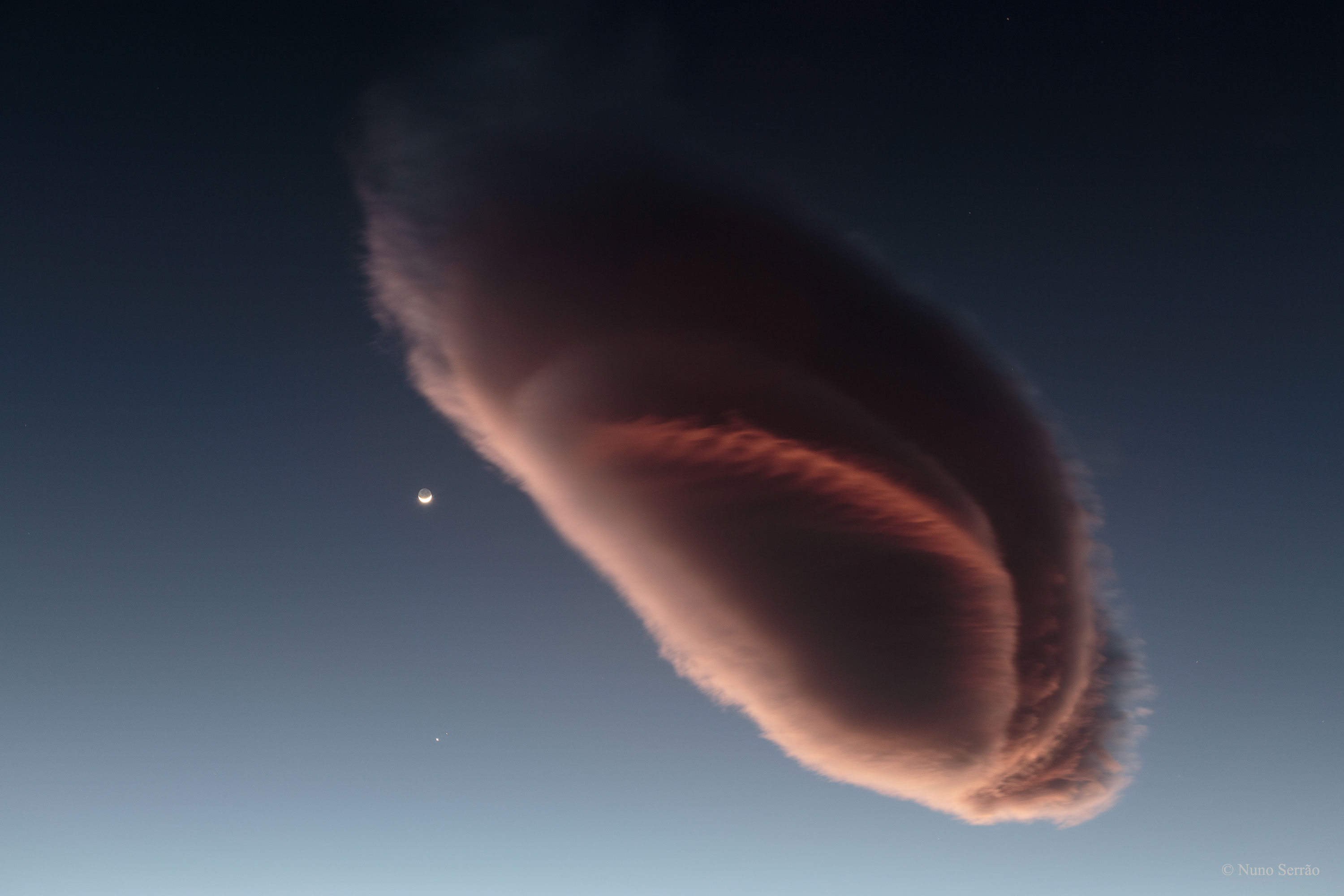
It is not every day that such an interesting cloud photobombs your image. The original plan was to photograph a rare angular conjunction of Mars and Venus that occurred a week and a half ago, with the added bonus of a crescent Moon and the International Space Station (ISS) both passing nearby. Unfortunately, on Madeira Island, Portugal, this event was clouded out. During the next day, however, a spectacular lenticular cloud appeared before sunset, so the industrious astrophotographer quickly formulated a new plan. A close look at the resulting image reveals the Moon visible toward the left of the frame, while underneath, near the bottom, are the famous planets with Venus being the brighter. It was the unexpected lenticular cloud, though, perhaps looking like some sort of futuristic spaceship, that stole the show. The setting Sun illuminated the stationary cloud (and everything else) from the bottom, setting up an intricate pattern of shadows, layers, and brightly illuminated regions, all seen evolving in a corresponding video. Mars and Venus will next appear this close on the sky in late August, but whether any place on Earth will catch them behind such a photogenic cloud is unknown. Follow APOD on: Facebook, Google Plus, or Twitter
No es todos los días que una nube tan interesante aparezca como intrusiva en una imagen. El plan original era fotografiar una conjunción angular poco común de Marte y Venus que tuvo lugar hace una semana y media, con la ventaja adicional de que la Luna menguante y la Estación Espacial Internacional (ISS) pasaran cerca. Desafortunadamente, en la isla de Madeira, Portugal, este evento fue cubierto por nubes. Sin embargo, al día siguiente, apareció una espectacular nube lenticular antes del atardecer, por lo que el fotógrafo astronómico trabajador formuló rápidamente un nuevo plan. Una mirada detallada a la imagen resultante revela que la Luna es visible hacia la izquierda del marco, mientras que debajo, cerca de la parte inferior, se encuentran los famosos planetas, siendo Venus el más brillante. Fue, sin embargo, la inesperada nube lenticular, que quizás parecía algún tipo de nave espacial futurista, la que se llevó la atención. El Sol poniente iluminó la nube estacionaria (y todo lo demás) desde la parte inferior, creando un patrón intrincado de sombras, capas y regiones brillantemente iluminadas, todas visibles evolucionando en un video correspondiente. Marte y Venus volverán a aparecer tan cerca en el cielo a finales de agosto, pero si algún lugar en la Tierra los captará detrás de una nube tan fotogénica, aún es desconocido.