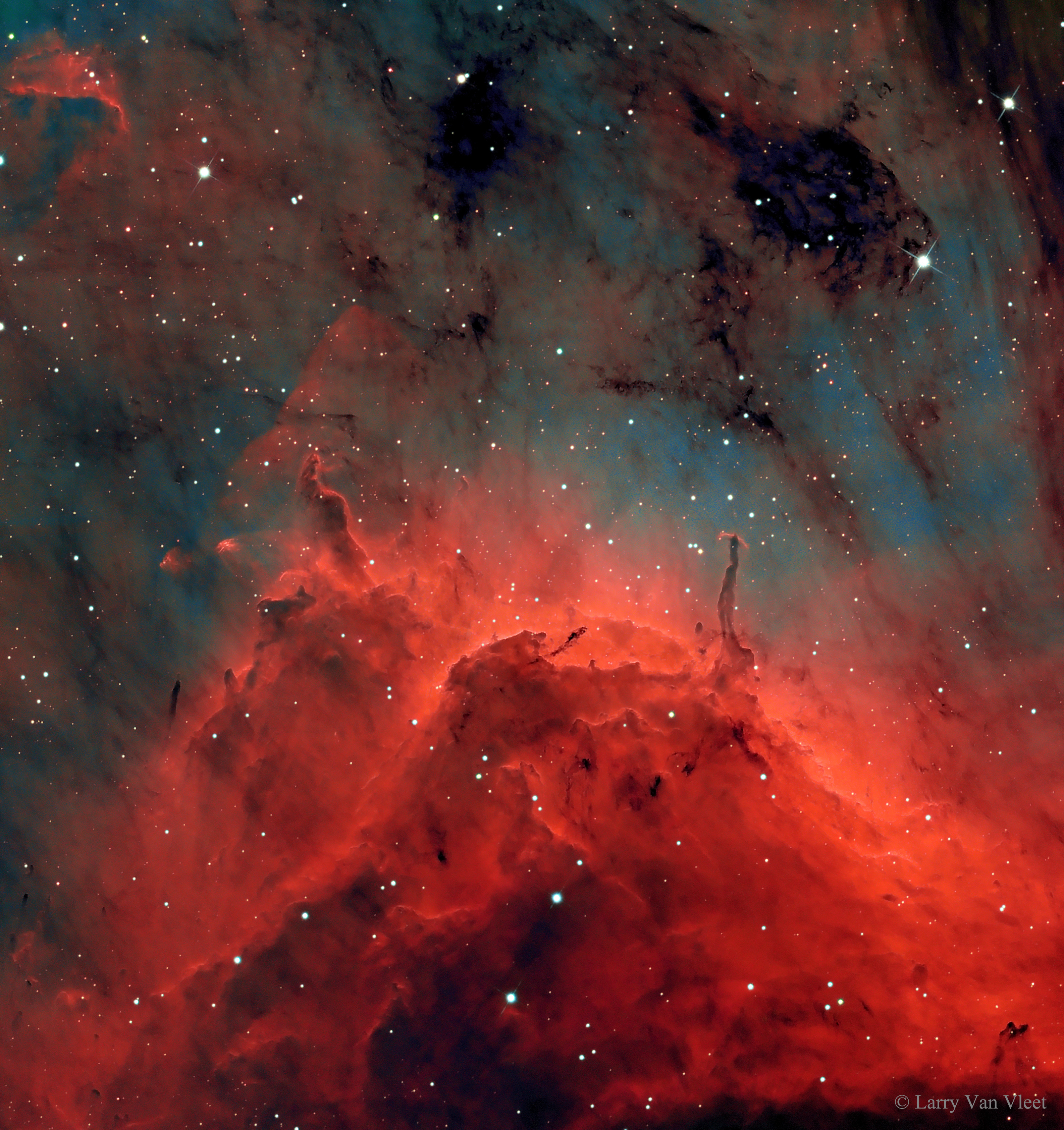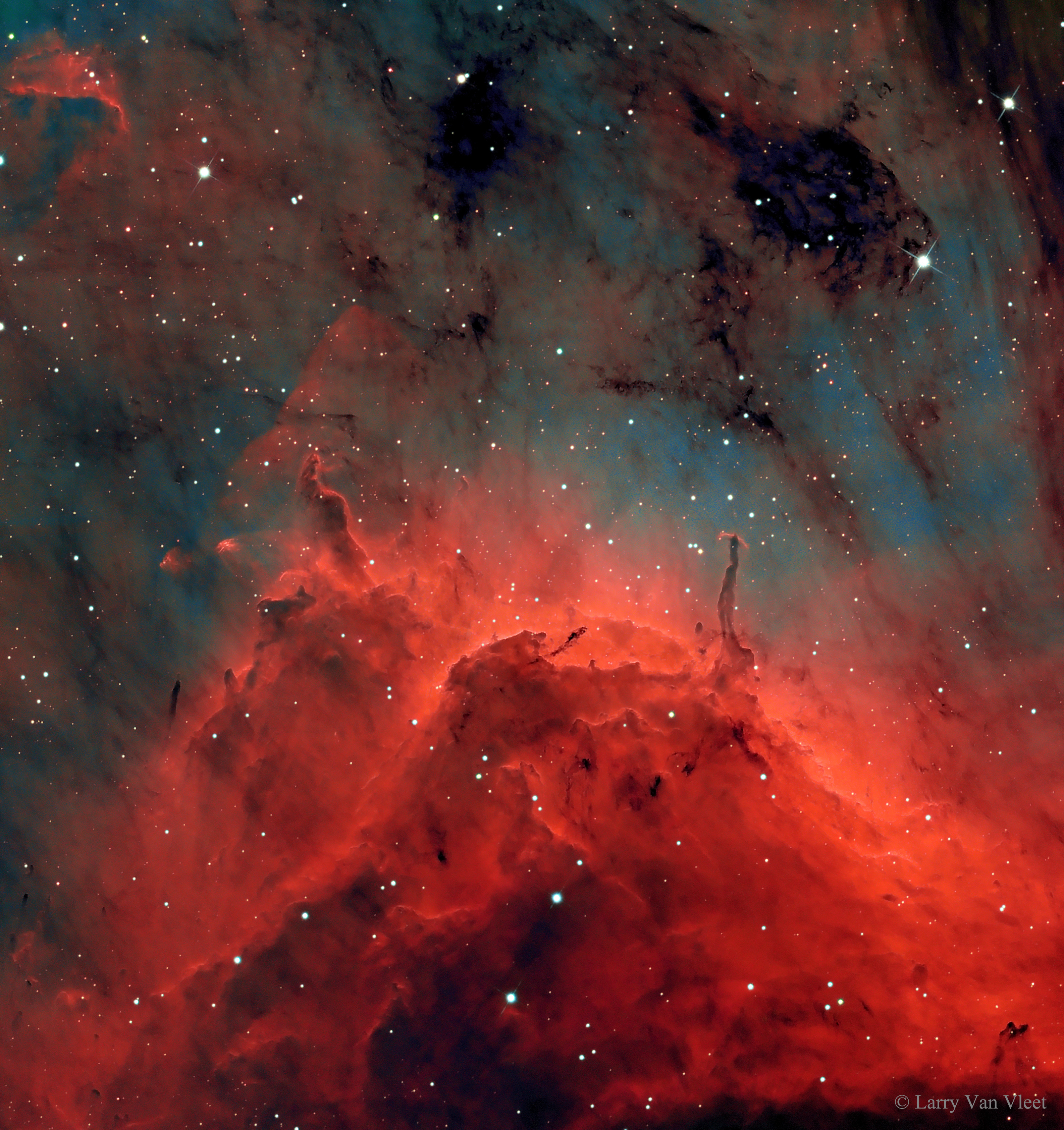
What dark structures arise from the Pelican Nebula? Visible as a bird-shaped nebula toward the constellation of a bird (Cygnus, the Swan), the Pelican Nebula is a place dotted with newly formed stars but fouled with dark dust. These smoke-sized dust grains formed in the cool atmospheres of young stars and were dispersed by stellar winds and explosions. Impressive Herbig-Haro jets are seen emitted by a star on the right that is helping to destroy the light year-long dust pillar that contains it. The featured image was scientifically-colored to emphasize light emitted by small amounts of ionized nitrogen, oxygen, and sulfur in the nebula made predominantly of hydrogen and helium. The Pelican Nebula (IC 5067 and IC 5070) is about 2,000 light-years away and can be found with a small telescope to the northeast of the bright star Deneb.
¿Qué estructuras oscuras surgen de la Nebulosa del Pavo? Visible como una nebulosa en forma de ave en la constelación de una ave (Cygno, el Cisne), la Nebulosa del Pavo es un lugar salpicado de estrellas recién formadas pero ensombrecido por polvo oscuro. Estas partículas de polvo del tamaño del humo se formaron en las atmósferas frías de estrellas jóvenes y fueron dispersadas por los vientos estelares y explosiones. Se ven impresionantes chorros Herbig-Haro emitidos por una estrella a la derecha que está ayudando a destruir el pilar de polvo de un año luz que lo contiene. La imagen destacada fue coloreada científicamente para resaltar la luz emitida por pequeñas cantidades de nitrógeno, oxígeno y azufre ionizados en la nebulosa, que está compuesta principalmente de hidrógeno y helio. La Nebulosa del Pavo (IC 5067 y IC 5070) está a unos 2.000 años luz de distancia y puede localizarse con un telescopio pequeño al noreste de la brillante estrella Deneb.