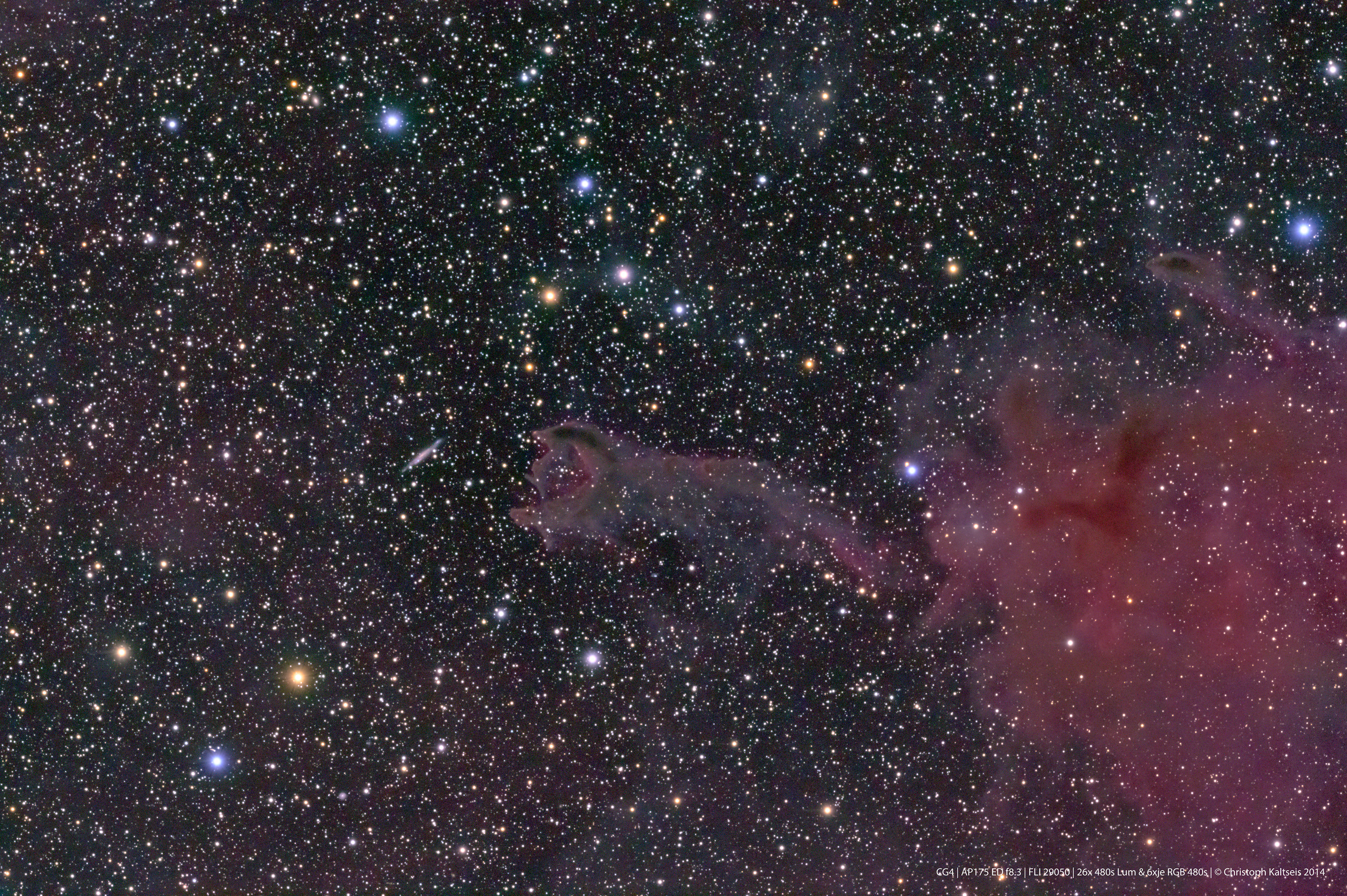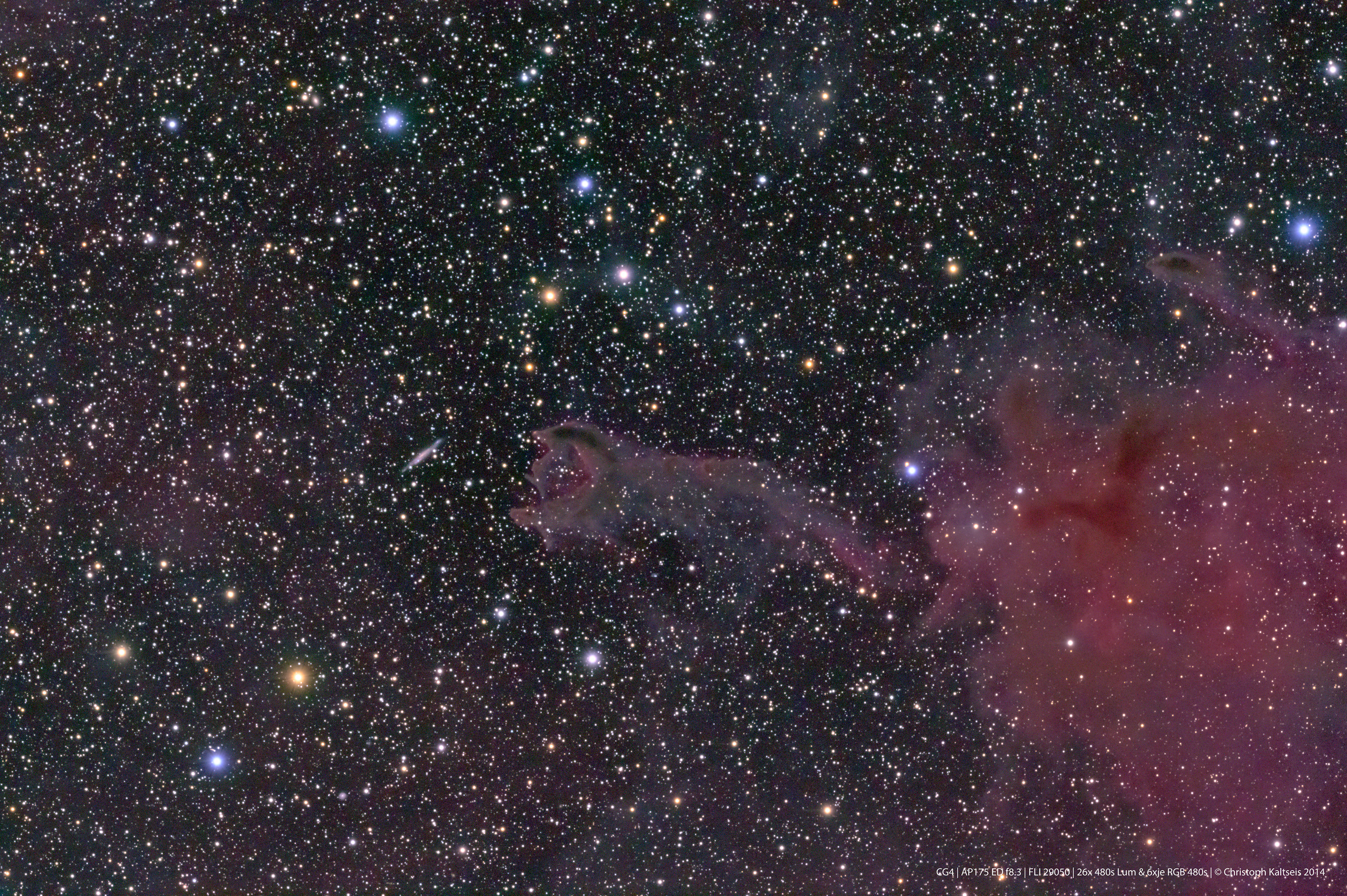
The faint and somehow menacing cometary globule CG4 reaches through the center of this deep southern skyscape. About 1,300 light-years from Earth toward the constellation Puppis, its head is about 1.5 light-years in diameter and its tail about 8 light-years long. That's far larger than the Solar System's comets that it seems to resemble. In fact, the dusty cloud contains enough material to form several Sun-like stars and likely has ongoing star formation within. How its distinctive form came about is still debated, but its long tail trails away from the Vela Supernova remnant near the center of the Gum Nebula, while its head could represent the rupture of an originally more spherical cloud. Still, the edge-on spiral galaxy also near picture center is not actually being threatened by CG4. The galaxy lies in the distant background more than 100 million light-years away.
El tenue y algo amenazador globulo cometario CG4 atraviesa el centro de este profundo paisaje celeste del sur. A unos 1.300 años luz de la Tierra hacia la constelación de Puppis, su cabeza tiene aproximadamente 1,5 años luz de diámetro y su cola unos 8 años luz de longitud. Eso es mucho más grande que los cometas del Sistema Solar que parece asemejarse. De hecho, la nube polvorienta contiene suficiente material para formar varias estrellas similares al Sol y probablemente tiene formación estelar en curso dentro. Cómo se formó su forma distintiva aún es objeto de debate, pero su larga cola se extiende hacia afuera del remanente de la supernova Vela cerca del centro de la Nebulosa Gum, mientras que su cabeza podría representar la ruptura de una nube originalmente más esférica. Sin embargo, la galaxia espiral alineada en el borde del plano de la imagen, también cerca del centro, no está realmente amenazada por el CG4. La galaxia se encuentra en el fondo distante, a más de 100 millones de años luz de distancia.