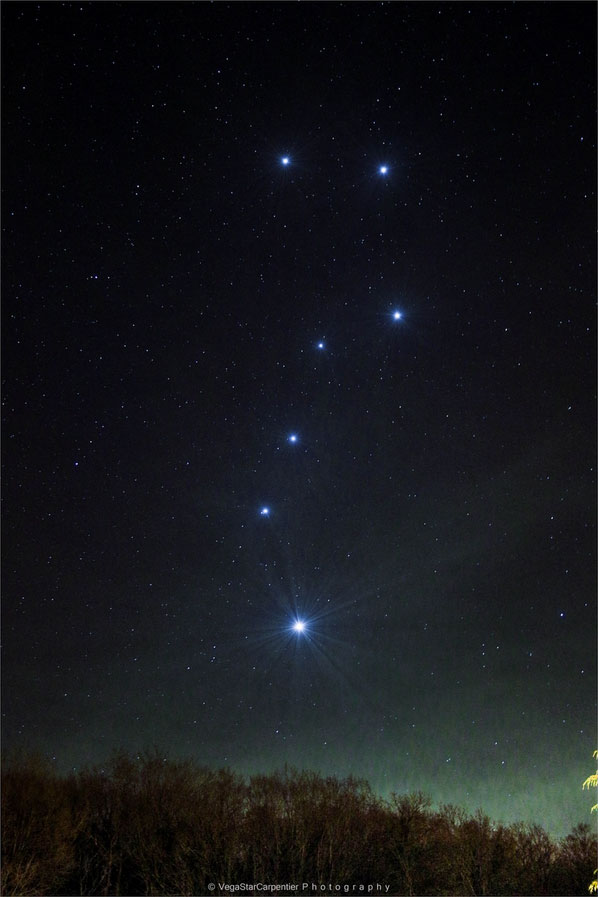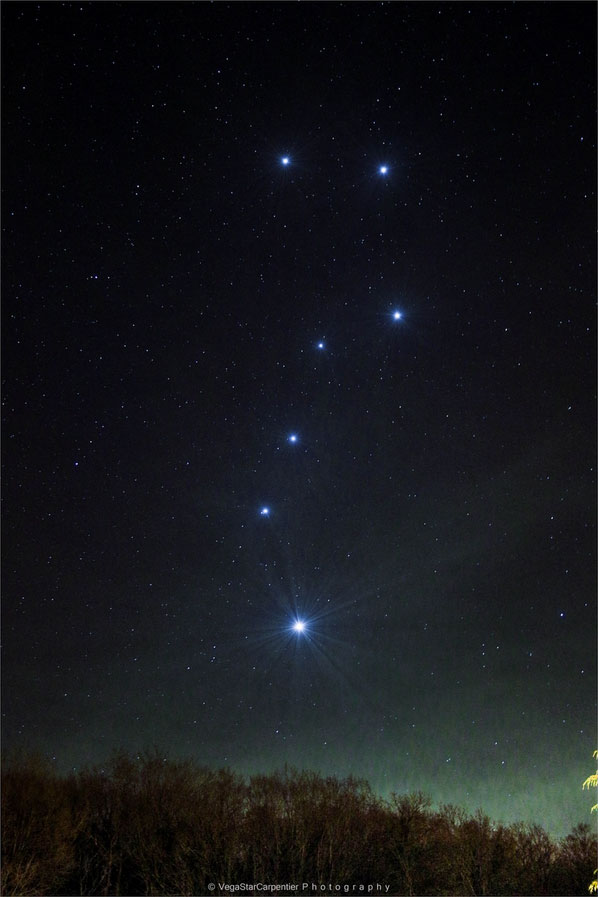
Do you see it? This common question frequently precedes the rediscovery of one of the most commonly recognized configurations of stars on the northern sky: the Big Dipper. This grouping of stars is one of the few things that has likely been seen, and will be seen, by every human generation. In this featured image, however, the stars of the Big Dipper have been digitally enhanced -- they do not really appear this much brighter than nearby stars. The image was taken earlier this month from France. The Big Dipper is not by itself a constellation. Although part of the constellation of the Great Bear (Ursa Major), the Big Dipper is an asterism that has been known by different names to different societies. Five of the Big Dipper stars are actually near each other in space and were likely formed at nearly the same time. Relative stellar motions will cause the Big Dipper to slowly change its apparent configuration over the next 100,000 years. Follow APOD on: Facebook, Google Plus, or Twitter
¿La ves? Esta pregunta común suele preceder al redescubrimiento de una de las configuraciones estelares más reconocidas en el cielo del hemisferio norte: la Osa Mayor. Este agrupamiento de estrellas es uno de los pocos objetos que probablemente han sido vistos, y serán vistos, por cada generación humana. Sin embargo, en esta imagen destacada, las estrellas de la Osa Mayor han sido reforzadas digitalmente — en realidad no aparecen tan brillantes en comparación con las estrellas cercanas. La imagen fue tomada hace poco tiempo desde Francia. La Osa Mayor no es en sí misma una constelación. Aunque forma parte de la constelación de la Gran Osa (Ursa Major), la Osa Mayor es un asterismo que ha sido conocido con diferentes nombres por diferentes sociedades. Cinco de las estrellas de la Osa Mayor están realmente cercanas entre sí en el espacio y probablemente se formaron casi al mismo tiempo. Los movimientos relativos de las estrellas causarán que la Osa Mayor cambie lentamente su configuración aparente durante los próximos 100.000 años.