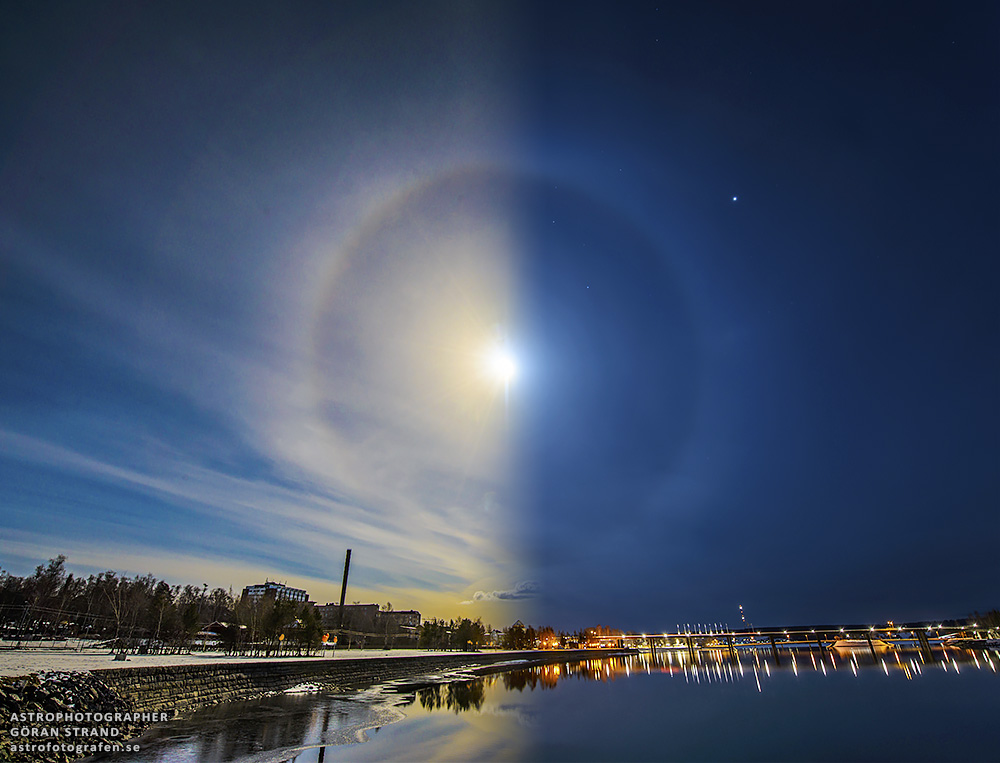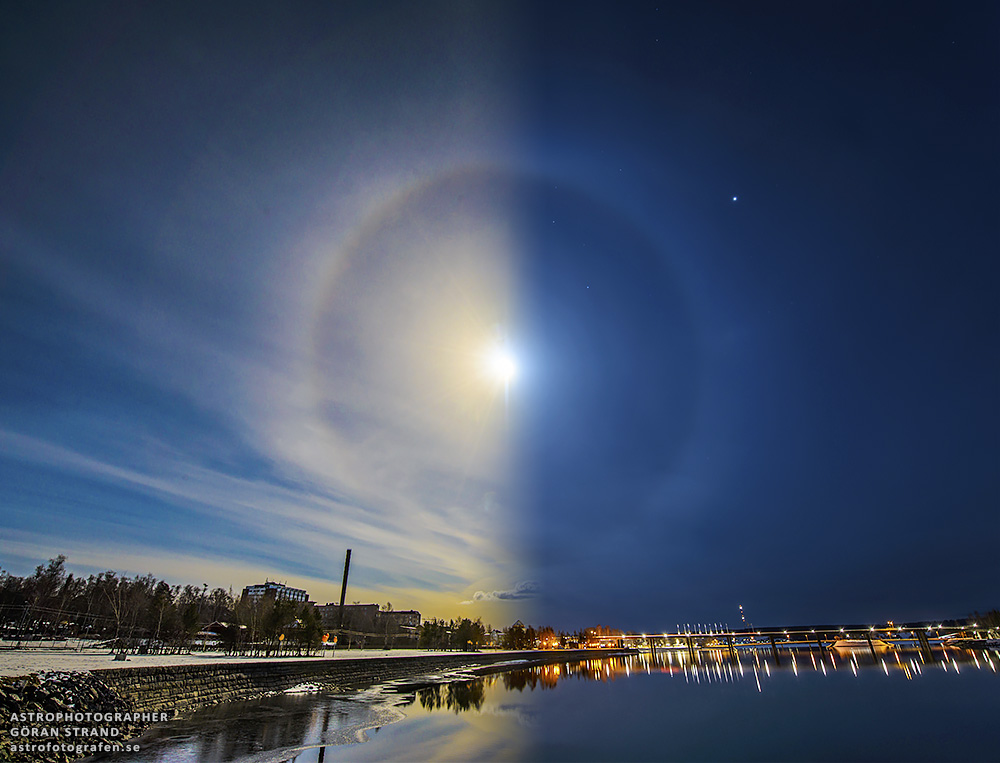
Two pictures captured on April 1 are combined in this creative day and night composite. Separated in time by about 10 hours the images otherwise match, looking along the coast at Östersund Sweden. The relative times were chosen to show the Sun and a nearly full Moon at the same place in the cold, early springtime sky. In the night scene Jupiter also shines above the waterfront lights, while Sun and Moon are both surrounded by a beautiful circular ice halo. The Sun and Moon halos really do align, each with an angular radius of 22 degrees. That radius is a constant, not determined by the brightness of Sun or Moon but only by the hexagonal geometry of atmospheric ice crystals and the reflection and refraction of light. Of course tomorrow, April 4, will find the Sun and Moon on opposite sides of planet Earth for a total lunar eclipse.
Dos imágenes capturadas el 1 de abril se combinan en este creativo composite de día y noche. Separadas en el tiempo por aproximadamente 10 horas, las imágenes coinciden en lo demás, mostrando la costa de Östersund, Suecia. Los tiempos relativos se eligieron para mostrar al Sol y una Luna casi llena en el mismo lugar del frío cielo de principios de primavera. En la escena nocturna, Júpiter también brilla por encima de las luces del área costera, mientras que tanto el Sol como la Luna están rodeados por un hermoso halo circular de hielo. Los halos del Sol y la Luna realmente se alinean, cada uno con un radio angular de 22 grados. Ese radio es constante, no determinado por la luminosidad del Sol o la Luna, sino solo por la geometría hexagonal de los cristales de hielo atmosféricos y la reflexión y refracción de la luz. Por supuesto, mañana, el 4 de abril, el Sol y la Luna estarán en lados opuestos del planeta Tierra para un eclipse lunar total.