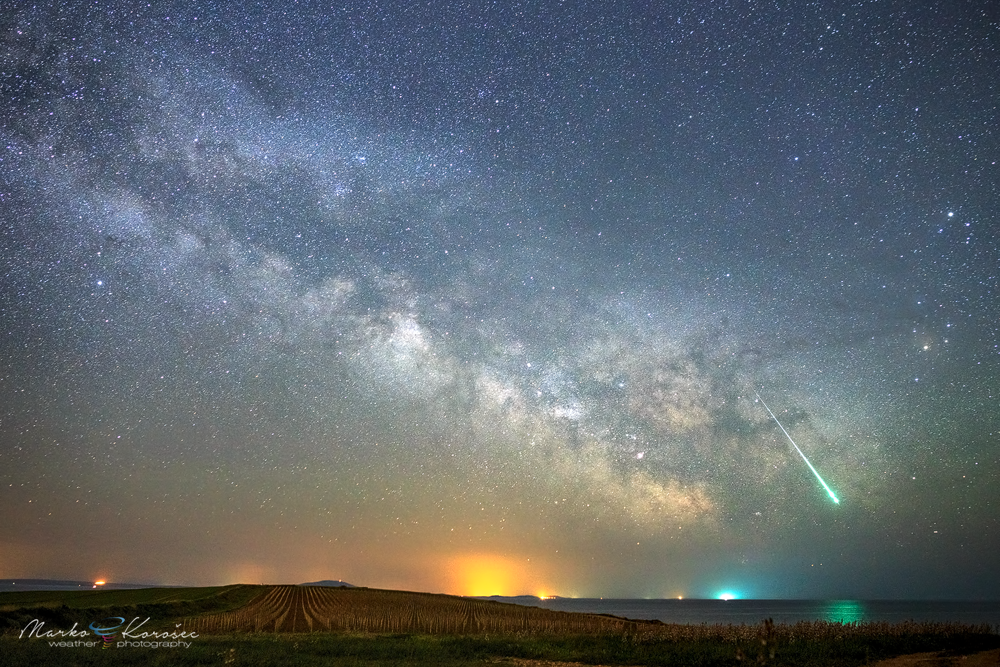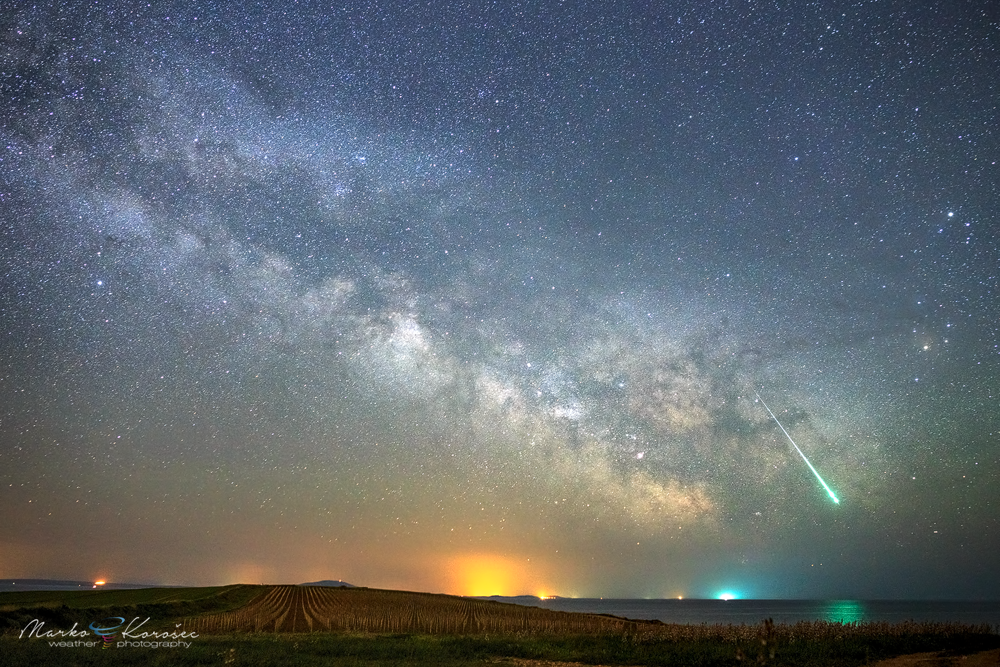
rth's April showers include the Lyrid Meteor Shower, observed for more than 2,000 years when the planet makes its annual passage through the dust stream of long-period Comet Thatcher. A grain of that comet's dust, moving 48 kilometers per second at an altitude of 100 kilometers or so, is swept up in this night sky view from the early hours of April 21. Flashing toward the southeastern horizon, the meteor's brilliant streak crosses the central region of the rising Milky Way. Its trail points back toward the shower's radiant in the constellation Lyra, high in the northern springtime sky and off the top of the frame. The yellowish hue of giant star Antares shines to the right of the Milky Way's bulge. Higher still is bright planet Saturn, near the right edge. Seen from Istra, Croatia, the Lyrid meteor's greenish glow reflects in the waters of the Adriatic Sea.
Las lluvias de abril de la Tierra incluyen la Lluvia de Meteoros de Lira, observada durante más de 2000 años cuando el planeta atraviesa anualmente el flujo de polvo del cometa de período largo Thatcher. Una partícula de ese polvo, que se mueve a 48 kilómetros por segundo a una altitud de unos 100 kilómetros, se ve capturada en esta vista del cielo nocturno tomada durante las primeras horas del 21 de abril. Brillando hacia el horizonte sureste, el resplandor de la estela del meteorito cruza la región central de la Vía Láctea en ascenso. Su trayectoria apunta hacia atrás hacia el radiante de la lluvia en la constelación de Lira, alta en el cielo primaveral del norte y fuera del borde superior del marco. El tono amarillento de la gigantesca estrella Antares brilla a la derecha del bulbo de la Vía Láctea. Aún más arriba se encuentra el brillante planeta Saturno, cerca del borde derecho. Visto desde Istra, Croacia, el resplandor verde del meteorito de Lira se refleja en las aguas del Mar Adriático.