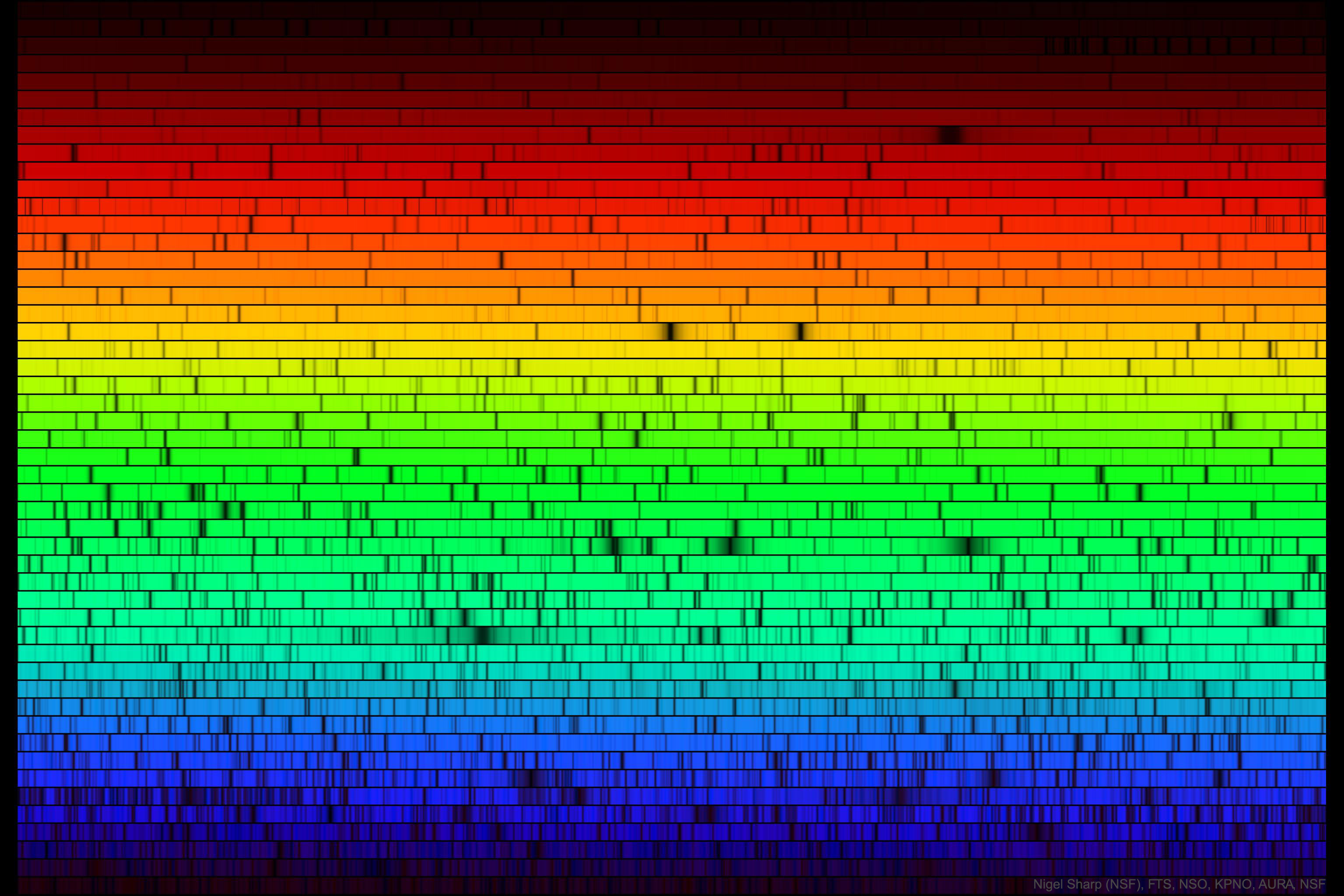
It is still not known why the Sun's light is missing some colors. Here are all the visible colors of the Sun, produced by passing the Sun's light through a prism-like device. The spectrum was created at the McMath-Pierce Solar Observatory and shows, first off, that although our white-appearing Sun emits light of nearly every color, it does indeed appear brightest in yellow-green light. The dark patches in the above spectrum arise from gas at or above the Sun's surface absorbing sunlight emitted below. Since different types of gas absorb different colors of light, it is possible to determine what gasses compose the Sun. Helium, for example, was first discovered in 1870 on a solar spectrum and only later found here on Earth. Today, the majority of spectral absorption lines have been identified - but not all. New Translations: APOD is now available in Croatian and Montenegrin.
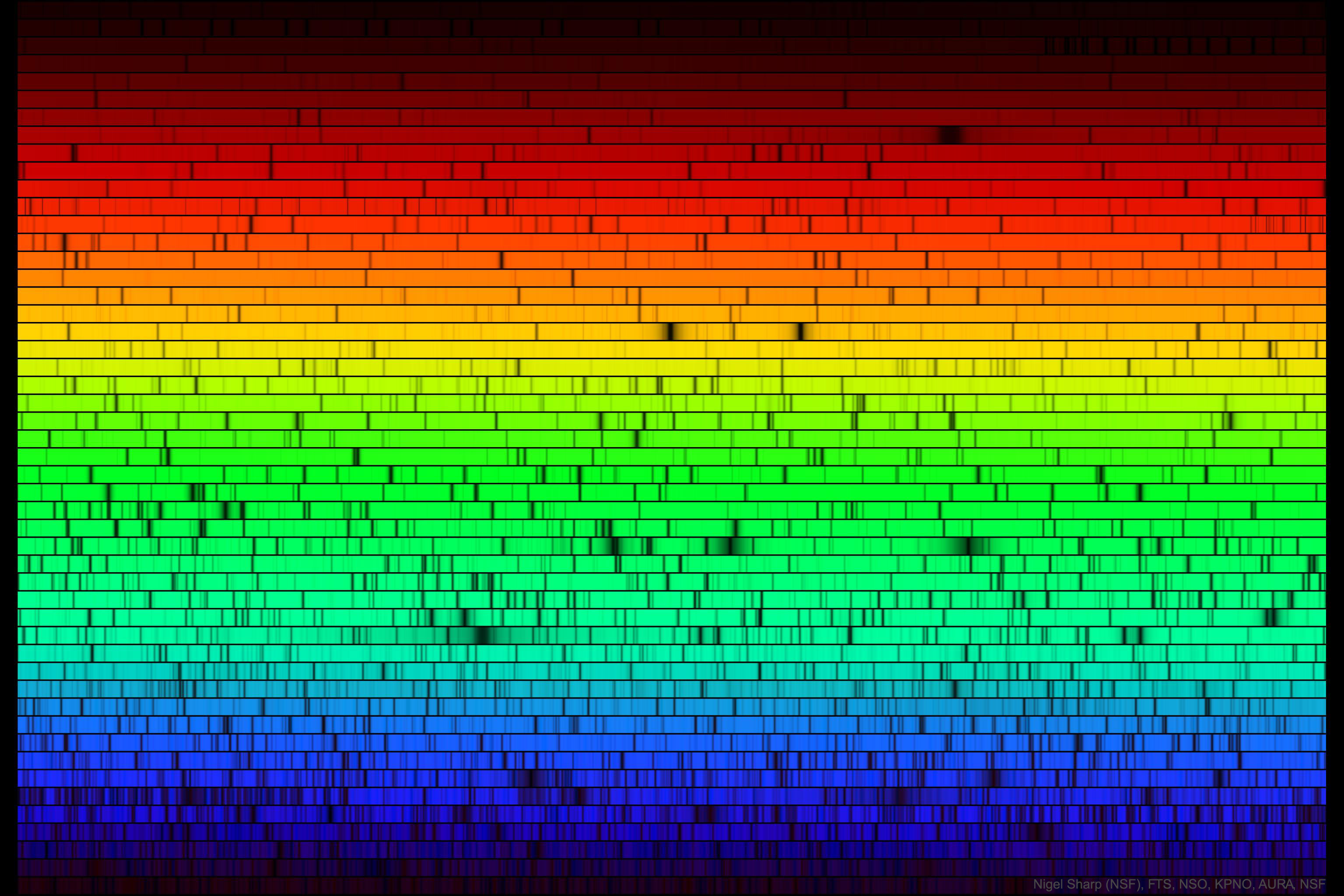
Aún no se sabe por qué la luz del Sol carece de algunos colores. Aquí se muestran todos los colores visibles del Sol, producidos al pasar la luz del Sol a través de un dispositivo similar a un prisma. El espectro fue creado en la Observatorio Solar McMath-Pierce y muestra, en primer lugar, que aunque nuestro Sol, que aparece blanco, emite luz de casi todos los colores, en realidad aparece más brillante en la luz amarillo-verde. Las manchas oscuras en el espectro anterior surgen de gas en o por encima de la superficie del Sol que absorbe la luz solar emitida por debajo. Dado que diferentes tipos de gas absorben diferentes colores de luz, es posible determinar qué gases componen el Sol. Por ejemplo, el helio fue descubierto por primera vez en 1870 en un espectro solar y solo más tarde se encontró aquí en la Tierra. Hoy en día, la mayoría de las líneas de absorción espectrales han sido identificadas, pero no todas.