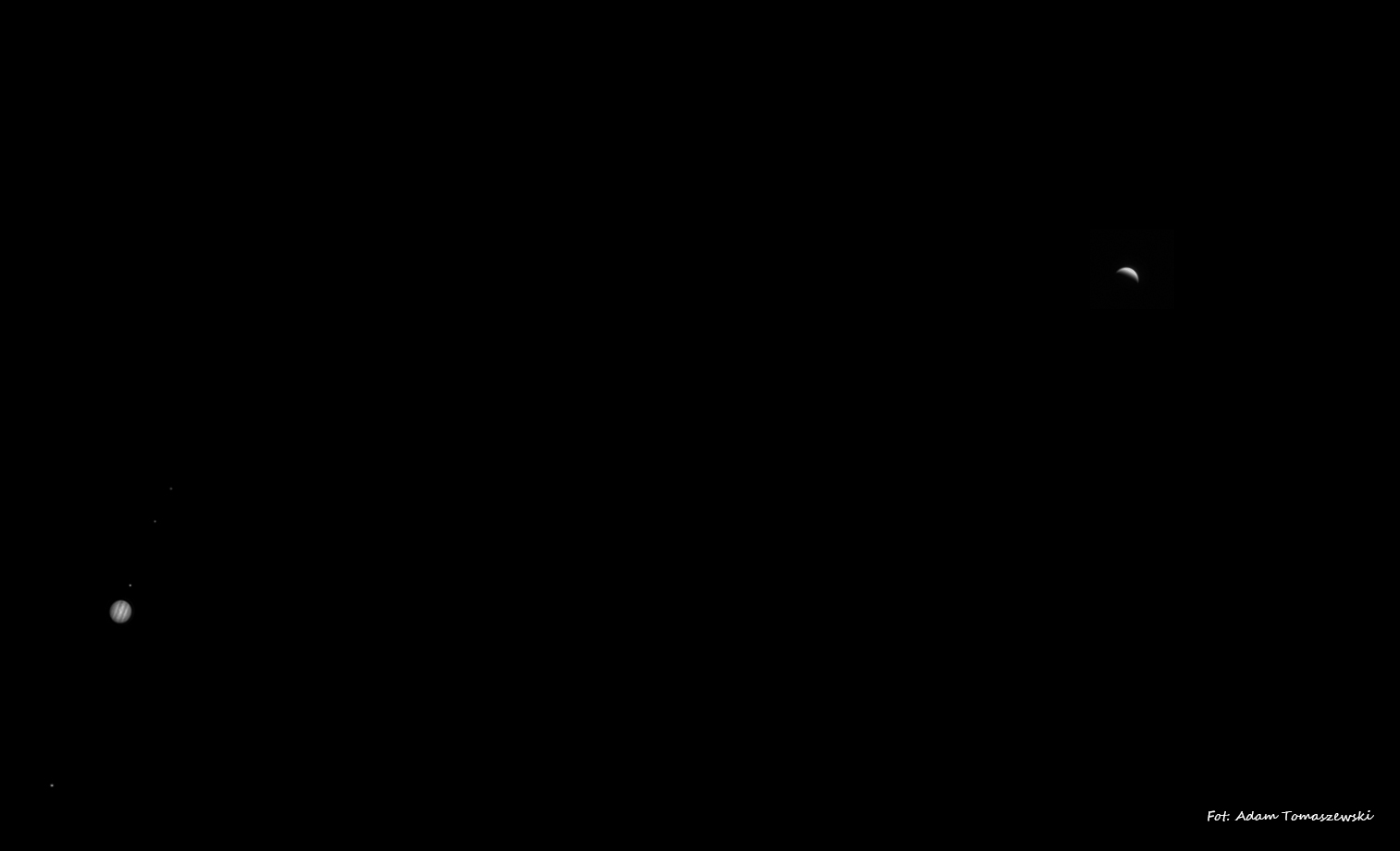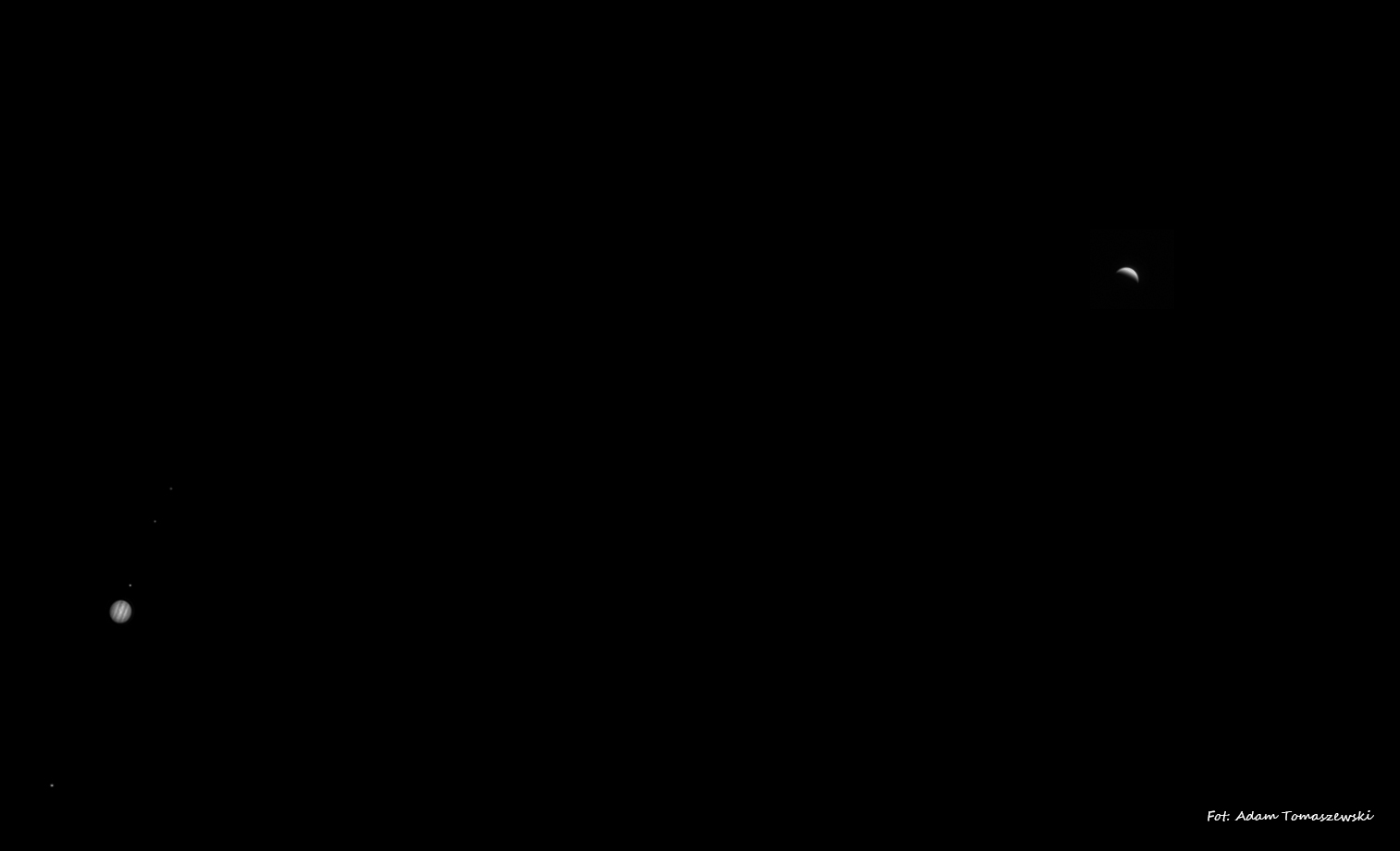
On June 30 Venus and Jupiter were actually far apart, but both appeared close in western skies at dusk. Near the culmination of this year's gorgeous conjunction, the two bright evening planets are captured in the same telescopic field of view in this sharp digital stack of images taken after sunset from Poznań in west-central Poland. In fact, banded gas giant Jupiter was about 910 million kilometers from Poland. That's over 11 times farther than crescent Venus, only 78 million kilometers distant at the time. But since the diameter of giant planet Jupiter is over 11 times larger than Venus both planets show about the same angular size. Of course, 16th century Polish astronomer Nicolaus Copernicus would also have enjoyed the simultaneous telescopic view including Jupiter's four Galilean moons and a crescent Venus. Observations of Jupiter's moons and Venus' crescent phase were evidence for the Copernican or heliocentric model of the solar system.
El 30 de junio, Venus y Júpiter estaban realmente muy alejados, pero ambos parecían cercanos en el cielo occidental al atardecer. Cerca del culminar de esta hermosa conjunción del año, los dos brillantes planetas del atardecer se capturan en el mismo campo visual telescópico en esta nítida pila digital de imágenes tomadas después del atardecer en Poznań, en el centro oeste de Polonia. De hecho, el gigantesco planeta gaseoso Júpiter estaba a unos 910 millones de kilómetros de Polonia. Eso es más de 11 veces más lejos que Venus en cuarto creciente, que estaba a solo 78 millones de kilómetros en ese momento. Sin embargo, dado que el diámetro del gigantesco planeta Júpiter es más de 11 veces mayor que el de Venus, ambos planetas muestran aproximadamente el mismo tamaño angular. Por supuesto, el astrónomo polaco del siglo XVI Nicolás Copérnico también habría disfrutado de la vista telescópica simultánea que incluye las cuatro lunas galileanas de Júpiter y un Venus en cuarto creciente. Las observaciones de las lunas de Júpiter y la fase de cuarto creciente de Venus fueron evidencia del modelo copernicano o heliocéntrico del sistema solar.