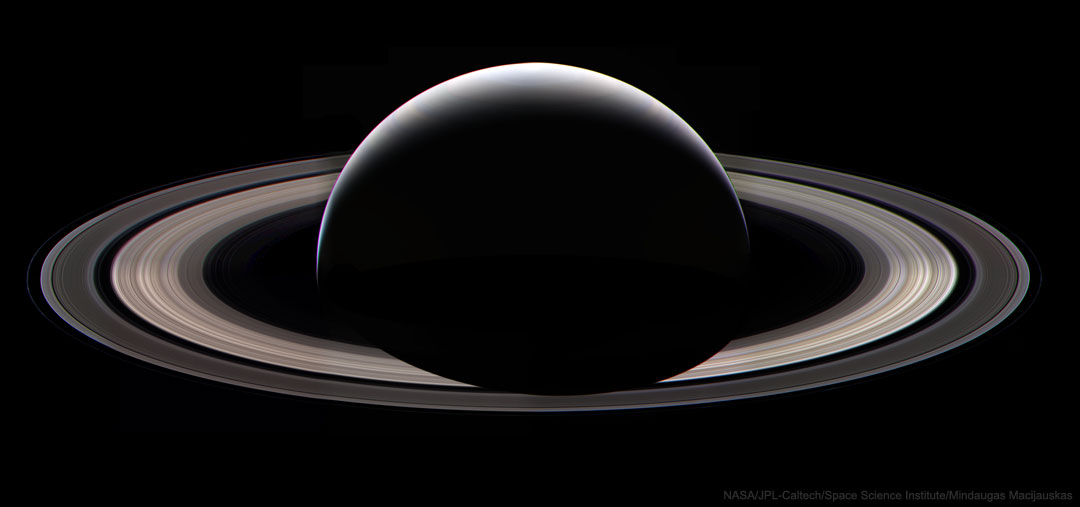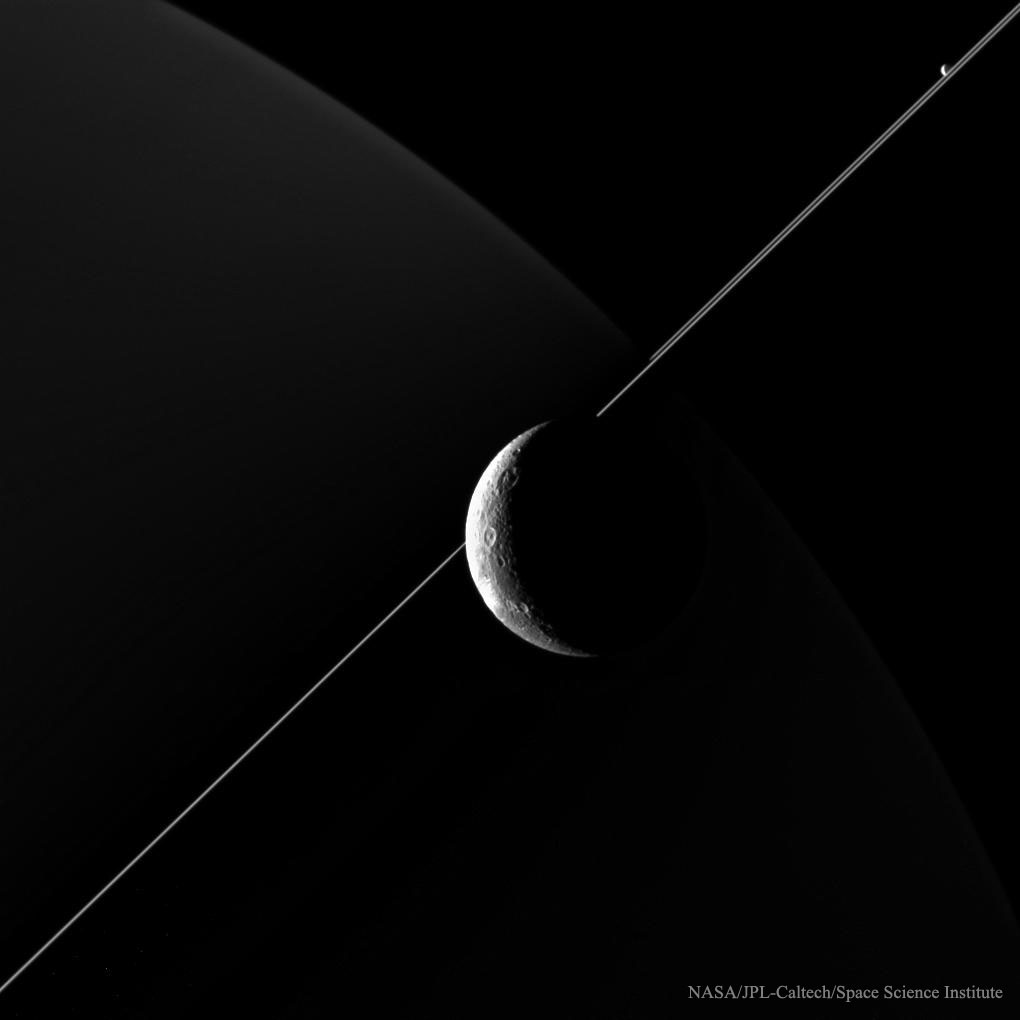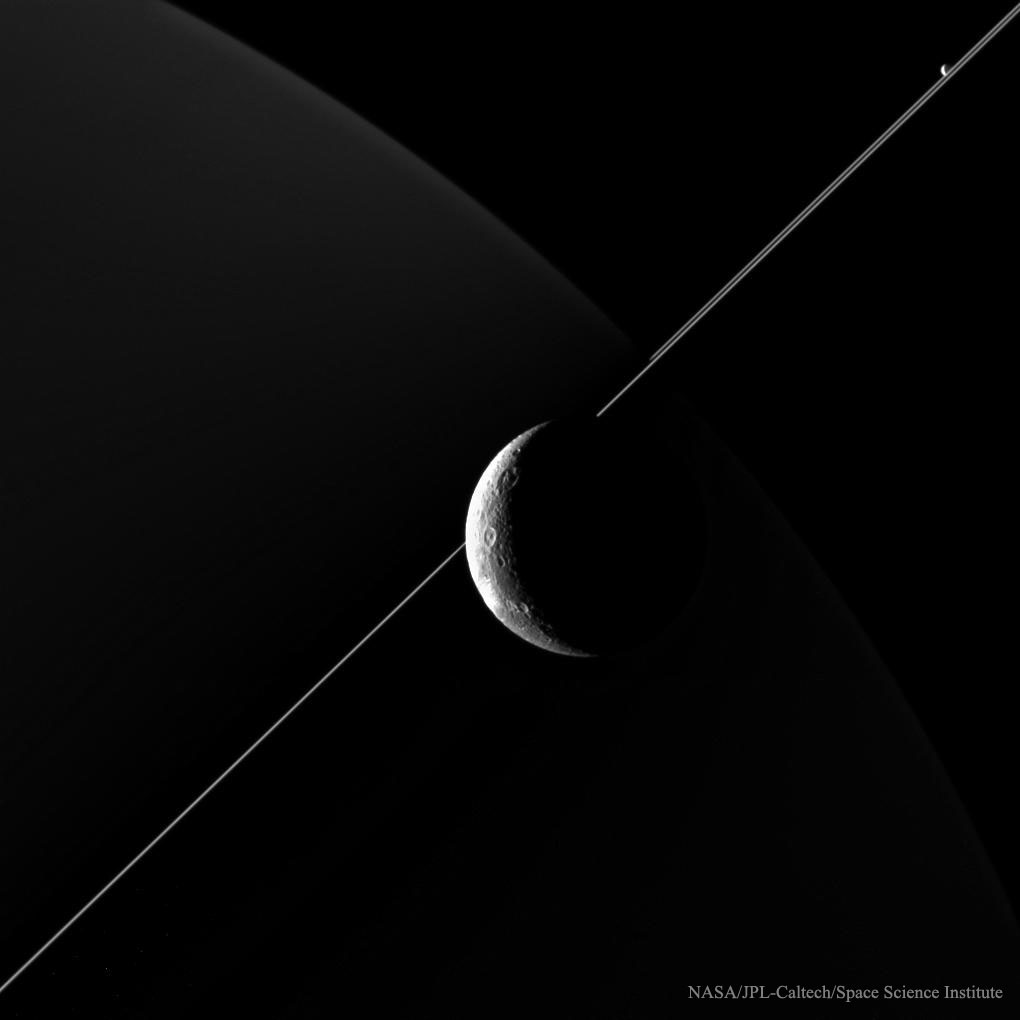
That is not our Moon. It's Dione, and it�s a moon of Saturn. The robotic Cassini spacecraft took the featured image during a flyby of Saturn's cratered Moon last month. Perhaps what makes this image so interesting, though, is the background. First, the large orb looming behind Dione is Saturn itself, faintly lit by sunlight first reflected from the rings. Next, the thin lines running diagonally across the image are the rings of Saturn themselves. The millions of icy rocks that compose Saturn's spectacular rings all orbit Saturn in the same plane, and so appear surprisingly thin when seen nearly edge-on. Front and center, Dione appears in crescent phase, partially lit by the Sun that is off to the lower left. A careful inspection of the ring plane should also locate the moon Enceladus on the upper right.
Esa no es nuestra Luna. Es Dione, y es un satélite de Saturno. La nave espacial robótica Cassini tomó la imagen destacada durante un sobrevuelo del cráteroso satélite de Saturno el mes pasado. Lo que quizás hace que esta imagen sea tan interesante, sin embargo, es el fondo. En primer lugar, la gran esfera que se ve detrás de Dione es Saturno mismo, suavemente iluminado por la luz solar reflejada primero desde los anillos. Luego, las finas líneas que se extienden diagonalmente a través de la imagen son los anillos de Saturno mismos. Los millones de rocas heladas que componen los espectaculares anillos de Saturno orbitan a Saturno en el mismo plano, y por lo tanto aparecen sorprendentemente delgados cuando se ven casi de perfil. En primer plano y en el centro, Dione aparece en fase de cuarto creciente, parcialmente iluminada por el Sol que se encuentra a la izquierda inferior. Una inspección cuidadosa del plano de los anillos también debería localizar el satélite Enceladus en la parte superior derecha.