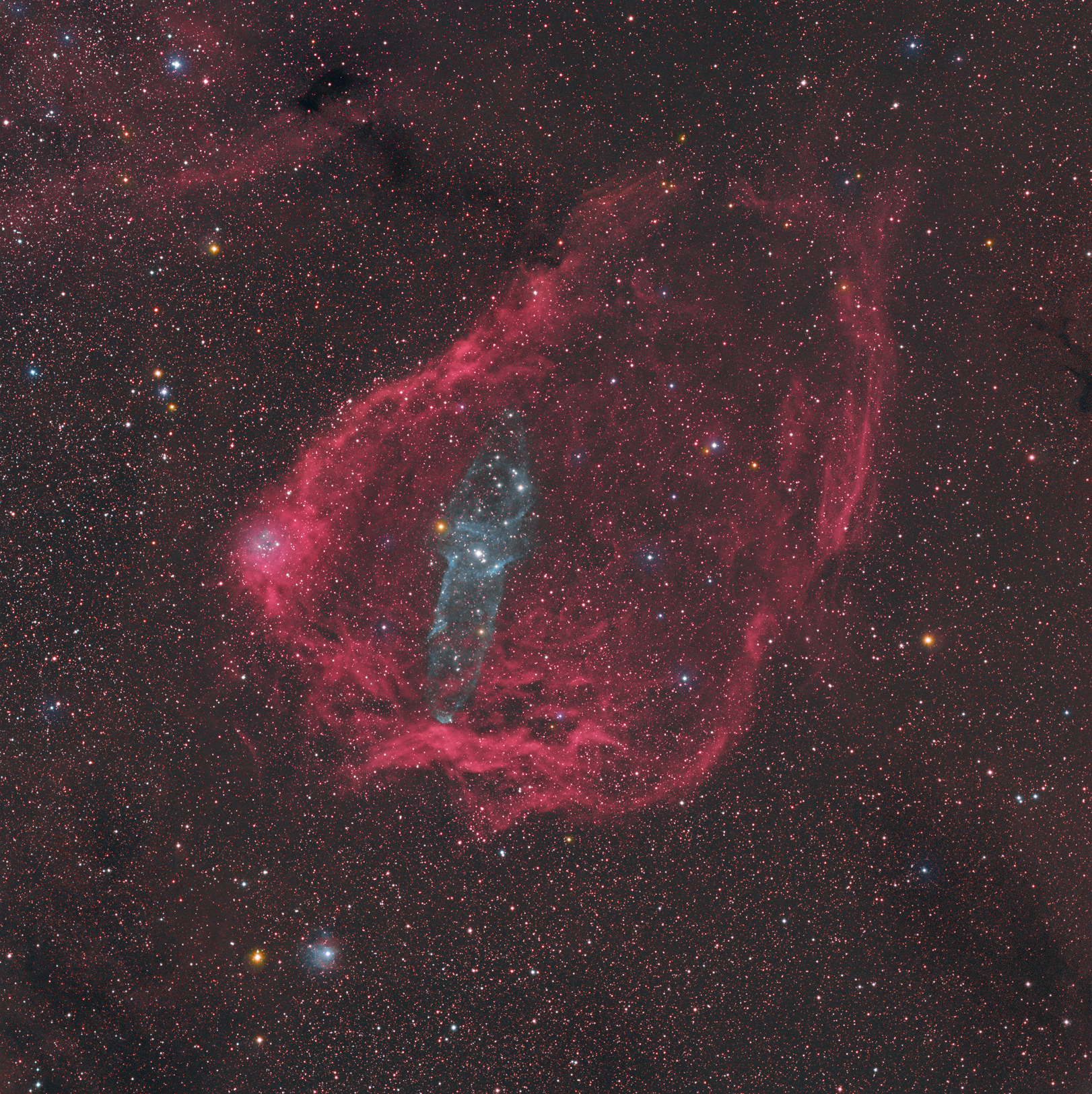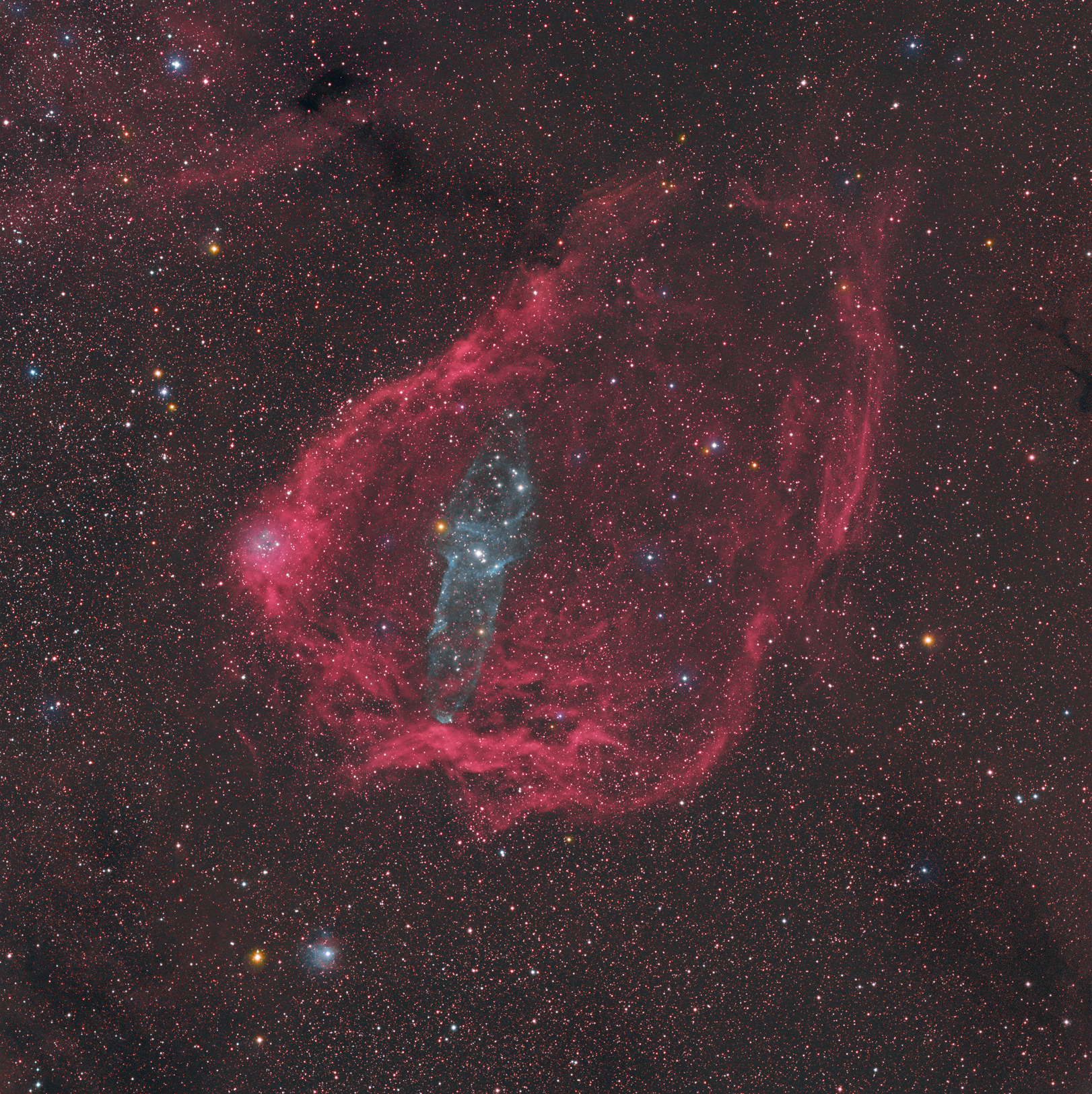
Very faint but also very large on planet Earth's sky, a giant Squid Nebula cataloged as Ou4, and Sh2-129 also known as the Flying Bat Nebula, are both caught in this scene toward the royal constellation Cepheus. Composed with a total of 20 hours of broadband and narrowband data, the telescopic field of view is almost 4 degrees or 8 Full Moons across. Discovered in 2011 by French astro-imager Nicolas Outters, the Squid Nebula's alluring bipolar shape is distinguished here by the telltale blue-green emission from doubly ionized oxygen atoms. Though apparently completely surrounded by the reddish hydrogen emission region Sh2-129, the true distance and nature of the Squid Nebula have been difficult to determine. Still, a recent investigation suggests Ou4 really does lie within Sh2-129 some 2,300 light-years away. Consistent with that scenario, Ou4 would represent a spectacular outflow driven by HR8119, a triple system of hot, massive stars seen near the center of the nebula. If so, the truly giant Squid Nebula would physically be nearly 50 light-years across.
Muy tenue pero también muy grande en el cielo de la Tierra, la Nebulosa Calamar Gigante catalogada como Ou4, y la Nebulosa del Murciélago Volador también conocida como Sh2-129, aparecen ambas en esta escena hacia la constelación real de Cefeo. Compuesta con un total de 20 horas de datos de banda ancha y banda estrecha, el campo visual telescópico abarca casi 4 grados, o 8 lunas llenas. Descubierta en 2011 por el astrofotógrafo francés Nicolas Outters, la forma bipolar atractiva de la Nebulosa Calamar se distingue aquí por la emisión azul-verdosa característica de los átomos de oxígeno doblemente ionizados. Aunque aparentemente completamente rodeada por la región de emisión de hidrógeno rojizo Sh2-129, la verdadera distancia y naturaleza de la Nebulosa Calamar han sido difíciles de determinar. Sin embargo, una investigación reciente sugiere que Ou4 realmente se encuentra dentro de Sh2-129 a unos 2.300 años luz de distancia. Consistente con ese escenario, Ou4 representaría un espectacular flujo impulsado por HR8119, un sistema triple de estrellas calientes y masivas visto cerca del centro de la nebulosa. Si es así, la verdaderamente gigantesca Nebulosa Calamar tendría un tamaño físico de casi 50 años luz.