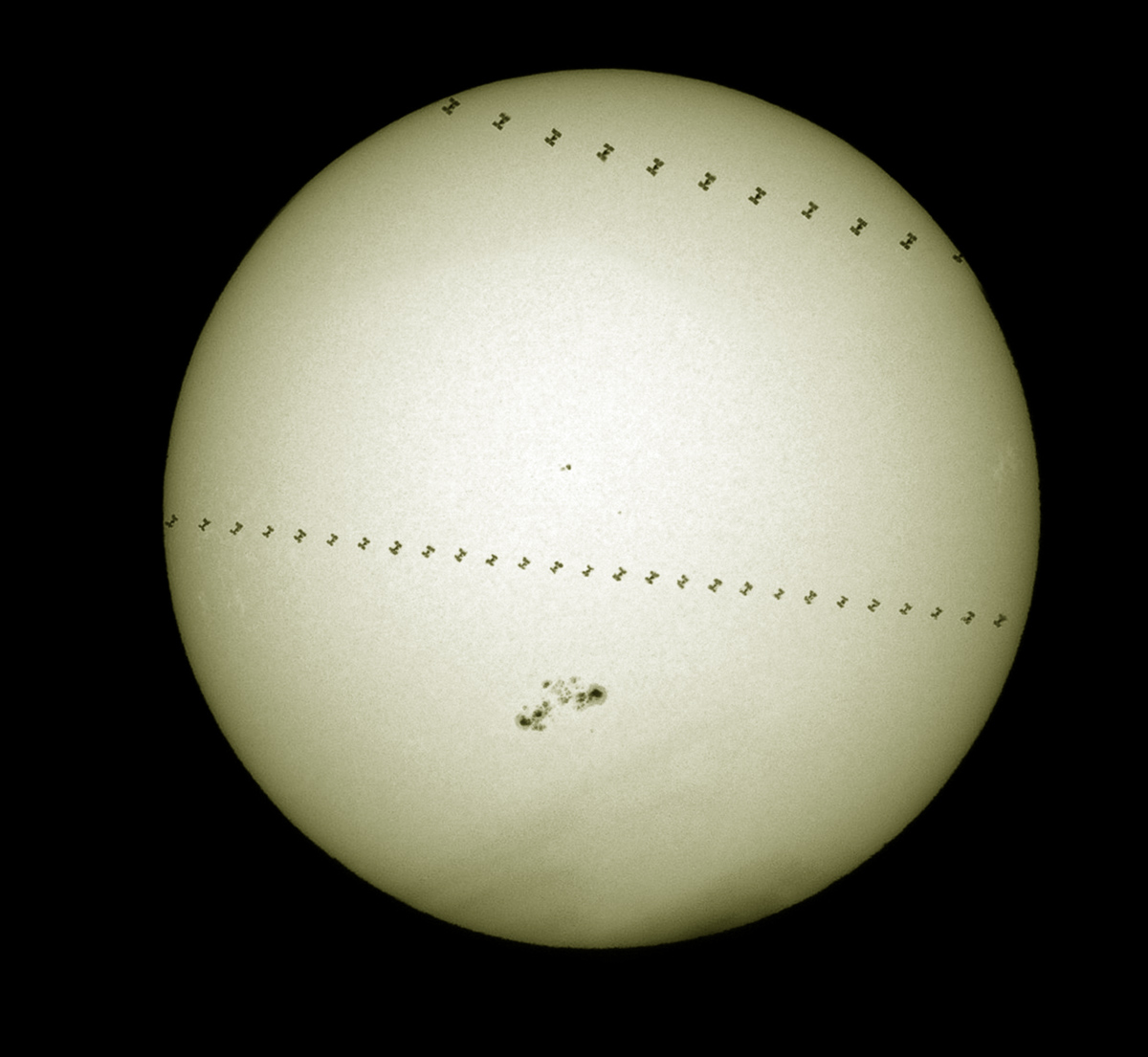
Not once, but twice the International Space Station transits the Sun on consecutive orbits of planet Earth in this video frame composite. The scene was captured on August 22 from a single well-chosen location in Schmalenbeck, Germany where the ISS created intersecting shadow paths only around 7 kilometers wide. Crossing the solar disk in a second or less, the transits themselves were separated in time by about 90 minutes, corresponding to the space station's orbital period. While the large, flare-producing sunspot group below center, AR 2403, remained a comfortable 150 million kilometers away, the distance between camera and orbiting station was 656 kilometers for its first (upper) transit and 915 kilometers for the second more central transit. In sharp silhouette the ISS is noticeably larger in angular size during the closer, first pass. Of course, tomorrow the Moon will transit the Sun. But even at well-chosen locations, its dark, central shadow just misses the Earth's surface creating a partial solar eclipse.
No una, sino dos veces la Estación Espacial Internacional tránsita por el Sol en órbitas consecutivas alrededor del planeta Tierra en este compuesto de imágenes de video. La escena fue capturada el 22 de agosto desde una ubicación bien elegida en Schmalenbeck, Alemania, donde la ISS creó trayectorias de sombras que se cruzaron con un ancho aproximado de solo 7 kilómetros. Cruzando el disco solar en un segundo o menos, los tránsitos mismos estuvieron separados en el tiempo por aproximadamente 90 minutos, correspondiendo al período orbital de la estación espacial. Mientras que el gran grupo de manchas solares, que produce llamaradas, ubicado en la parte inferior central, AR 2403, permaneció a una distancia cómoda de 150 millones de kilómetros, la distancia entre la cámara y la estación espacial orbitante fue de 656 kilómetros para su primer tránsito (superior) y 915 kilómetros para el segundo tránsito más central. En silueta nítida, la ISS se ve claramente más grande en tamaño angular durante el primer paso más cercano. Por supuesto, mañana la Luna tránsita por el Sol. Pero incluso en ubicaciones bien elegidas, su sombra oscura central solo se aleja de la superficie terrestre, creando un eclipse solar parcial.