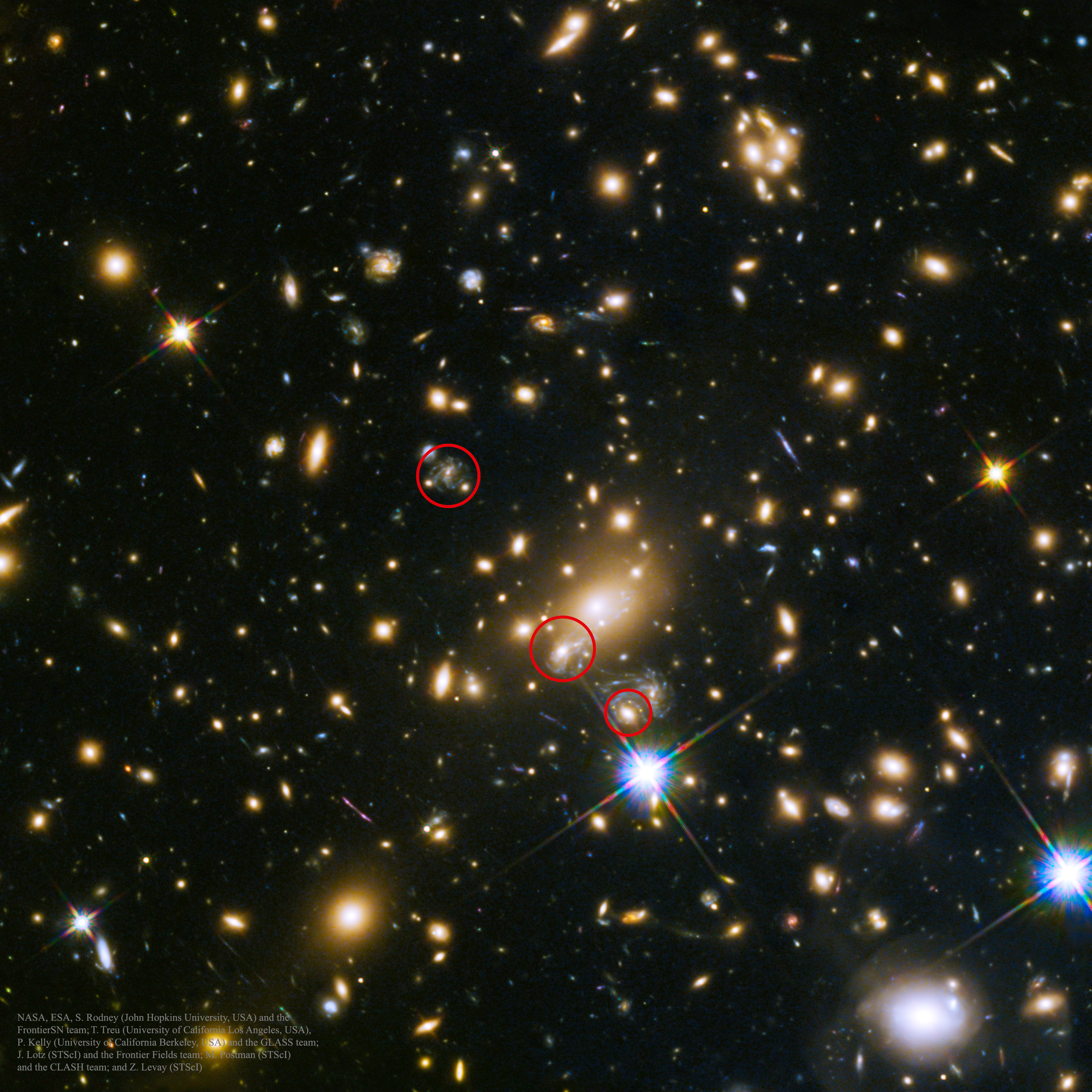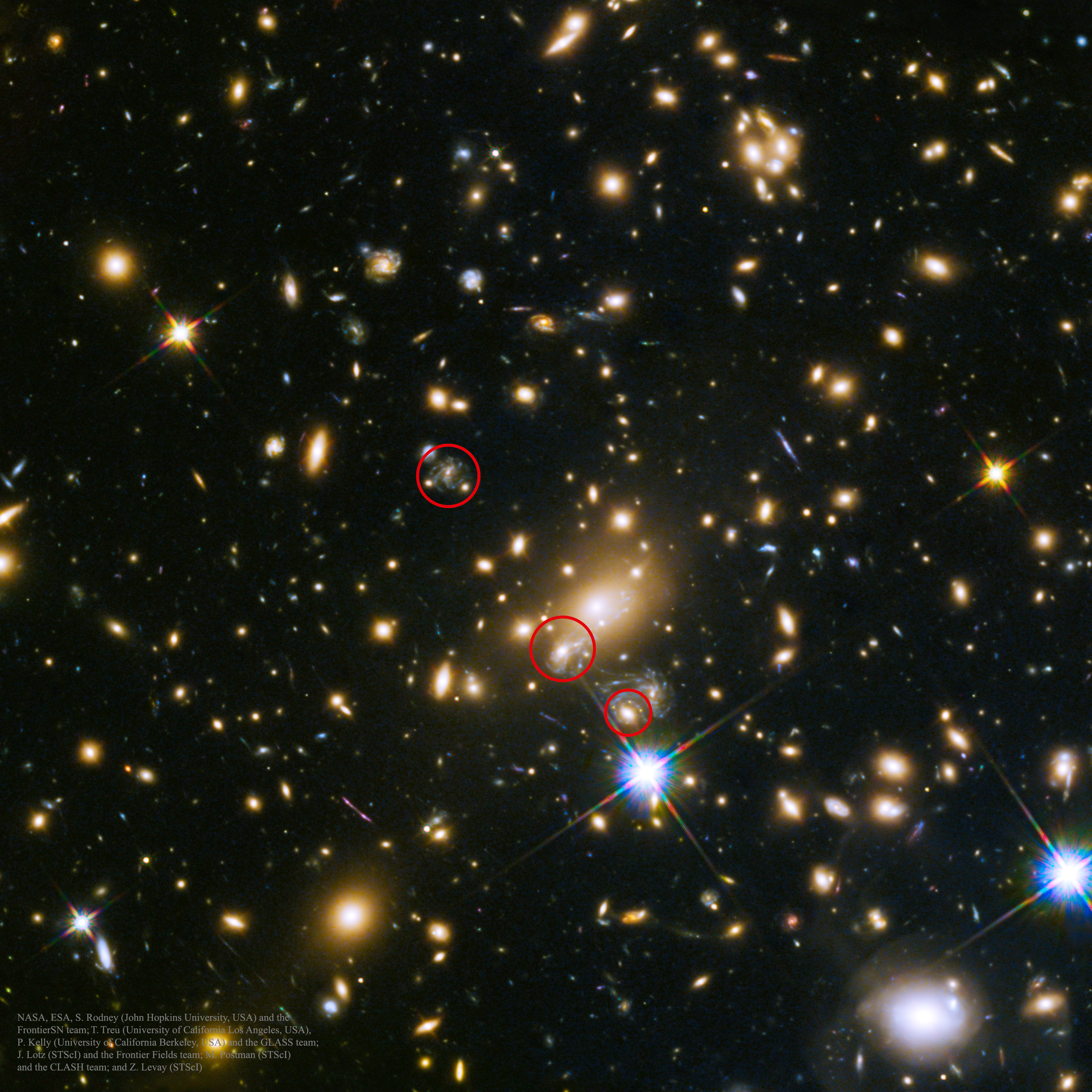
It's back. Never before has an observed supernova been predicted. The unique astronomical event occurred in the field of galaxy cluster MACS J1149.5+2223. Most bright spots in the featured image are galaxies in this cluster. The actual supernova, dubbed Supernova Refsdal, occurred just once far across the universe and well behind this massive galaxy cluster. Gravity caused the cluster to act as a massive gravitational lens, splitting the image of Supernova Refsdal into multiple bright images. One of these images arrived at Earth about ten years ago, likely in the upper red circle, and was missed. Four more bright images peaked in April in the lowest red circle, spread around a massive galaxy in the cluster as the first Einstein Cross supernova. But there was more. Analyses revealed that a sixth bright supernova image was likely still on its way to Earth and likely to arrive within the next year. Earlier this month -- right on schedule -- this sixth bright image was recovered, in the middle red circle, as predicted. Studying image sequences like this help humanity to understand how matter is distributed in galaxies and clusters, how fast the universe expands, and how massive stars explode. Follow APOD on: Facebook, Google Plus, or Twitter
Vuelve. Nunca antes se ha predicho una supernova observada. Este evento astronómico único ocurrió en el campo del cúmulo de galaxias MACS J1149.5+2223. La mayoría de los puntos brillantes en la imagen destacada son galaxias en este cúmulo. La propia supernova, denominada Supernova Refsdal, ocurrió una sola vez muy lejos en el universo y bien detrás de este denso cúmulo de galaxias. La gravedad hizo que el cúmulo actuara como un poderoso lente gravitacional, dividiendo la imagen de la Supernova Refsdal en múltiples imágenes brillantes. Una de estas imágenes llegó a la Tierra hace aproximadamente diez años, probablemente en el círculo rojo superior, y fue pasada por alto. Cuatro imágenes brillantes alcanzaron su máximo en abril en el círculo rojo inferior, distribuidas alrededor de una galaxia masiva en el cúmulo, formando la primera cruz de Einstein de una supernova. Pero había más. Los análisis revelaron que una sexta imagen brillante de la supernova probablemente aún estaba en camino hacia la Tierra y probablemente llegaría dentro del próximo año. A principios de este mes —justo a tiempo— se recuperó esta sexta imagen brillante, en el círculo rojo central, tal como se había predicho. Estudiar secuencias de imágenes como esta ayuda a la humanidad a comprender cómo se distribuye la materia en galaxias y cúmulos, cuán rápido se expande el universo y cómo explotan las estrellas masivas.