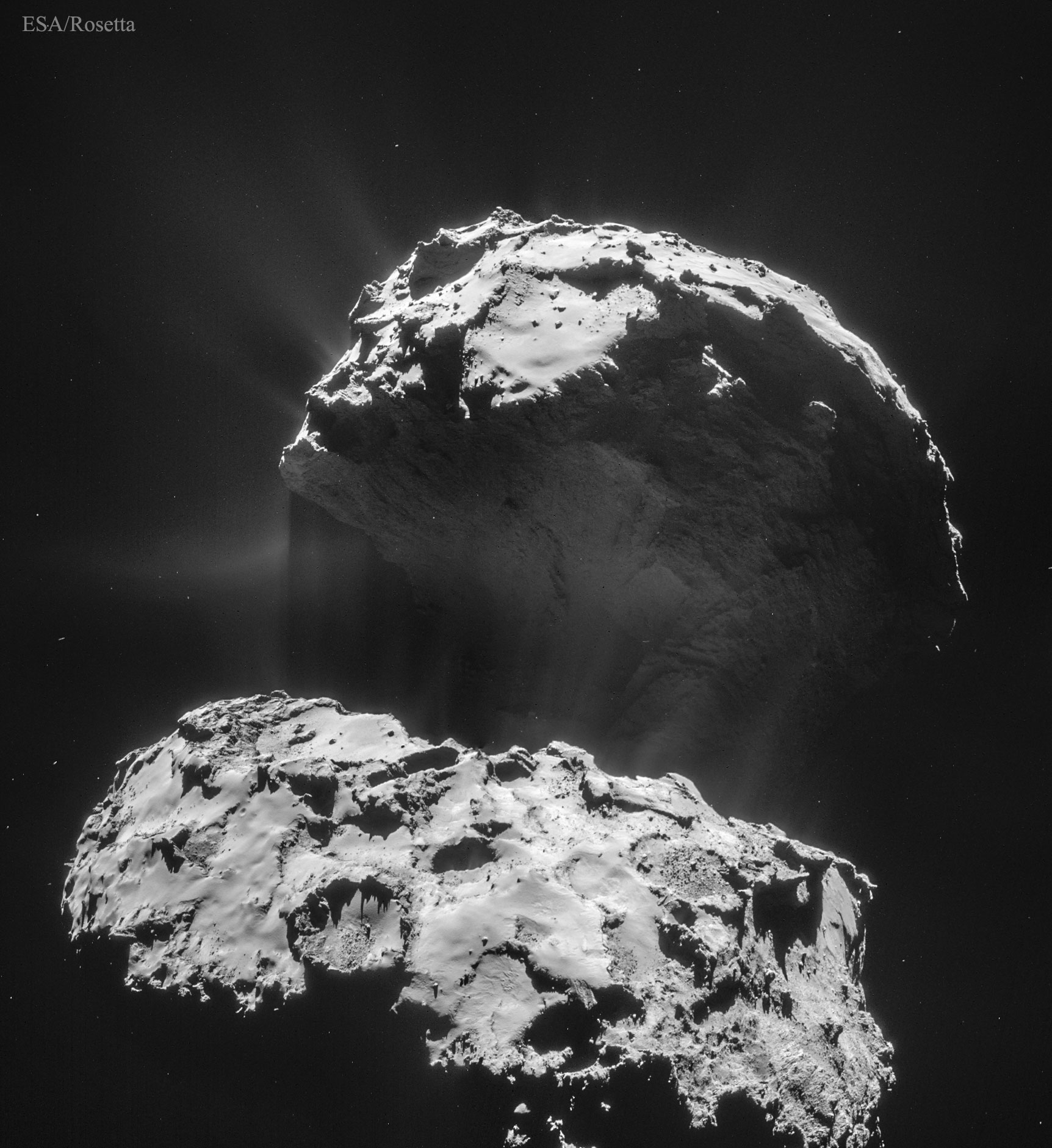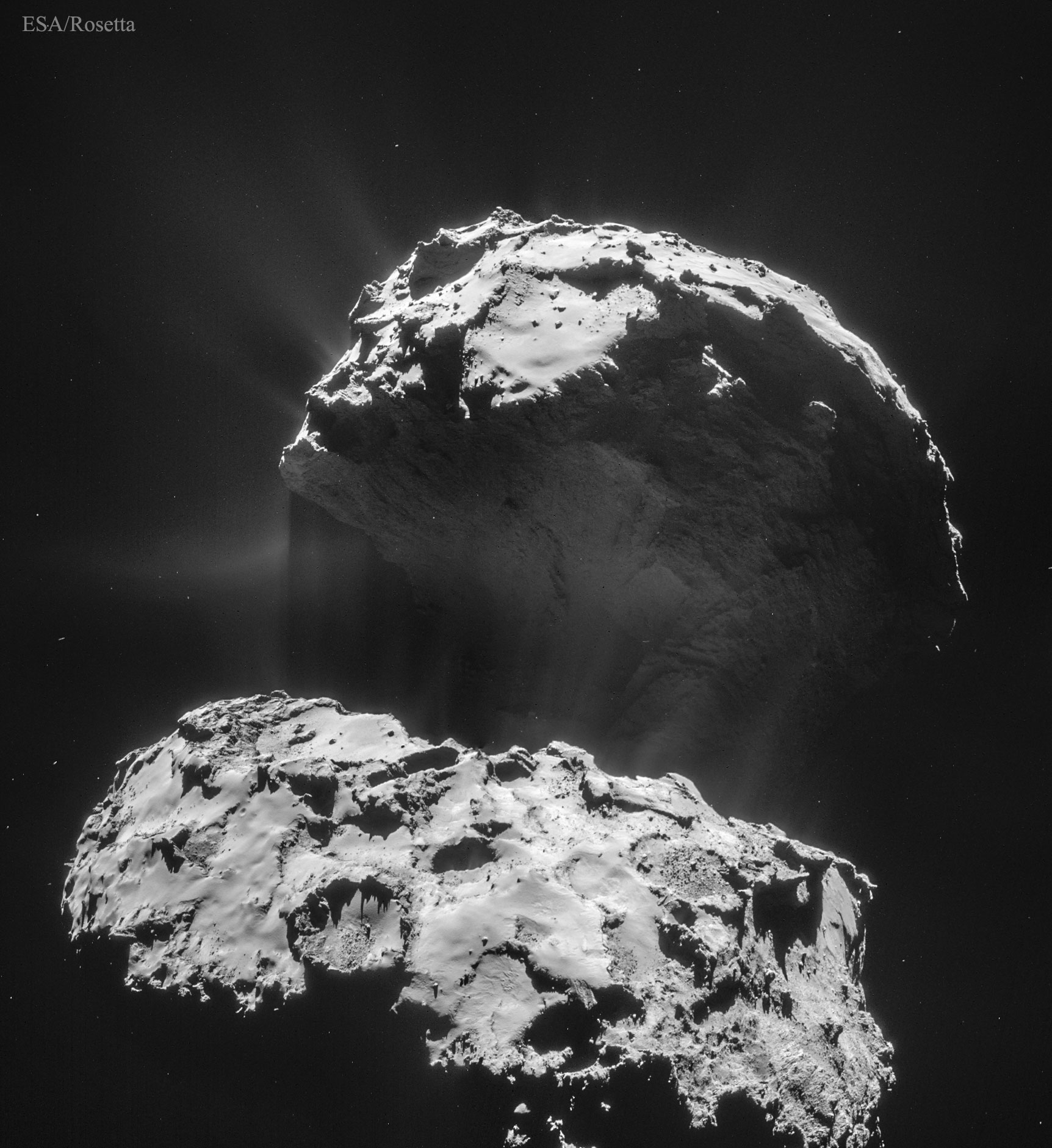
Spacecraft Rosetta continues to circle and map Comet Churyumov-Gerasimenko. Crossing the inner Solar System for ten years to reach the vicinity of the comet in 2014, the robotic spacecraft continues to image the unusual double-lobed comet nucleus. The featured image, taken one year ago, shows dust and gas escaping from the comet's nucleus. Although appearing bright here, the comet's surface reflects only about four percent of impinging visible light, making it as dark as coal. Comet 67P/Churyumov�Gerasimenko spans about four kilometers in length and has a surface gravity so low that an astronaut could jump off of it. With Rosetta in tow, Comet 67P passed its closest to the Sun last year and is now headed back to the furthest point -- just past the orbit of Jupiter. Astrophysicists: Browse 1,200+ codes in the Astrophysics Source Code Library
La nave espacial Rosetta continúa orbitando y mapeando el cometa Churyumov-Gerasimenko. Tras cruzar el Sistema Solar interior durante diez años para llegar a las cercanías del cometa en 2014, la nave espacial robótica continúa capturando imágenes del núcleo inusual del cometa, que tiene forma de doble lóbulo. La imagen destacada, tomada hace un año, muestra polvo y gas escapando del núcleo del cometa. Aunque aquí aparece brillante, la superficie del cometa refleja solo aproximadamente el cuatro por ciento de la luz visible incidente, lo que la hace tan oscura como el carbón. El cometa 67P/Churyumov-Gerasimenko tiene aproximadamente cuatro kilómetros de longitud y posee una gravedad superficial tan baja que un astronauta podría saltar de él. Con Rosetta a su lado, el cometa 67P alcanzó su punto más cercano al Sol el año pasado y ahora se dirige hacia el punto más alejado — justo más allá de la órbita de Júpiter.