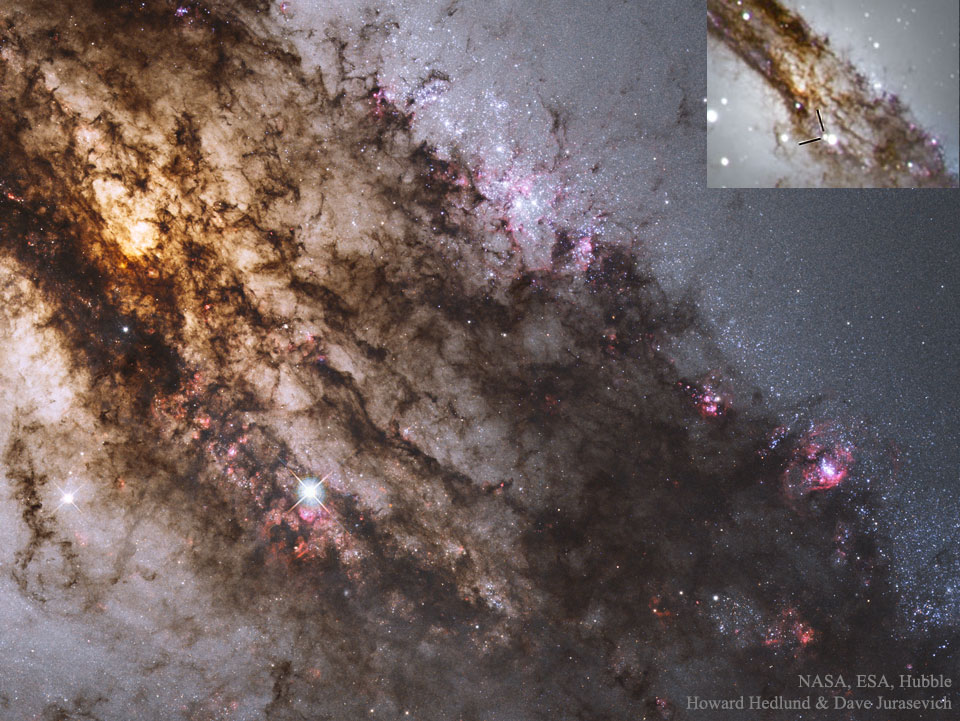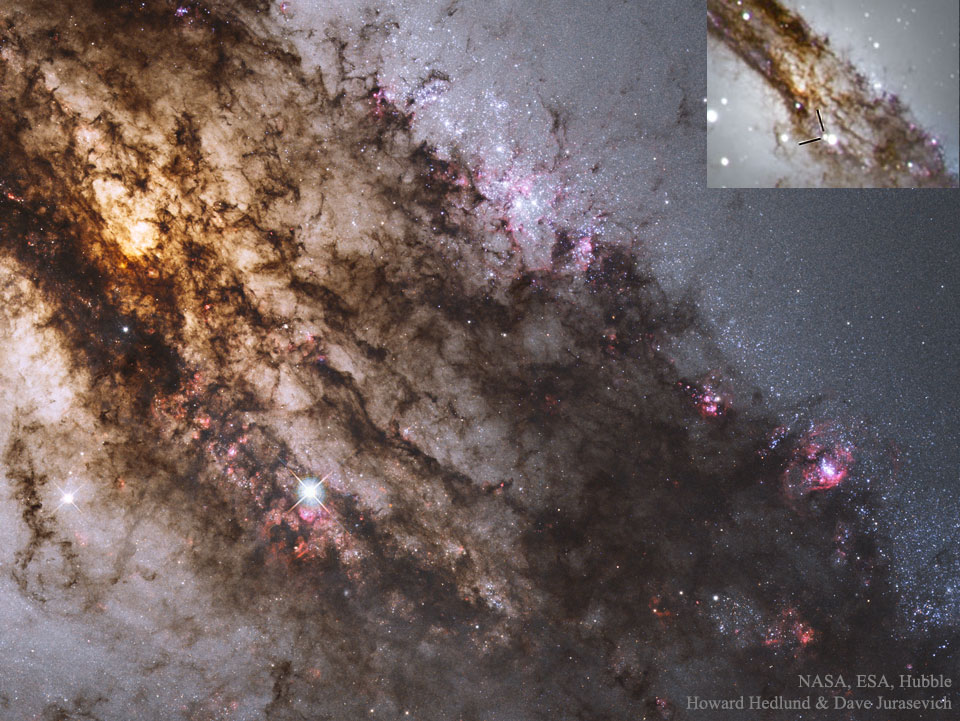
Telescopes around the world are tracking a bright supernova that occurred in a nearby dusty galaxy. The powerful stellar explosion was first noted earlier this month. The nearby galaxy is the photogenic Centaurus A, visible with binoculars and known for impressive filaments of light-absorbing dust that cross its center. Cen A is featured here in a high-resolution archival Hubble Space Telescope image, with an inset image featuring the supernova taken from the ground only two days after discovery. Designated SN2016adj, the supernova is highlighted with crosshairs in the inset, appearing just to the left of a bright foreground star in our Milky Way Galaxy. This supernova is currently thought to be of Type IIb, a stellar-core-collapse supernova, and is of high interest because it occurred so nearby and because it is being seen through a known dust filament. Current and future observations of this supernova may give us new clues about the fates of massive stars and how some elements found on our Earth were formed.
Telescopios de todo el mundo están rastreando una brillante supernova que ocurrió en una galaxia cercana y polvorienta. La poderosa explosión estelar fue notada por primera vez a principios de este mes. La galaxia cercana es Centaurus A, visible con binoculares y conocida por sus impresionantes filamentos de polvo que absorbe la luz y cruzan su centro. Cen A se muestra aquí en una imagen de alta resolución del Telescopio Espacial Hubble, con una imagen inserta que muestra la supernova tomada desde el suelo solo dos días después de su descubrimiento. Designada SN2016adj, la supernova se destaca con una cruz en la imagen inserta, apareciendo justo a la izquierda de una brillante estrella del primer plano en nuestra Galaxia Vía Láctea. Actualmente se cree que esta supernova es de tipo IIb, una supernova por colapso del núcleo estelar, y es de gran interés porque ocurrió tan cerca y porque se está observando a través de un filamento de polvo conocido. Las observaciones actuales y futuras de esta supernova pueden darnos nuevas pistas sobre los destinos de las estrellas masivas y sobre cómo algunos elementos encontrados en la Tierra se formaron.