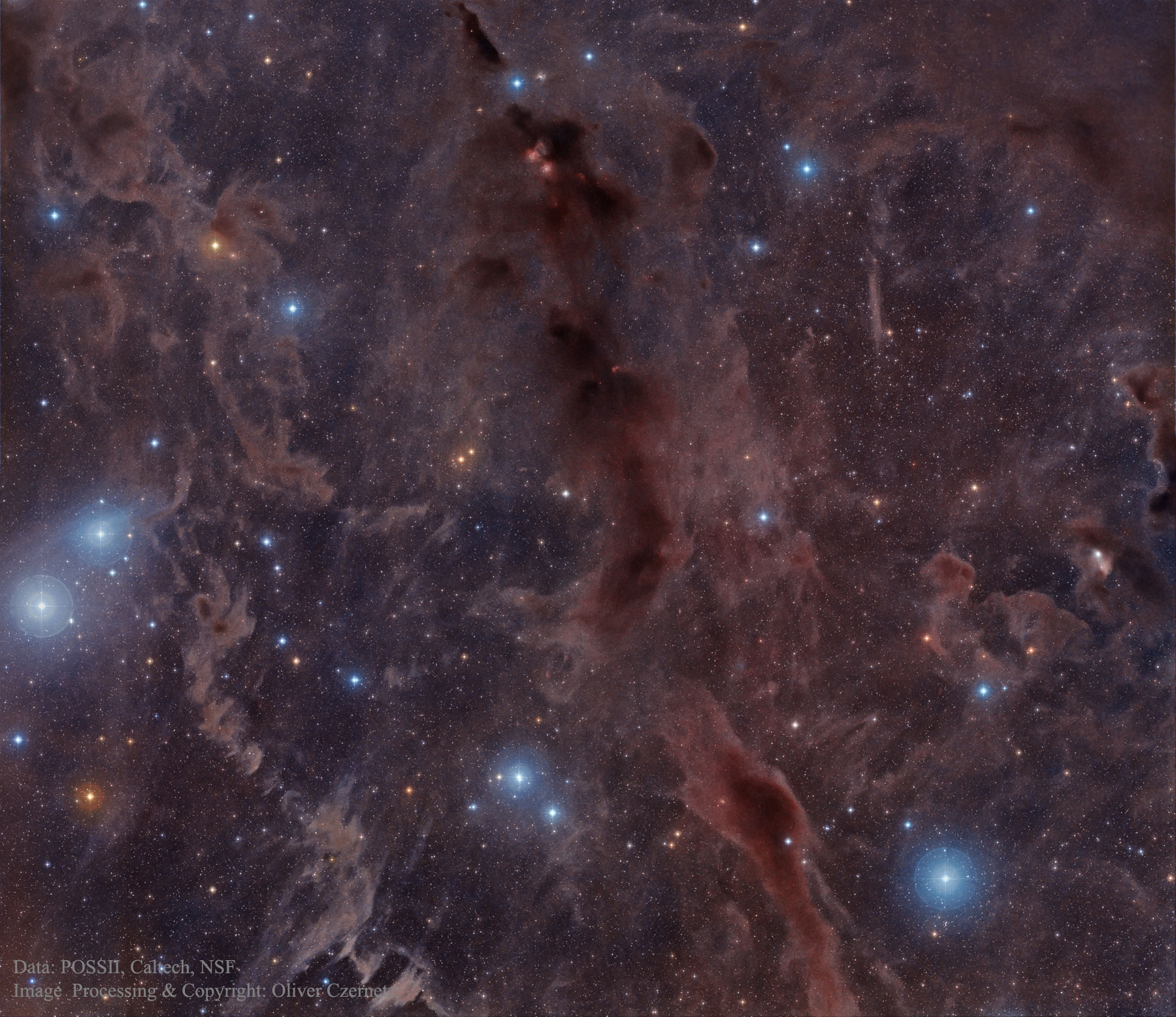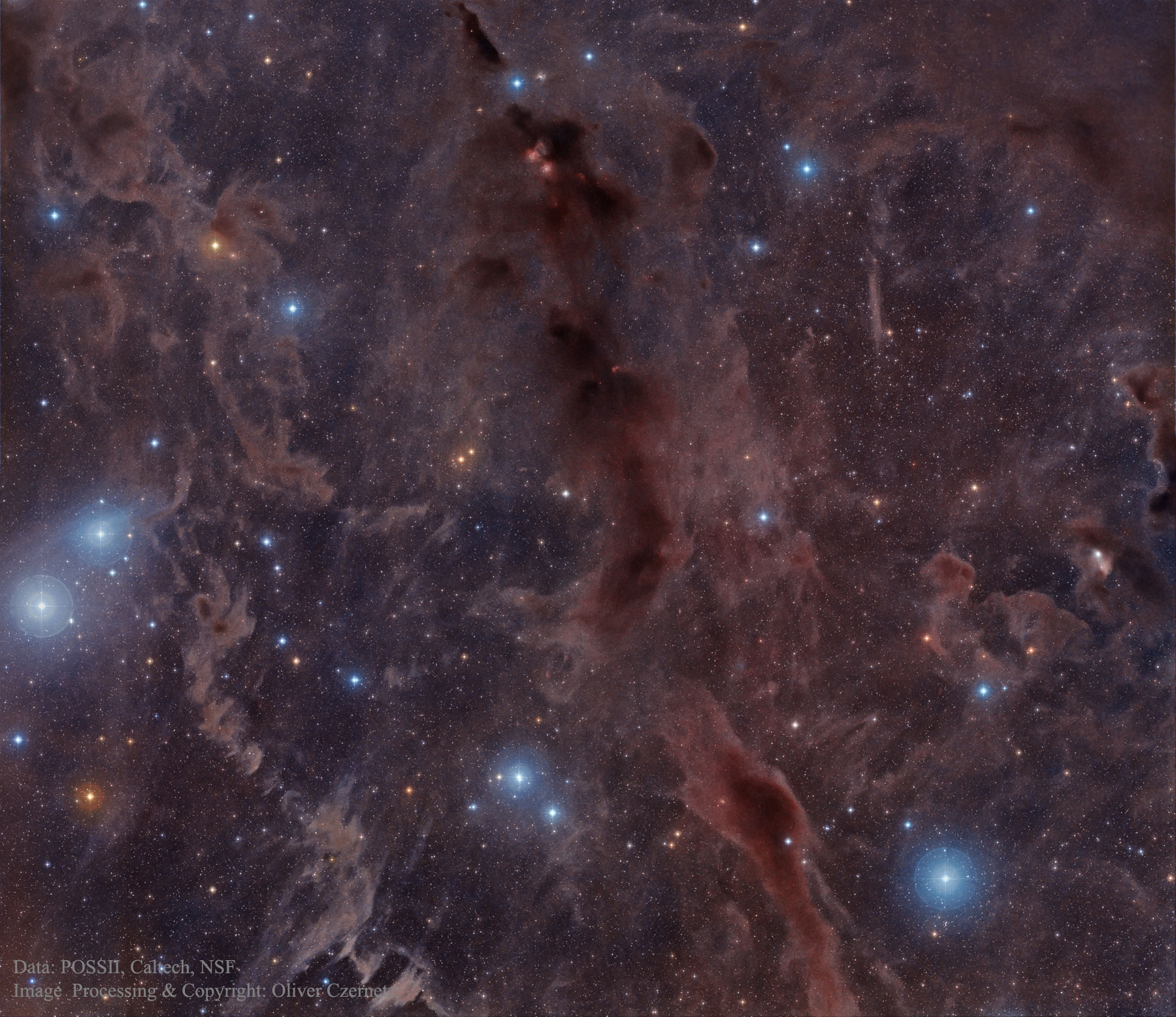
Sometimes even the dark dust of interstellar space has a serene beauty. One such place occurs toward the constellation of Taurus. The filaments featured here can be found on the sky between the Pleiades star cluster and the California Nebula. This dust is not known not for its bright glow but for its absorption and opaqueness. Several bright stars are visible with their blue light seen reflecting off the brown dust. Other stars appear unusually red as their light barely peaks through a column of dark dust, with red the color that remains after the blue is scattered away. Yet other stars are behind dust pillars so thick they are not visible here. Although appearing serene, the scene is actually an ongoing loop of tumult and rebirth. This is because massive enough knots of gas and dust will gravitationally collapse to form new stars -- stars that both create new dust in their atmospheres and destroy old dust with their energetic light and winds.
A veces, incluso el polvo oscuro del espacio interestelar tiene una belleza serena. Un lugar así se encuentra hacia la constelación de Tauro. Los filamentos mostrados aquí se pueden observar en el cielo entre el cúmulo estelar de las Pléyades y la Nebulosa de California. Este polvo no se conoce por su brillo intenso, sino por su absorción y opacidad. Varios estrellas brillantes son visibles con su luz azul reflejada en el polvo marrón. Otras estrellas aparecen de un color inusualmente rojo, ya que su luz apenas atraviesa una columna de polvo oscuro, con el rojo siendo el color que queda después de que el azul se dispersa. Otras estrellas están detrás de columnas de polvo tan densas que no son visibles aquí. Aunque parece serena, la escena en realidad es un ciclo continuo de turbulencia y renacimiento. Esto se debe a que los nudos suficientemente grandes de gas y polvo colapsarán gravitacionalmente para formar nuevas estrellas — estrellas que crean nuevo polvo en sus atmósferas y destruyen el polvo antiguo con su luz energética y vientos.