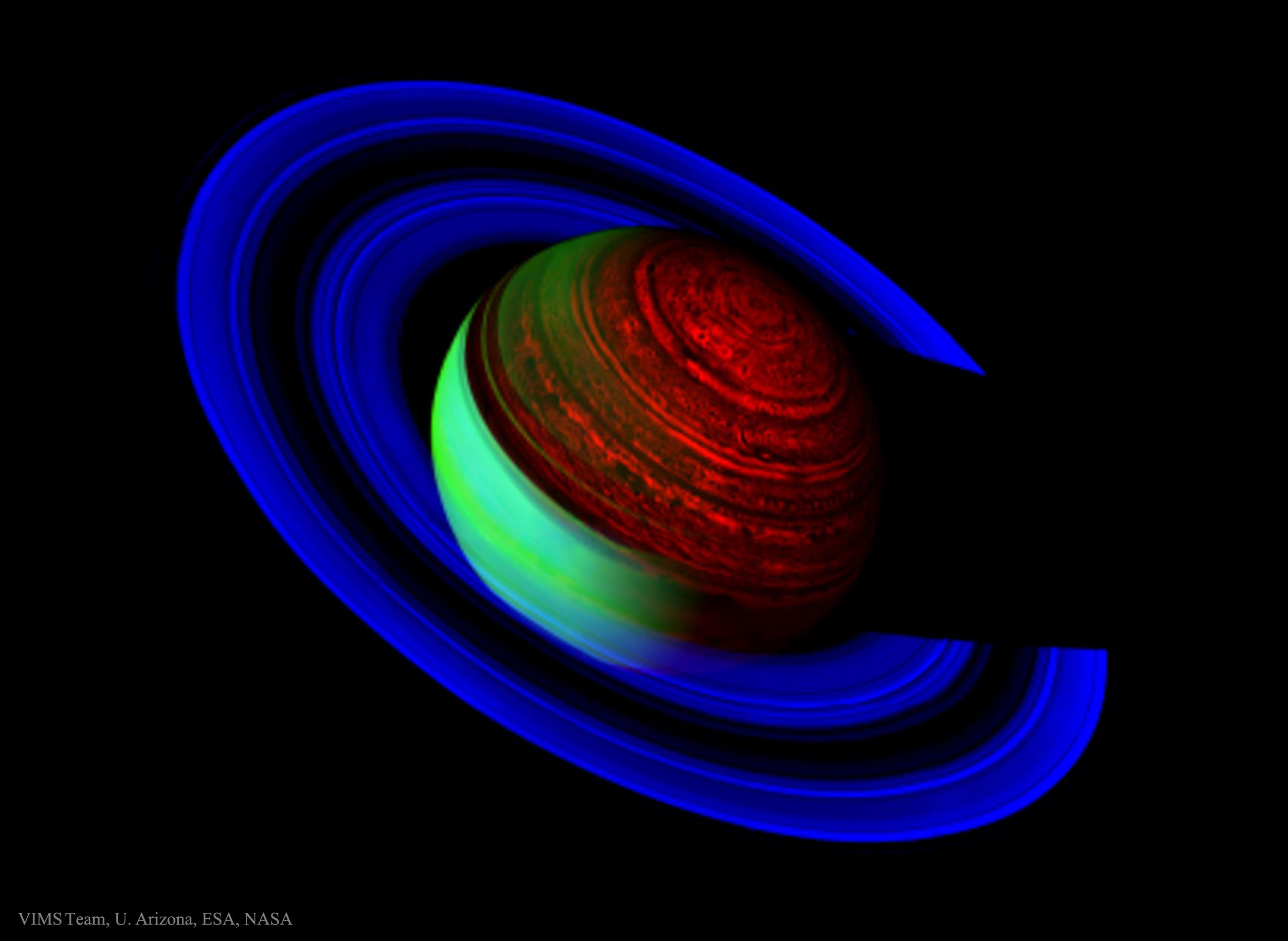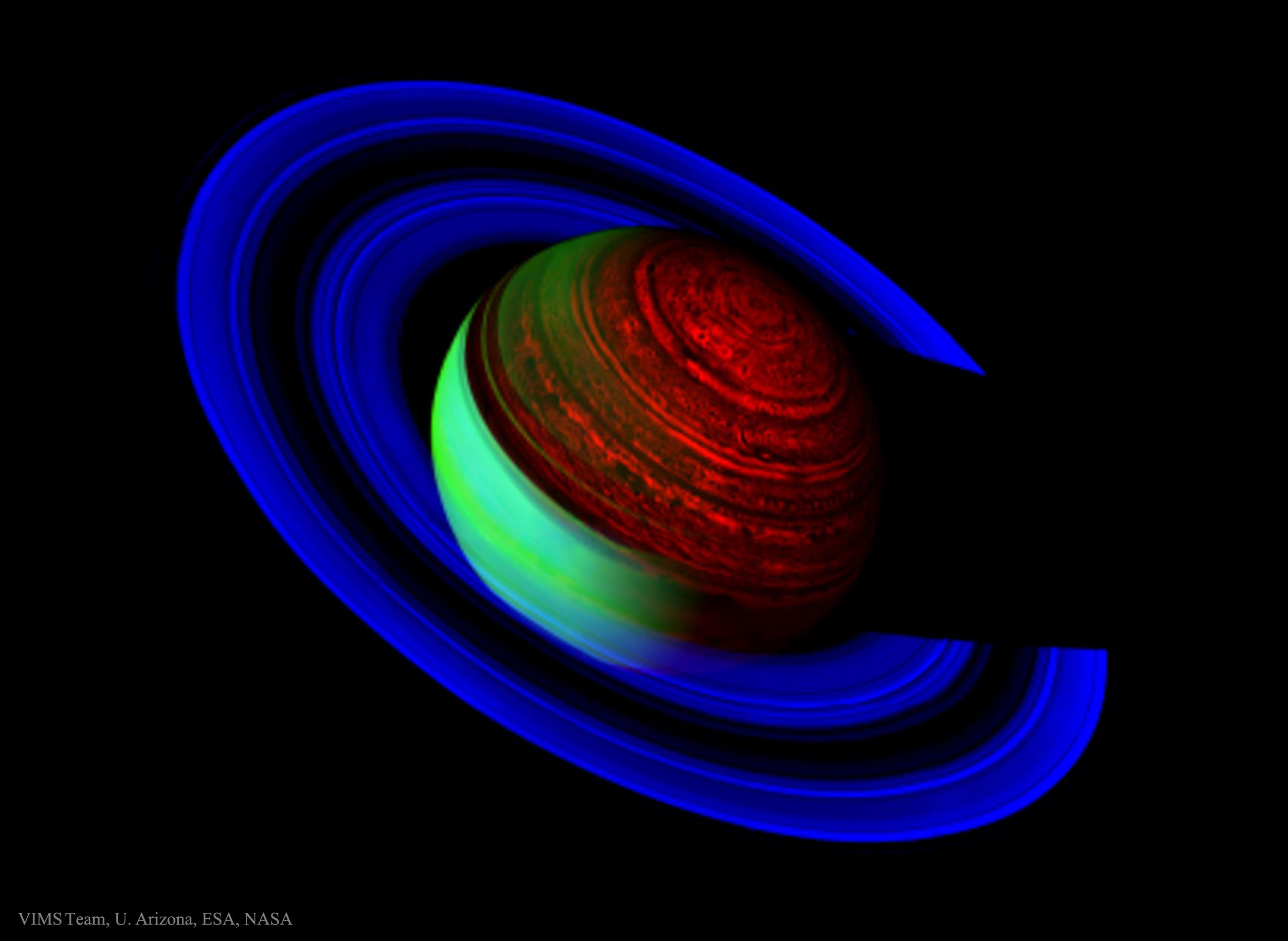
If seen in the right light, Saturn glows like a neon sign. Although Saturn has comparatively little of the element neon, a composite image false-colored in three bands of infrared light highlights features of the giant ringed planet like a glowing sign. At the most blue band of the infrared light featured, false-colored blue in the above image, Saturn itself appears dark but Saturn's thin rings brightly reflect light from our Sun. Conversely, Saturn's B ring is so thick that little reflected light makes it through, creating a dark band between Saturn's A and C rings. At the most red band of the infrared, false-colored red above, Saturn emits a surprisingly detailed thermal glow, indicating planet-wide bands, huge hurricane-like storms, and a strange hexagon-shaped cloud system around the North Pole. In the middle infrared band, false-colored green, the sunlit side of Saturn's atmosphere reflects brightly. The above image was obtained in 2007 by the robotic Cassini spacecraft orbiting about 1.6 million kilometers out from Saturn. Follow APOD on: Facebook, Google Plus, Twitter, or Instagram
Si se observa con la luz adecuada, Saturno brilla como una señal de neón. Aunque Saturno tiene relativamente poca cantidad del elemento neón, una imagen compuesta falsecolorada en tres bandas de luz infrarroja resalta características del planeta gigante con anillos como una señal brillante. En la banda más azul de la luz infrarroja mostrada, falsecolorada en azul en la imagen anterior, Saturno mismo aparece oscuro, pero sus delgados anillos reflejan brillantemente la luz de nuestro Sol. Por el contrario, el anillo B de Saturno es tan grueso que poca luz reflejada logra atravesarlo, creando una banda oscura entre los anillos A y C de Saturno. En la banda más roja de la luz infrarroja, falsecolorada en rojo arriba, Saturno emite un brillo térmico sorprendentemente detallado, indicando bandas a nivel planetario, grandes tormentas similares a huracanes y un sistema nuboso de forma hexagonal alrededor del polo norte. En la banda intermedia de infrarrojo, falsecolorada en verde, el lado iluminado de la atmósfera de Saturno refleja brillantemente la luz. La imagen anterior fue obtenida en 2007 por la nave espacial robótica Cassini, que orbita a unos 1.6 millones de kilómetros de Saturno.