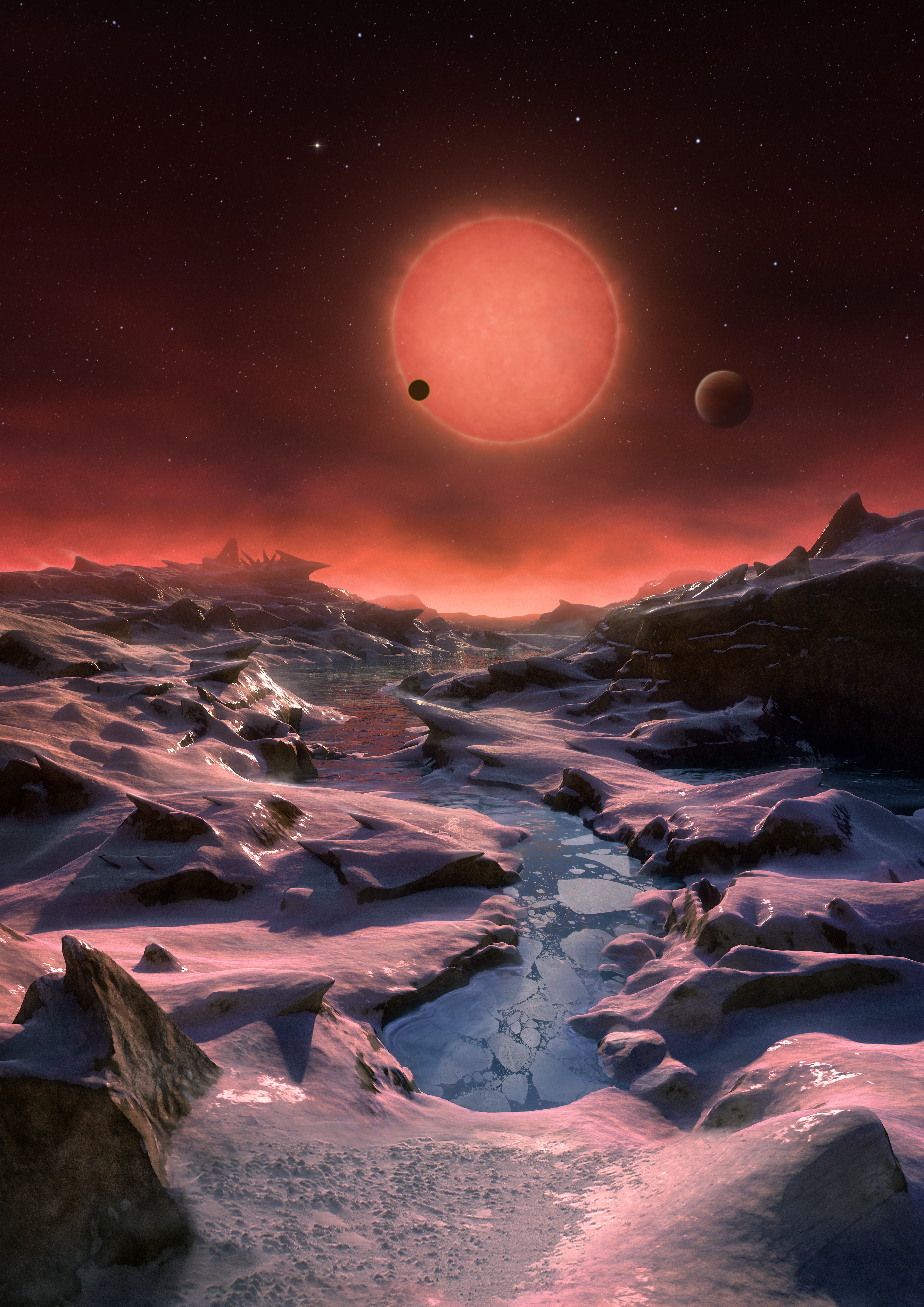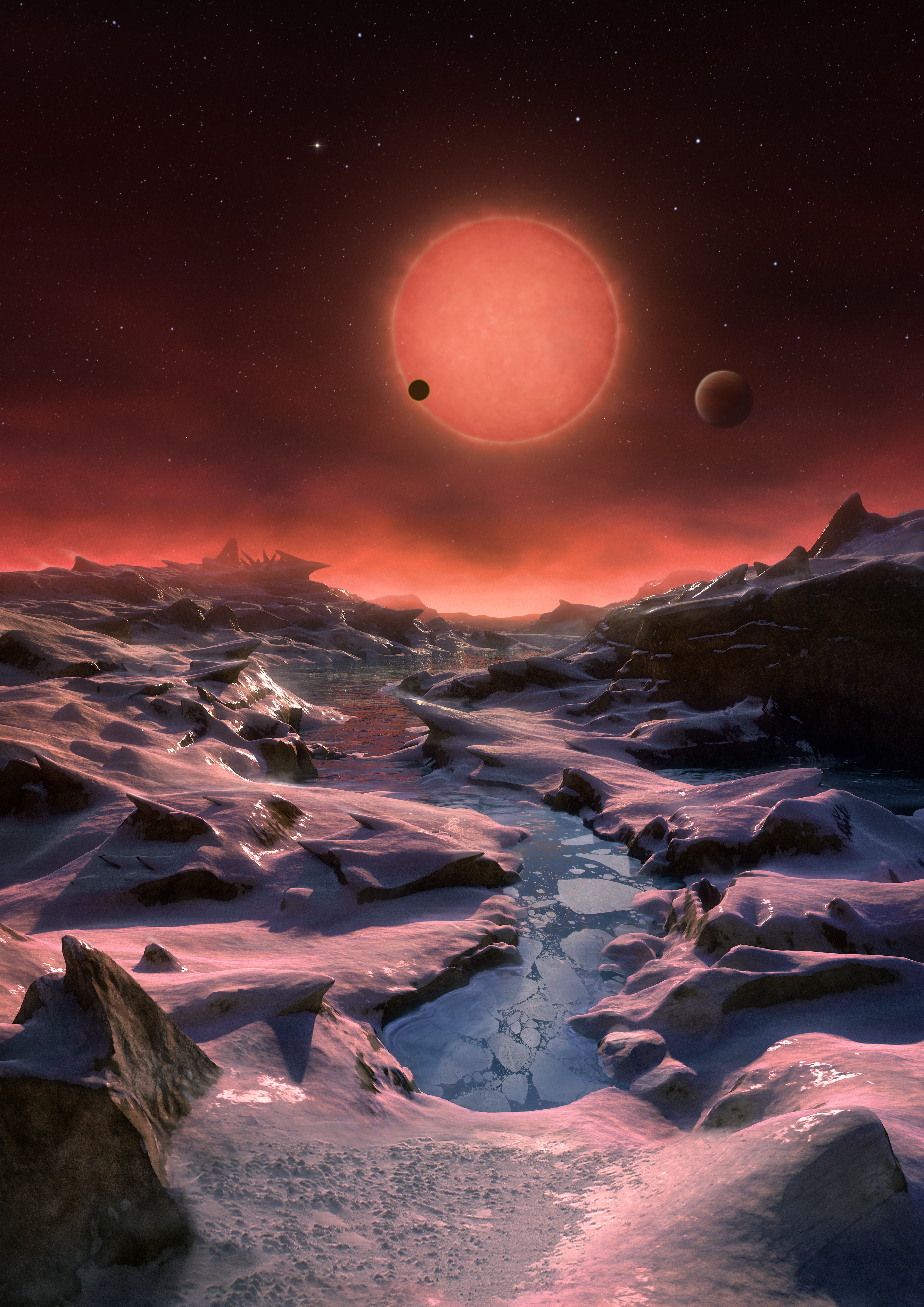
Three new found worlds orbit the ultracool dwarf star TRAPPIST-1, a mere 40 light-years away. Their transits were first detected by the Belgian robotic TRAnsiting Planets and Planetesimals Small Telescope, TRAPPIST, at ESO's La Silla Observatory in Chile. The newly discovered exoplanets are all similar in size to Earth. Because they orbit very close to their faint, tiny star they could also have regions where surface temperatures allow for the presence of liquid water, a key ingredient for life. Their tantalizing proximity to Earth makes them prime candidates for future telescopic explorations of the atmospheres of these potentially habitable planets. All three worlds appear in this artist's vision, an imagined scene near the horizon of the system's outermost planet. Of course, the inner planet is transiting the dim, red, nearly Jupiter-sized parent star.
Tres nuevos mundos orbitan la estrella enana ultracool TRAPPIST-1, situada a tan solo 40 años luz de distancia. Sus tránsitos fueron detectados por primera vez por el telescopio robótico belga TRAnsiting Planets and Planetesimals Small Telescope, TRAPPIST, ubicado en el Observatorio La Silla del ESO en Chile. Los nuevos exoplanetas descubiertos son todos similares en tamaño a la Tierra. Debido a que orbitan muy cerca de su estrella tenue y diminuta, podrían tener regiones donde las temperaturas superficiales permiten la presencia de agua líquida, un ingrediente clave para la vida. Su atractiva proximidad a la Tierra los convierte en candidatos ideales para futuras exploraciones telescópicas de las atmósferas de estos planetas potencialmente habitables. Los tres mundos aparecen en esta visión artística, una escena imaginada cerca del horizonte del planeta más externo del sistema. Por supuesto, el planeta interno está transitando la tenue, roja, casi jupiteriana estrella madre.