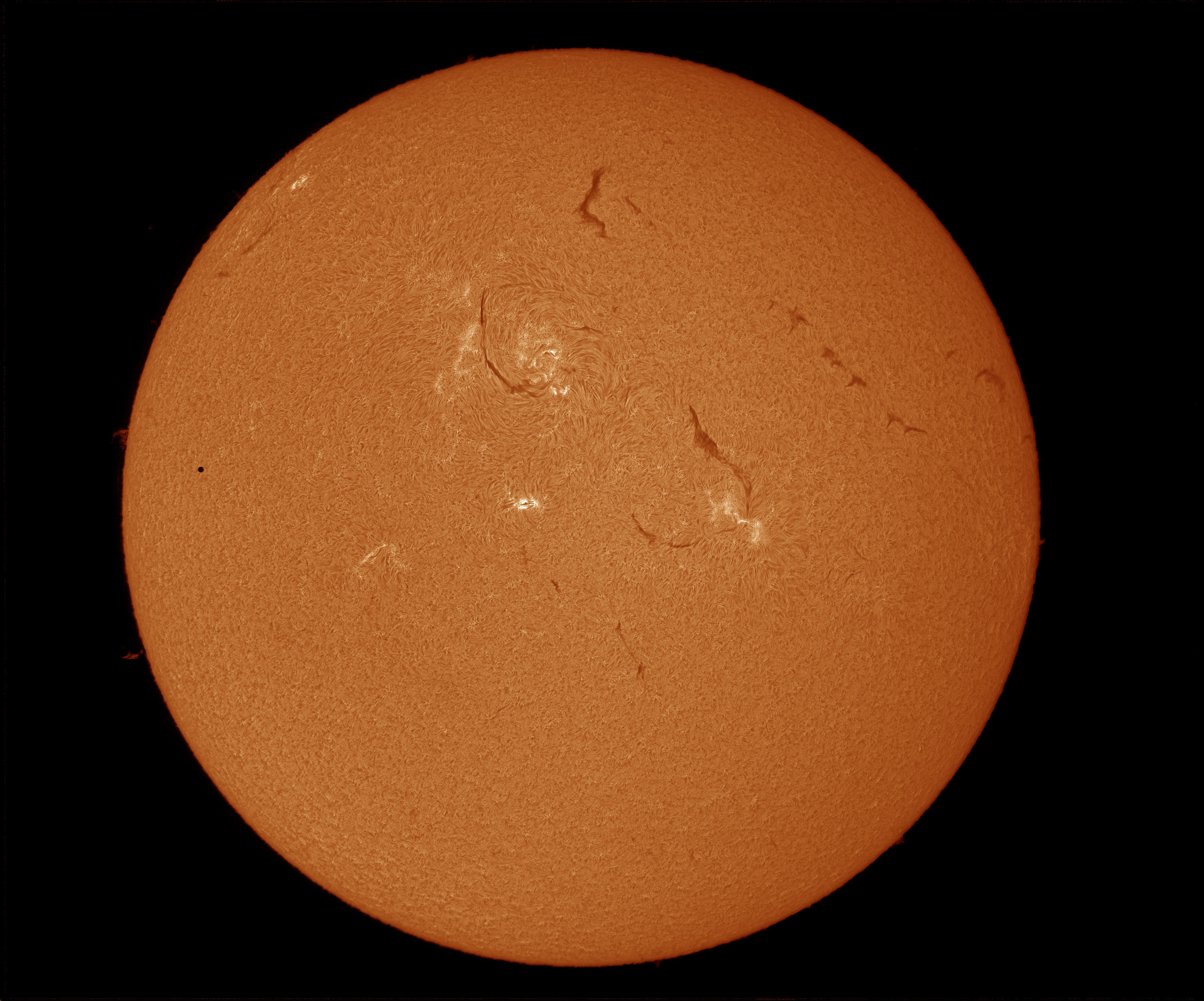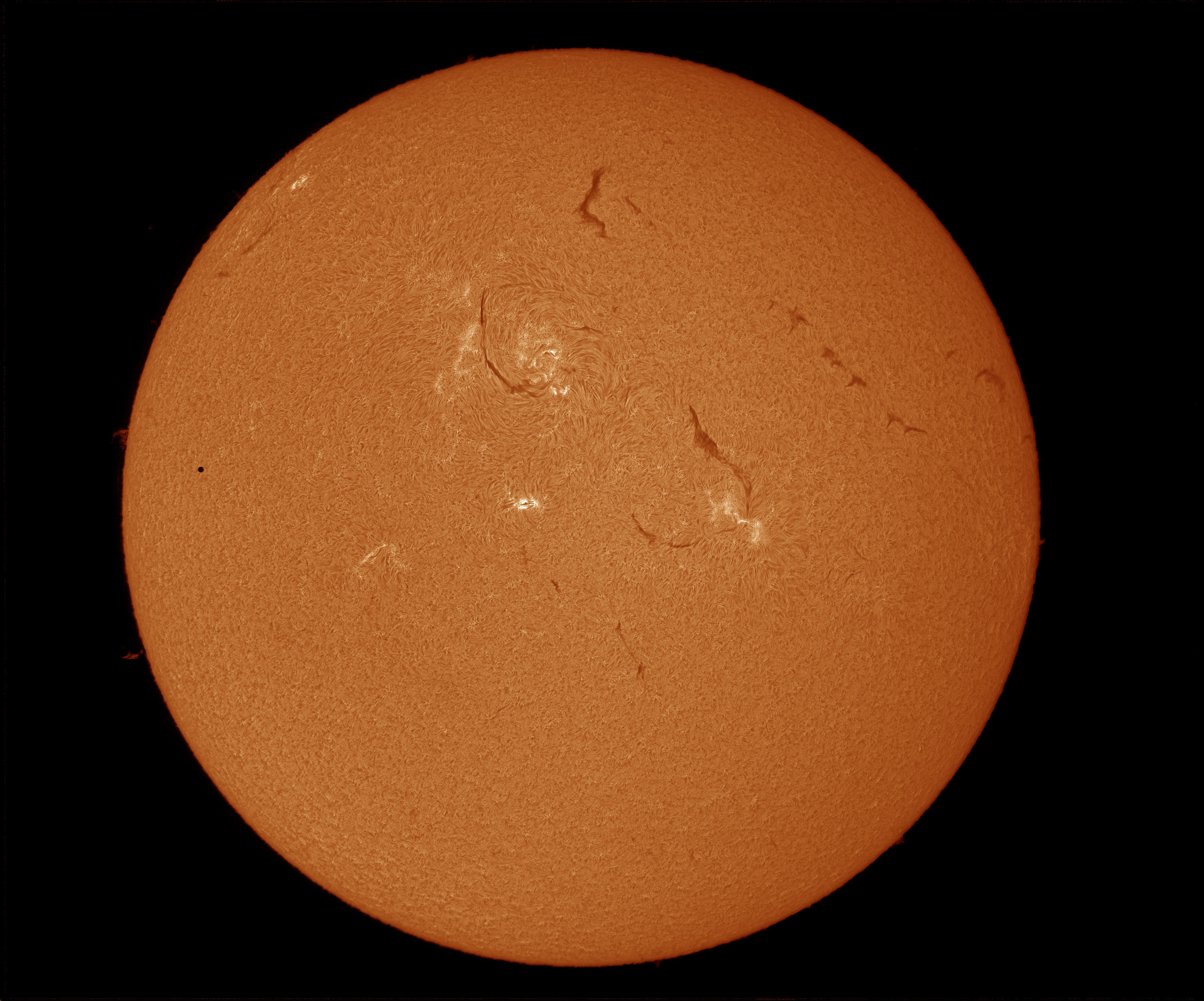
On May 9, the diminutive disk of Mercury spent about seven and a half hours crossing in front of the Sun as viewed from the general vicinity of Earth. It was the third of 14 transits of the Solar System's innermost planet in the 21st century. Captured from Fulham, London, England, planet Earth the tiny silhouette shares the enormous solar disk with prominences, filaments, and active regions in this sharp image. But Mercury's round disk (left of center) appears to be the only dark spot, despite the planet-sized sunspots scattered across the Sun. Made with an H-alpha filter that narrowly transmits the red light from hydrogen atoms, the image emphasizes the chromosphere, stretching above the photosphere or normally visible solar surface. In H-alpha pictures of the chromosphere, normally dark sunspot regions are dominated by bright splotches called plages.
El 9 de mayo, el pequeño disco de Mercurio pasó durante aproximadamente siete y medio horas frente al Sol, tal como se observa desde la región general de la Tierra. Fue el tercero de los 14 tránsitos del planeta más interno del Sistema Solar en el siglo XXI. Capturado desde Fulham, Londres, Inglaterra, la diminuta silueta de Mercurio comparte el enorme disco solar con prominencias, filamentos y regiones activas en esta imagen nítida. Sin embargo, el disco redondo de Mercurio (a la izquierda del centro) parece ser el único punto oscuro, a pesar de que hay manchas solares del tamaño de un planeta distribuidas por el Sol. La imagen fue capturada con un filtro H-alfa que transmite selectivamente la luz roja de los átomos de hidrógeno, resaltando la cromosfera, que se extiende por encima de la fotosfera o superficie solar normalmente visible. En imágenes H-alfa de la cromosfera, las regiones normalmente oscuras de las manchas solares están dominadas por manchas brillantes llamadas plages.