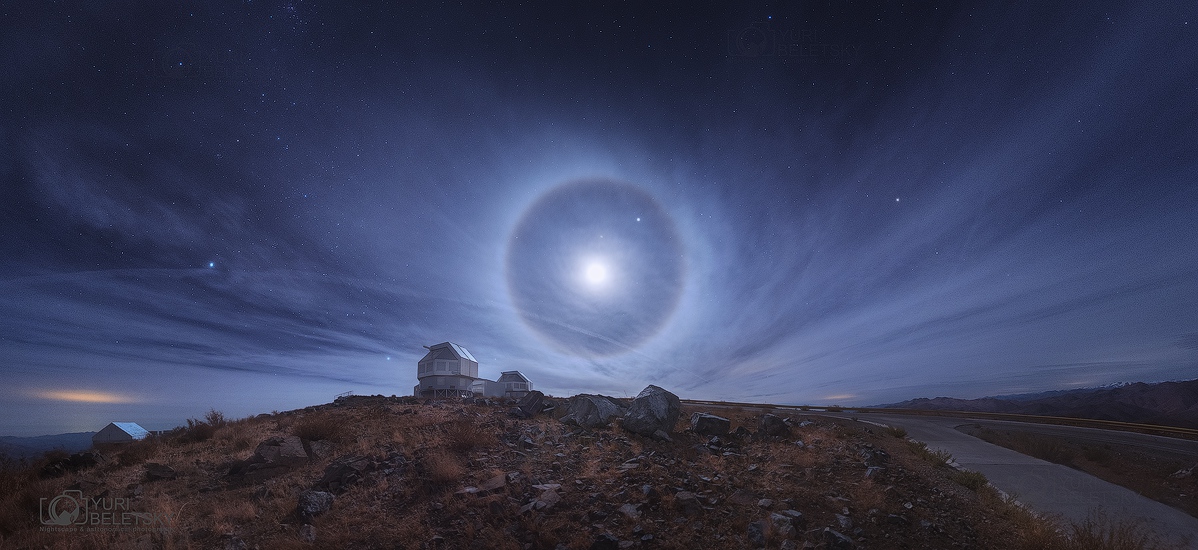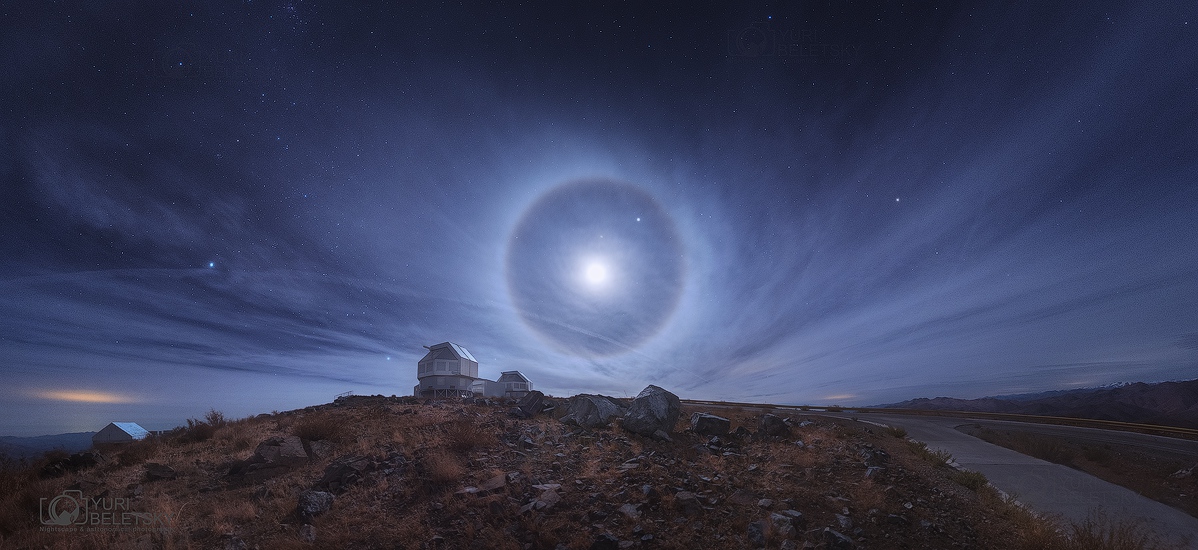
Influenced by the strong Pacific El Nino, cloudy skies have more often come to Chile's high Atacama Desert this season, despite its reputation as an astronomer's paradise. Located in one of the driest, darkest places on planet Earth, domes of the region's twin 6.5 meter Magellan telescopes of Carnegie Las Campanas Observatory were closed on May 13. Still, a first quarter Moon and bright stars shine through in this panoramic night skyscape, the lunar disk surrounded by a beautiful, bright halo. The angular radius of the halo is 22 degrees. Not determined by the brightness or phase of the Moon itself, the angle is set by the hexagonal geometry of atmospheric ice crystals that reflect and refract the moonlight. On that night, the brilliant star just inside the halo's radius was really planet Jupiter. The brightest star flanking the halo to the far left is Canopus, with Arcturus on the halo's right. Participate: Take an Aesthetics & Astronomy Survey
Influenciado por el fuerte fenómeno El Niño en el Pacífico, los cielos nublados han sido más frecuentes en esta temporada en el desierto de Atacama, en Chile, a pesar de su fama como paraíso para los astrónomos. Ubicado en uno de los lugares más secos y oscuros de la Tierra, los domos de los dos telescopios gemelos de 6,5 metros del Observatorio Carnegie Las Campanas fueron cerrados el 13 de mayo. Sin embargo, una luna en cuarto creciente y estrellas brillantes resplandecen en este paisaje nocturno panorámico, con el disco lunar rodeado por un hermoso y brillante halo. El radio angular del halo es de 22 grados. Este ángulo no depende de la luminosidad o fase de la luna, sino que está determinado por la geometría hexagonal de los cristales de hielo en la atmósfera que reflejan y refractan la luz lunar. Esa noche, la brillante estrella dentro del radio del halo era en realidad el planeta Júpiter. La estrella más brillante que flanquea el halo a la izquierda lejana es Canopus, mientras que en el lado derecho del halo se encuentra Arcturus.