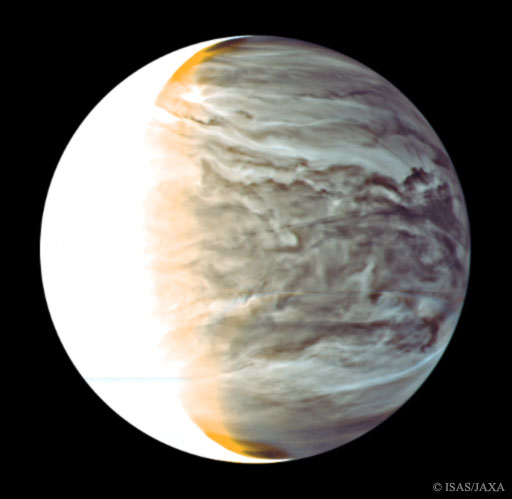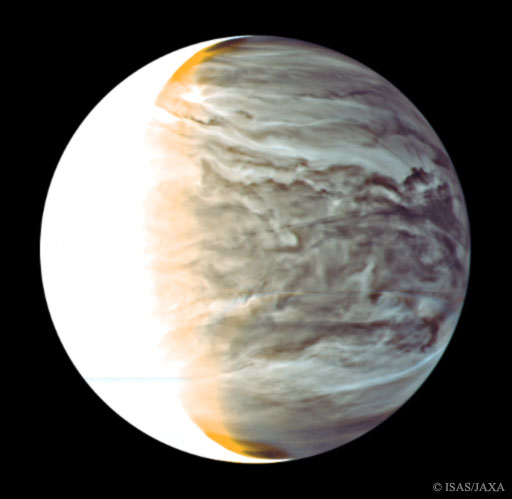
Why is Venus so different from Earth? To help find out, Japan launched the robotic Akatsuki spacecraft which entered orbit around Venus late last year after an unplanned five-year adventure around the inner Solar System. Even though Akatsuki has passed its original planned lifetime, the spacecraft and its instruments are operating so well that much of its original mission has been reinstated. In the featured image taken by Akatsuki late last month, Venus was captured in infrared light showing a surprising amount of atmospheric structure on its night side. The vertical orange terminator stripe between night and day is so wide because of light is so diffused by Venus' thick atmosphere. Also known as the Venus Climate Orbiter, Akatsuki has cameras and instruments that will investigate unknowns about the planet, including whether volcanoes are still active, whether lightning occurs in the dense atmosphere, and why wind speeds greatly exceed the planet's rotation speed.
¿Por qué es Venus tan diferente de la Tierra? Para ayudar a descubrirlo, Japón lanzó la nave espacial robótica Akatsuki, que entró en órbita alrededor de Venus a finales del año pasado tras una aventura inesperada de cinco años alrededor del sistema solar interno. Aunque Akatsuki ha superado su vida útil originalmente planeada, la nave y sus instrumentos están funcionando tan bien que gran parte de su misión original ha sido reinstalada. En la imagen destacada tomada por Akatsuki a finales del mes pasado, Venus fue capturado en luz infrarroja, mostrando una cantidad sorprendente de estructura atmosférica en su lado nocturno. La amplia banda naranja vertical entre el día y la noche es tan ancha debido a que la luz está tan difundida por la densa atmósfera de Venus. También conocida como la nave orbitadora de la climatología de Venus, Akatsuki tiene cámaras e instrumentos que investigarán incógnitas sobre el planeta, incluyendo si los volcanes aún están activos, si ocurre relámpagos en la densa atmósfera, y por qué las velocidades del viento superan ampliamente la velocidad de rotación del planeta.