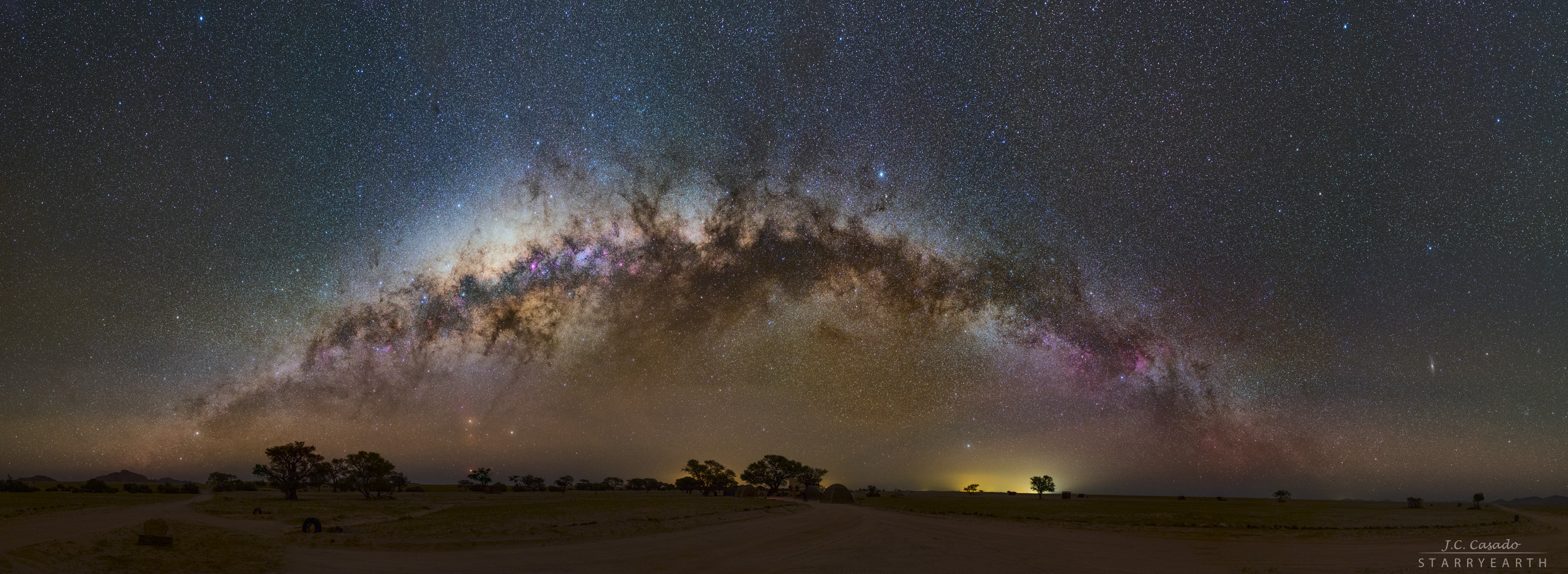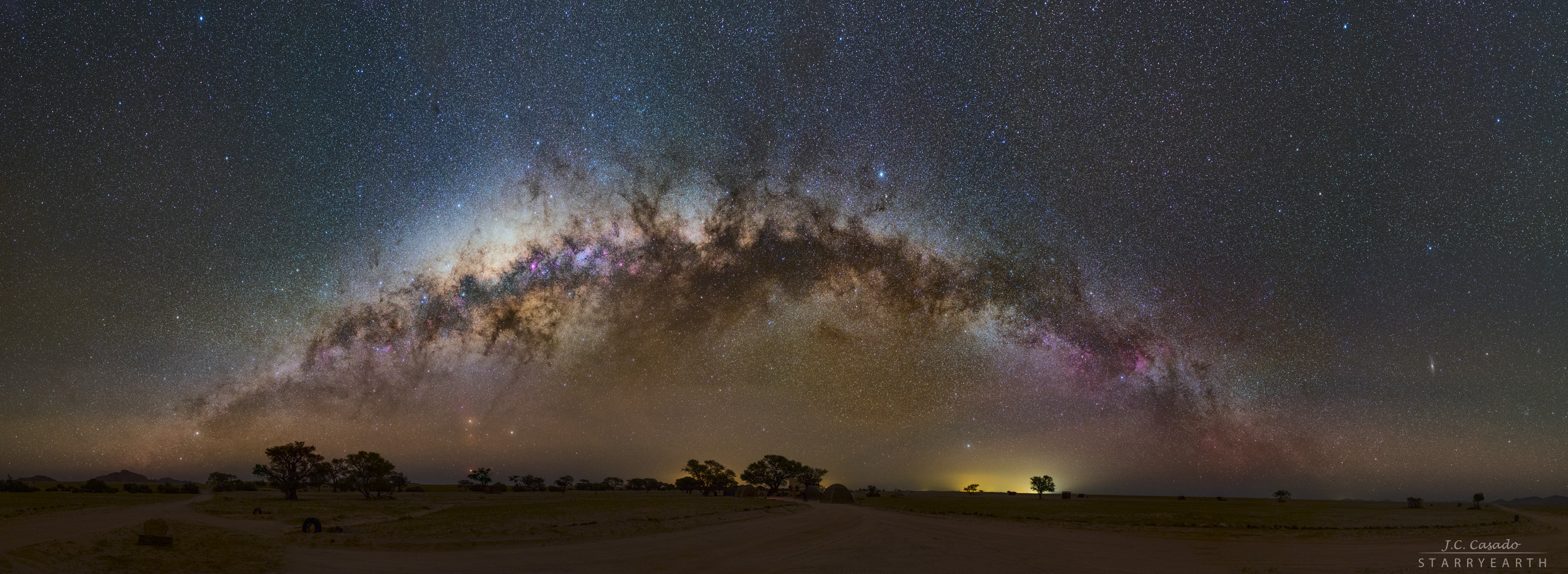
Under dark skies the setting of the Milky Way can be a dramatic sight. Stretching nearly parallel to the horizon, this rich, edge-on vista of our galaxy above the dusty Namibian desert stretches from bright, southern Centaurus (left) to Cepheus in the north (right). From early August, the digitally stitched, panoramic night skyscape captures the Milky Way's congeries of stars and rivers of cosmic dust, along with colors of nebulae not readily seen with the eye. Mars, Saturn, and Antares, visible even in more luminous night skies, form the the bright celestial triangle just touching the trees below the galaxy's central bulge. Of course, our own galaxy is not the only galaxy in the scene. Two other major members of our local group, the Andromeda Galaxy and the Triangulum Galaxy, lie near the right edge of the frame, beyond the arc of the setting Milky Way.
Bajo cielos oscuros, el puesta de la Vía Láctea puede ser un espectáculo dramático. Estirándose casi paralelo al horizonte, esta rica vista lateral de nuestra galaxia sobre el árido desierto namibio se extiende desde el brillante Centauro del sur (izquierda) hasta Cefeo en el norte (derecha). Desde principios de agosto, el paisaje nocturno panorámico, digitalmente unido, captura la congeries de estrellas y ríos de polvo cósmico de la Vía Láctea, junto con los colores de las nebulosas que no son fácilmente visibles a simple vista. Marte, Saturno y Antares, visibles incluso en cielos nocturnos más luminosos, forman el triángulo celeste brillante que toca los árboles justo debajo del bulbo central de la galaxia. Por supuesto, nuestra propia galaxia no es la única galaxia en la escena. Dos otros miembros principales de nuestro grupo local, la Galaxia de Andrómeda y la Galaxia de Triángulo, se encuentran cerca del borde derecho de la imagen, más allá del arco de la Vía Láctea que se pone.