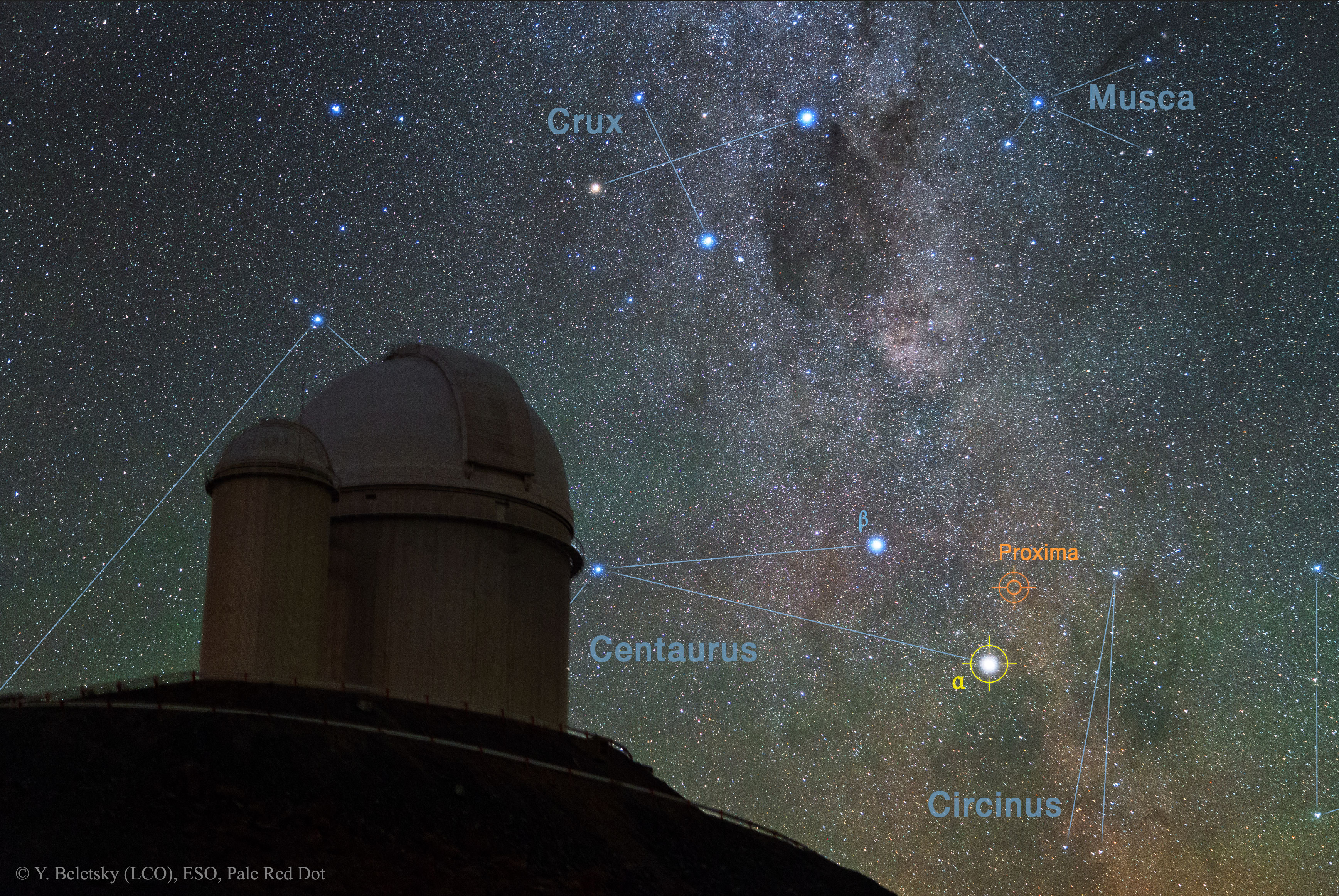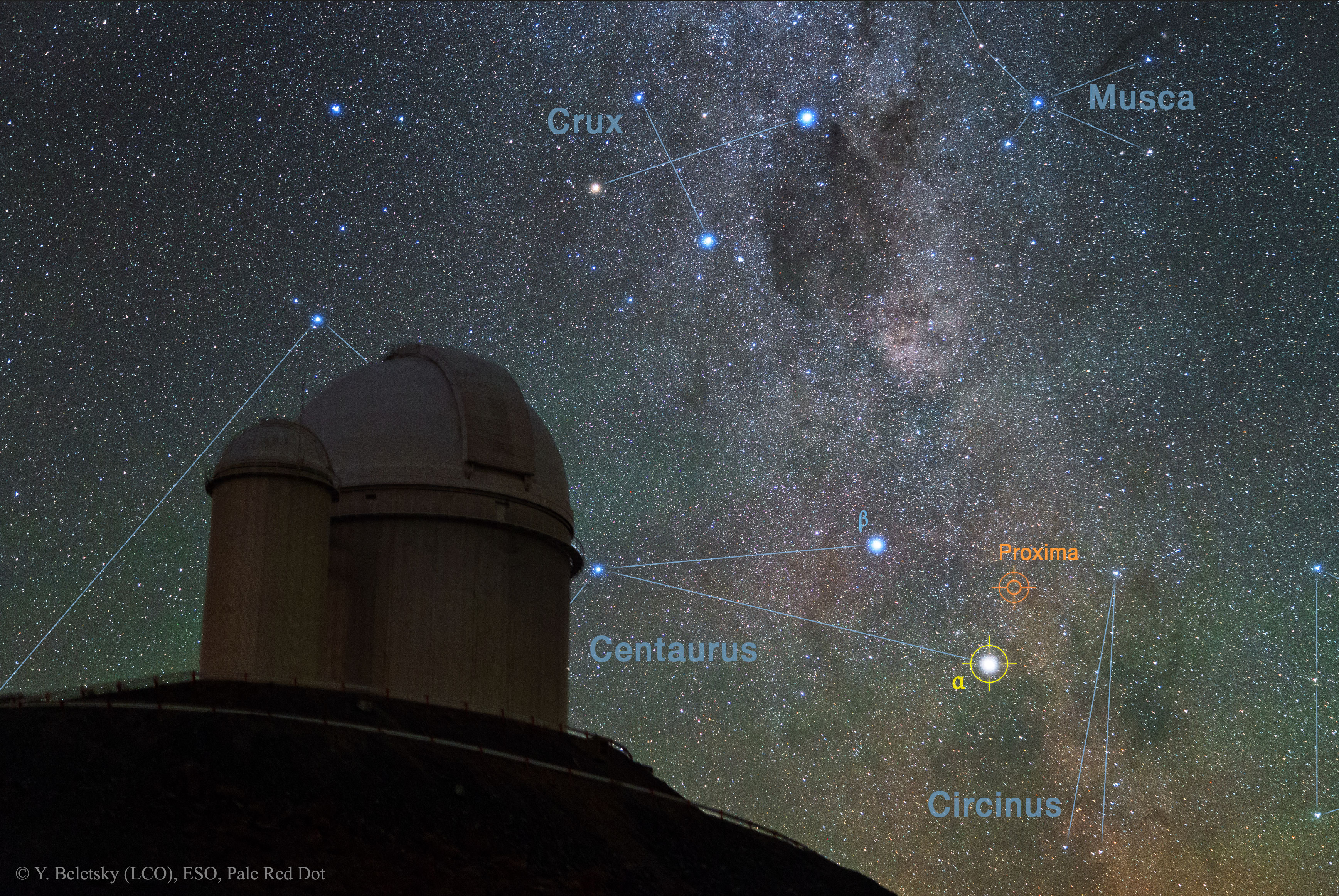
The star closest to the Sun has a planet similar to the Earth. As announced yesterday, recent observations confirmed that this planet not only exists but inhabits a zone where its surface temperature could allow liquid water, a key ingredient for life on Earth. It is not yet known if this planet, Proxima b, has any life. Even if not, its potential ability to sustain liquid water might make it a good first hop for humanity's future trips out into the Milky Way Galaxy. Although the planet's parent star, Proxima Centauri, is cooler and redder than our Sun, one of the other two stars in the Alpha Centauri star system is very similar to our Sun. The featured image shows the sky location of Proxima Centauri in southern skies behind the telescope that made many of the discovery observations: ESO's 3.6-meter telescope in La Silla, Chile. The discovered planet orbits close in -- so close one year there takes only 11 days on Earth. The planet was discovered by the ESO's Pale Red Dot collaboration. Although seemingly unlikely, if Proxima b does have intelligent life, at 4.25 light years distance it is close enough to Earth for two-way communication.
La estrella más cercana al Sol tiene un planeta similar a la Tierra. Como se anunció ayer, observaciones recientes confirmaron que este planeta no solo existe, sino que se encuentra en una zona donde su temperatura superficial podría permitir la existencia de agua líquida, un ingrediente clave para la vida en la Tierra. Aún no se sabe si este planeta, Proxima b, alberga vida. Incluso si no la tiene, su potencial capacidad para sostener agua líquida podría hacerlo una buena primera parada para los futuros viajes de la humanidad hacia la Vía Láctea. Aunque su estrella madre, Proxima Centauri, es más fría y rojiza que nuestro Sol, una de las otras dos estrellas en el sistema estelar Alpha Centauri es muy similar a nuestro Sol. La imagen destacada muestra la ubicación en el cielo de Proxima Centauri en el cielo del sur, detrás del telescopio que realizó muchas de las observaciones que llevaron al descubrimiento: el telescopio de 3,6 metros de ESO en La Silla, Chile. El planeta descubierto orbita muy cerca — tan cerca que un año allí dura solo 11 días en la Tierra. El planeta fue descubierto por la colaboración Pale Red Dot de ESO. Aunque parece improbable, si Proxima b tuviera vida inteligente, a una distancia de 4,25 años luz, estaría lo suficientemente cerca de la Tierra para permitir una comunicación de ida y vuelta.