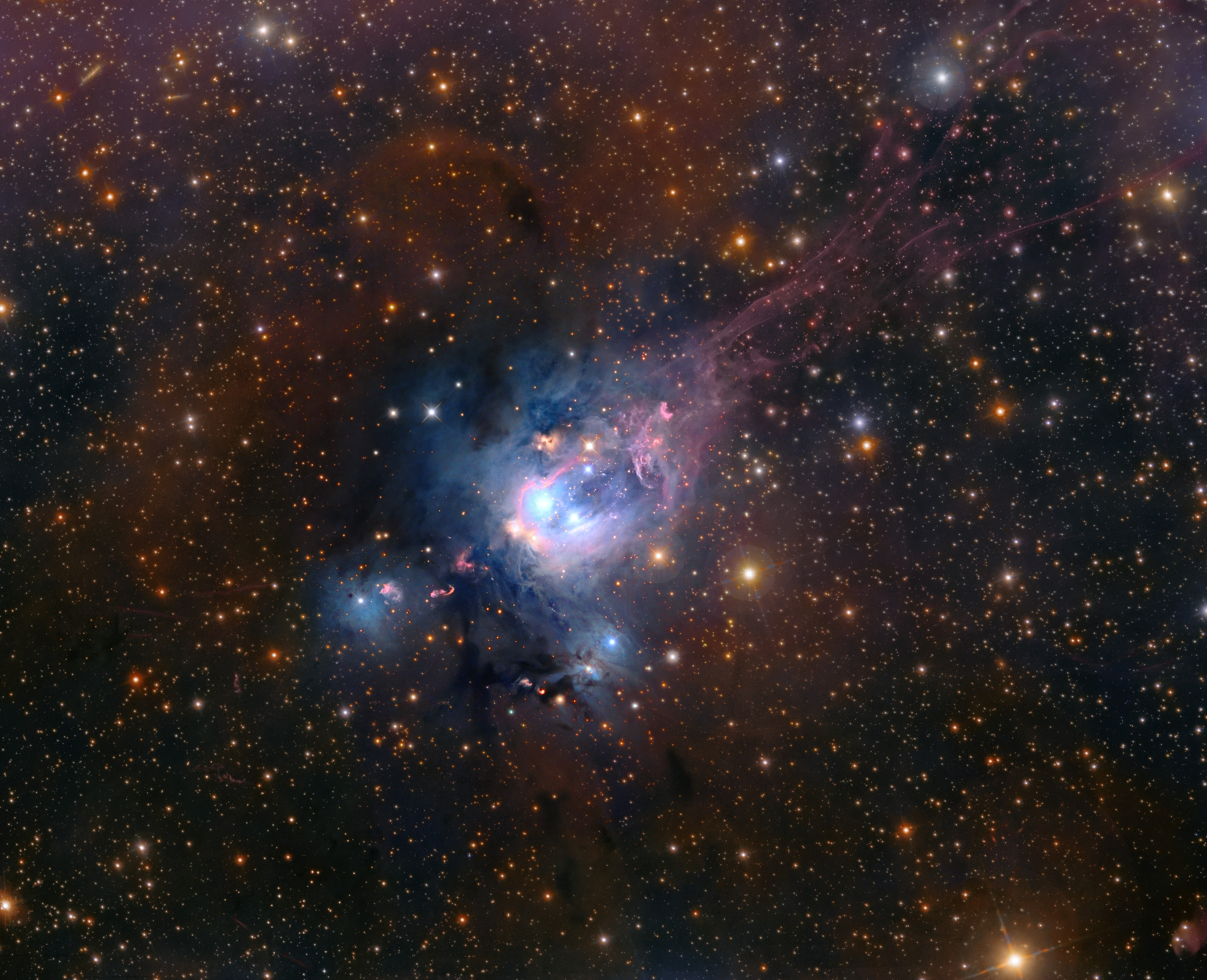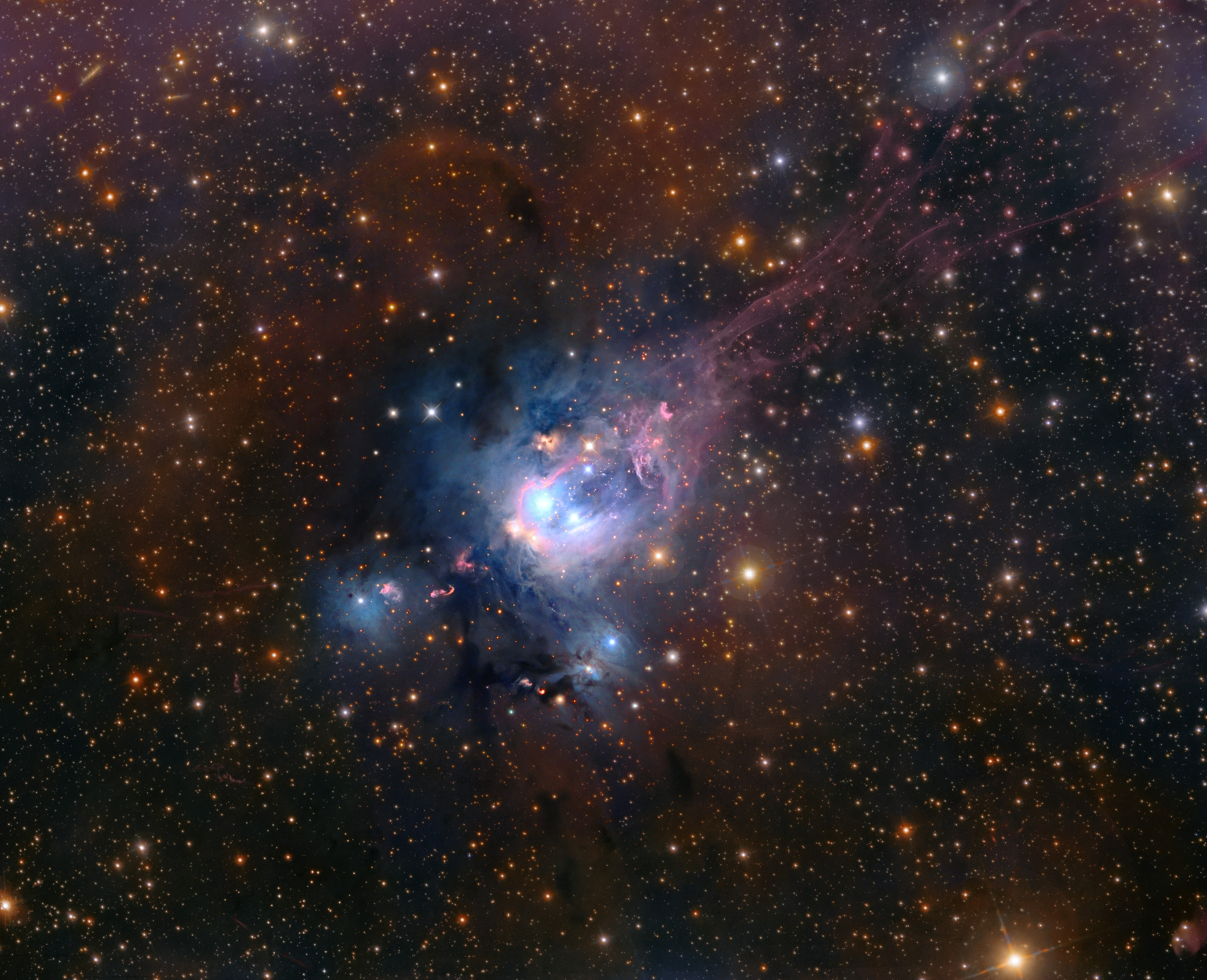
Young suns still lie within dusty NGC 7129, some 3,000 light-years away toward the royal constellation Cepheus. While these stars are at a relatively tender age, only a few million years old, it is likely that our own Sun formed in a similar stellar nursery some five billion years ago. Most noticeable in the sharp image are the lovely bluish dust clouds that reflect the youthful starlight. But the compact, deep red crescent shapes are also markers of energetic, young stellar objects. Known as Herbig-Haro objects, their shape and color is characteristic of glowing hydrogen gas shocked by jets streaming away from newborn stars. Paler, extended filaments of reddish emission mingling with the bluish clouds are caused by dust grains effectively converting the invisible ultraviolet starlight to visible red light through photoluminesence. Ultimately the natal gas and dust in the region will be dispersed, the stars drifting apart as the loose cluster orbits the center of the Galaxy. The processing of this remarkable composite image has revealed the faint red strands of emission at the upper right. They are recently recognized as a likely supernova remnant and are currently being analyzed by Bo Reipurth (Univ. Hawaii) who obtained the image data at the Subaru telescope. At the estimated distance of NGC 7129, this telescopic view spans over 40 light-years. Photo Gallery: Jupiter & Venus Conjunction of 2016 August
Los jóvenes soles aún permanecen dentro de la nubosa NGC 7129, a unos 3.000 años luz de distancia, hacia la constelación real de Cefeo. Aunque estas estrellas tienen una edad relativamente joven, solo unos pocos millones de años, es probable que nuestro propio Sol se formara en un nido estelar similar hace aproximadamente cinco mil millones de años. Lo más notable en la imagen nítida son las hermosas nubes azuladas de polvo que reflejan la luz estelar juvenil. Pero las formas compactas y crescentes de color rojo profundo también son indicadores de objetos estelares energéticos y jóvenes. Conocidos como objetos Herbig-Haro, su forma y color son característicos del gas hidrógeno brillante que se ilumina por chorros que se alejan de estrellas recién nacidas. Filamentos más pálidos y extendidos de emisión rojiza mezclados con las nubes azuladas son causados por granos de polvo que convierten eficazmente la luz ultravioleta invisible en luz roja visible a través de la fotoluminiscencia. Finalmente, el gas y el polvo natal en la región serán dispersados, las estrellas alejándose una de otra a medida que el grupo suelto orbita el centro de la Galaxia. El procesamiento de esta impresionante imagen compuesta ha revelado los tenues hilos rojos de emisión en la parte superior derecha. Se han reconocido recientemente como un posible remanente de supernova y actualmente están siendo analizados por Bo Reipurth (Universidad de Hawái), quien obtuvo los datos de la imagen con el telescopio Subaru. A la distancia estimada de NGC 7129, esta vista telescópica abarca más de 40 años luz.