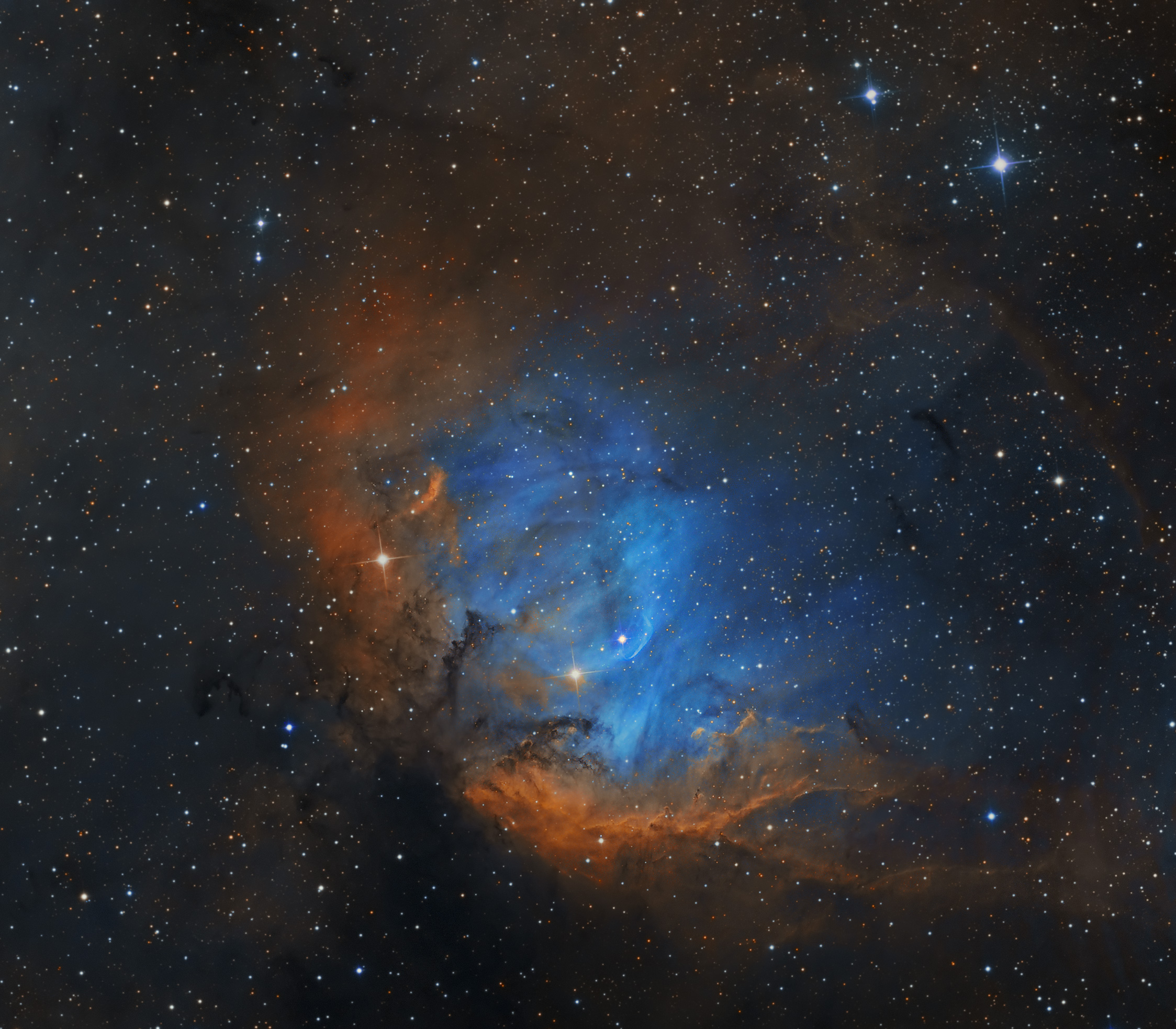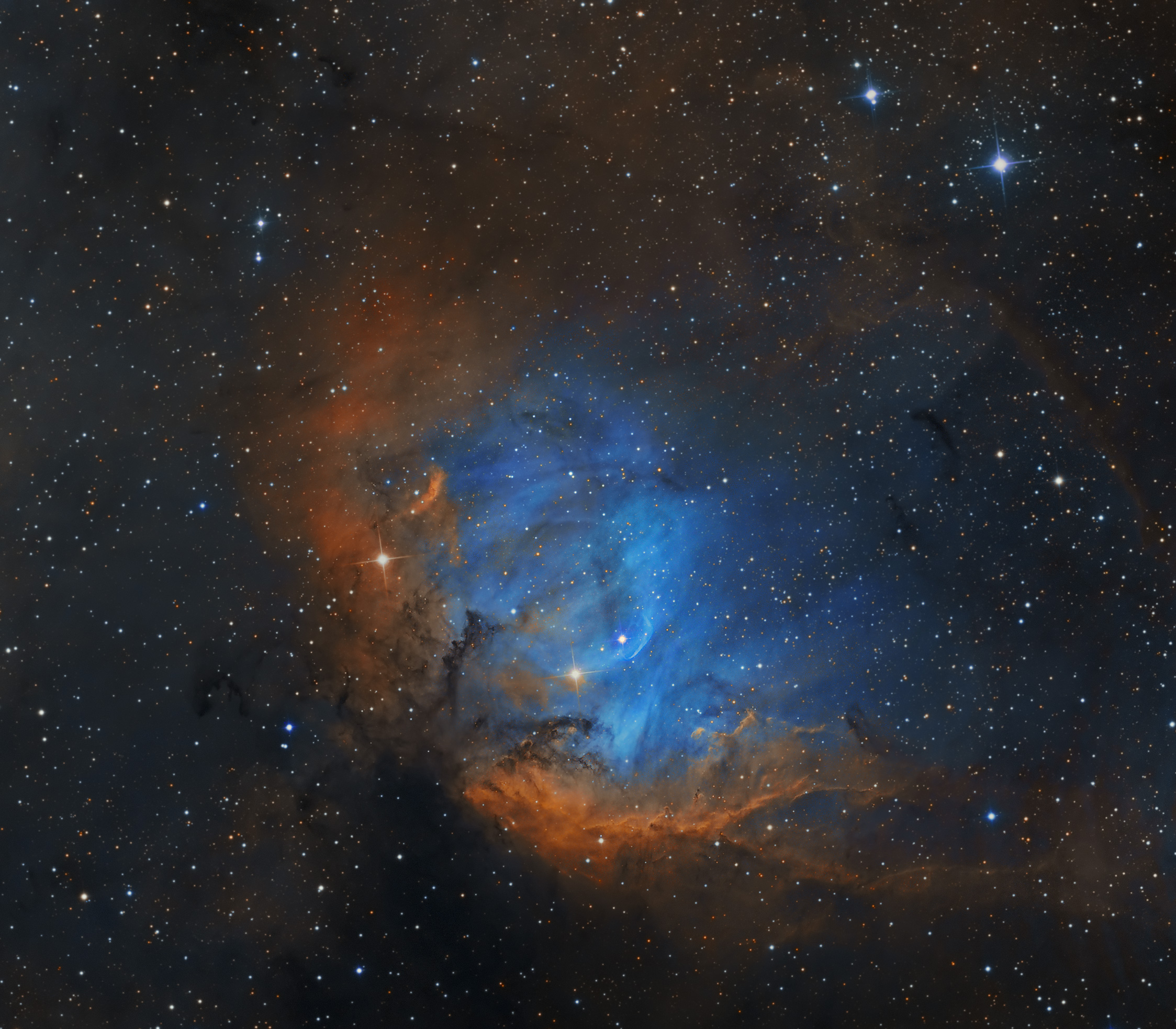
Framing a bright emission region this telescopic view looks out along the plane of our Milky Way Galaxy toward the nebula rich constellation Cygnus the Swan. Popularly called the Tulip Nebula, the glowing cloud of interstellar gas and dust is also found in the 1959 catalog by astronomer Stewart Sharpless as Sh2-101. About 8,000 light-years distant and 70 light-years across the complex and beautiful nebula blossoms at the center of the composite image. Red, green, and blue hues map emission from ionized sulfur, hydrogen, and oxygen atoms. Ultraviolet radiation from young, energetic stars at the edge of the Cygnus OB3 association, including O star HDE 227018, ionizes the atoms and powers the visible light emission from the Tulip Nebula. HDE 227018 is the bright star very near the blue arc at the center of the cosmic tulip.
Este amplio campo visual capturado por un telescopio se dirige a lo largo del plano de nuestra Galaxia Vía Láctea hacia la constelación rica en nebulosas de Cisne. Popularmente conocida como la Nebulosa Tulipán, la nube brillante de gas e interstelar también se encuentra en el catálogo de 1959 del astrónomo Stewart Sharpless como Sh2-101. A unos 8.000 años luz de distancia y con un diámetro de 70 años luz, la compleja y bella nebulosa florece en el centro de la imagen compuesta. Los tonos rojo, verde y azul representan la emisión de átomos ionizados de azufre, hidrógeno y oxígeno. La radiación ultravioleta de estrellas jóvenes y energéticas en el borde de la asociación estelar Cygnus OB3, incluida la estrella O HDE 227018, ioniza los átomos y alimenta la emisión visible de la Nebulosa Tulipán. HDE 227018 es la estrella brillante muy cercana al arco azul en el centro de la tulipán cósmica.