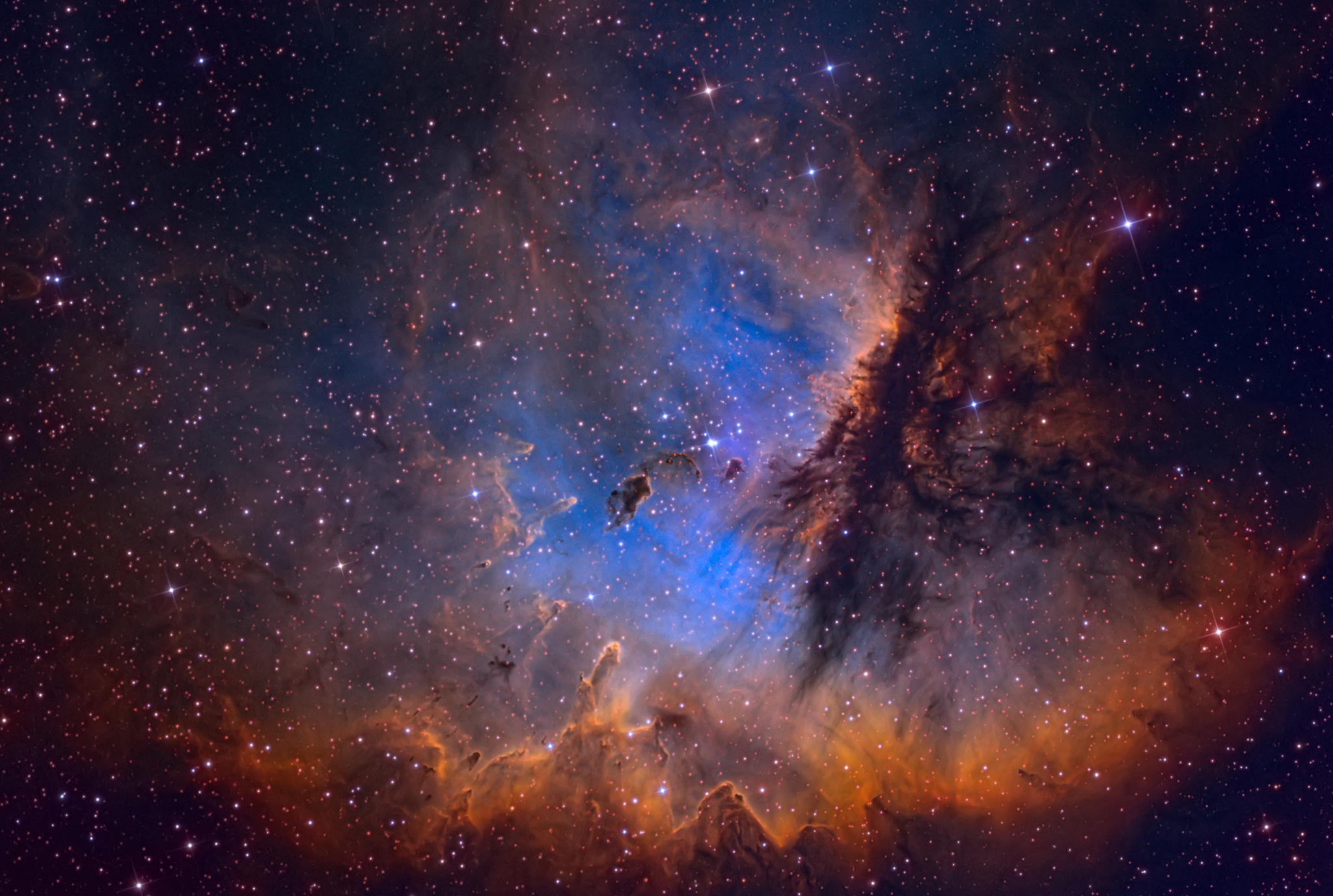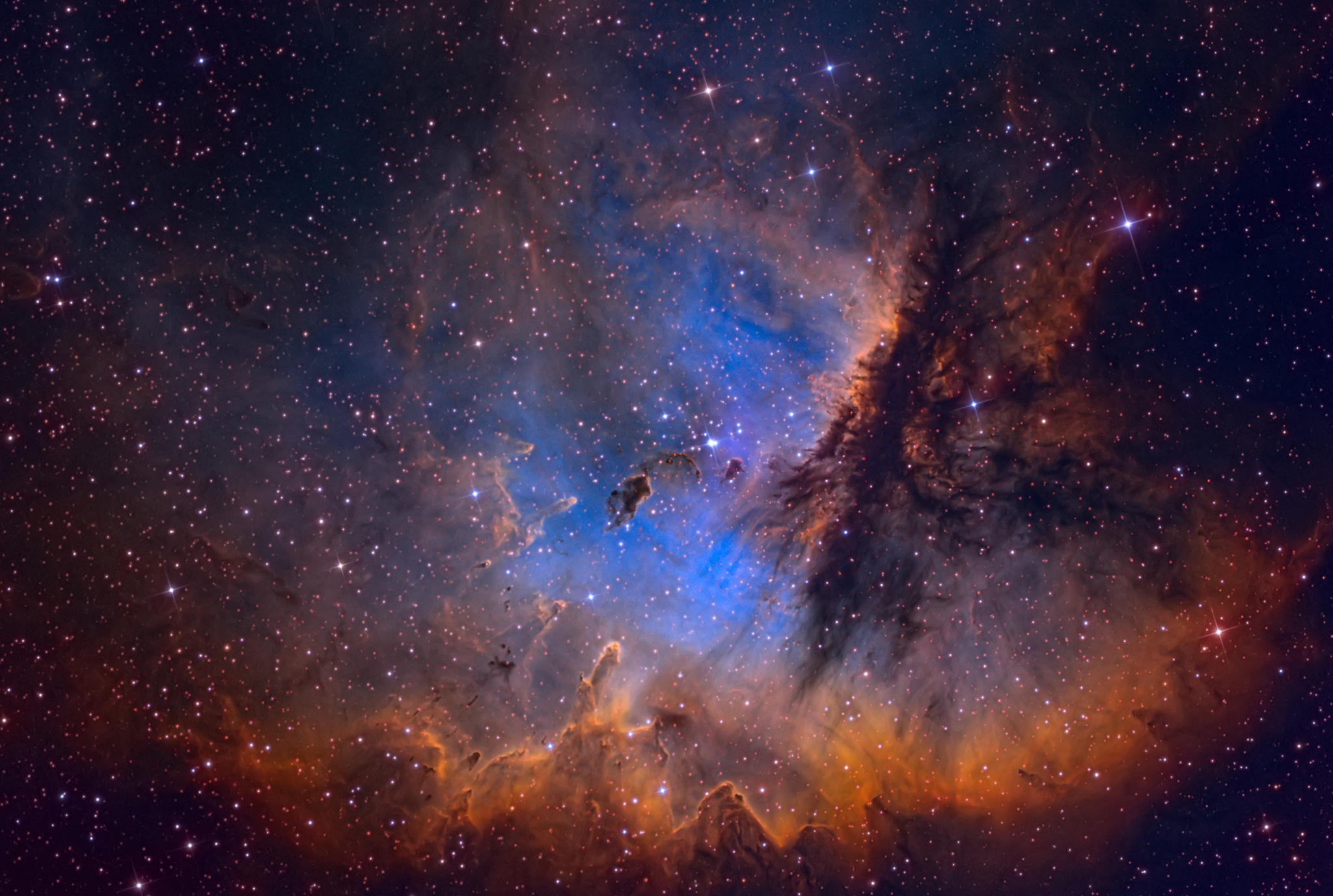
Look through the cosmic cloud cataloged as NGC 281 and you might miss the stars of open cluster IC 1590. Still, formed within the nebula that cluster's young, massive stars ultimately power the pervasive nebular glow. The eye-catching shapes looming in this portrait of NGC 281 are sculpted columns and dense dust globules seen in silhouette, eroded by intense, energetic winds and radiation from the hot cluster stars. If they survive long enough, the dusty structures could also be sites of future star formation. Playfully called the Pacman Nebula because of its overall shape, NGC 281 is about 10,000 light-years away in the constellation Cassiopeia. This sharp composite image was made through narrow-band filters, combining emission from the nebula's hydrogen, sulfur, and oxygen atoms in green, red, and blue hues. It spans over 80 light-years at the estimated distance of NGC 281.
Mire a través de la nube cósmica catalogada como NGC 281 y podría pasar por alto las estrellas del cúmulo abierto IC 1590. Sin embargo, formado dentro de la nebulosa, las estrellas jóvenes y masivas del cúmulo alimentan finalmente el resplandor nebuloso generalizado. Las formas llamativas que se destacan en este retrato de NGC 281 son columnas talladas y globulos densos de polvo vistos en silueta, erosionados por vientos y radiación intensa y energética proveniente de las estrellas calientes del cúmulo. Si sobreviven lo suficiente, estas estructuras polvorientas también podrían ser lugares de futura formación estelar. Divertidamente llamada la Nebulosa Pacman debido a su forma general, NGC 281 se encuentra a unos 10 000 años luz de distancia en la constelación de Casiopea. Esta imagen compuesta nítida se creó mediante filtros de banda estrecha, combinando emisiones de los átomos de hidrógeno, azufre y oxígeno de la nebulosa en tonos verde, rojo y azul. Cubre más de 80 años luz a la distancia estimada de NGC 281.