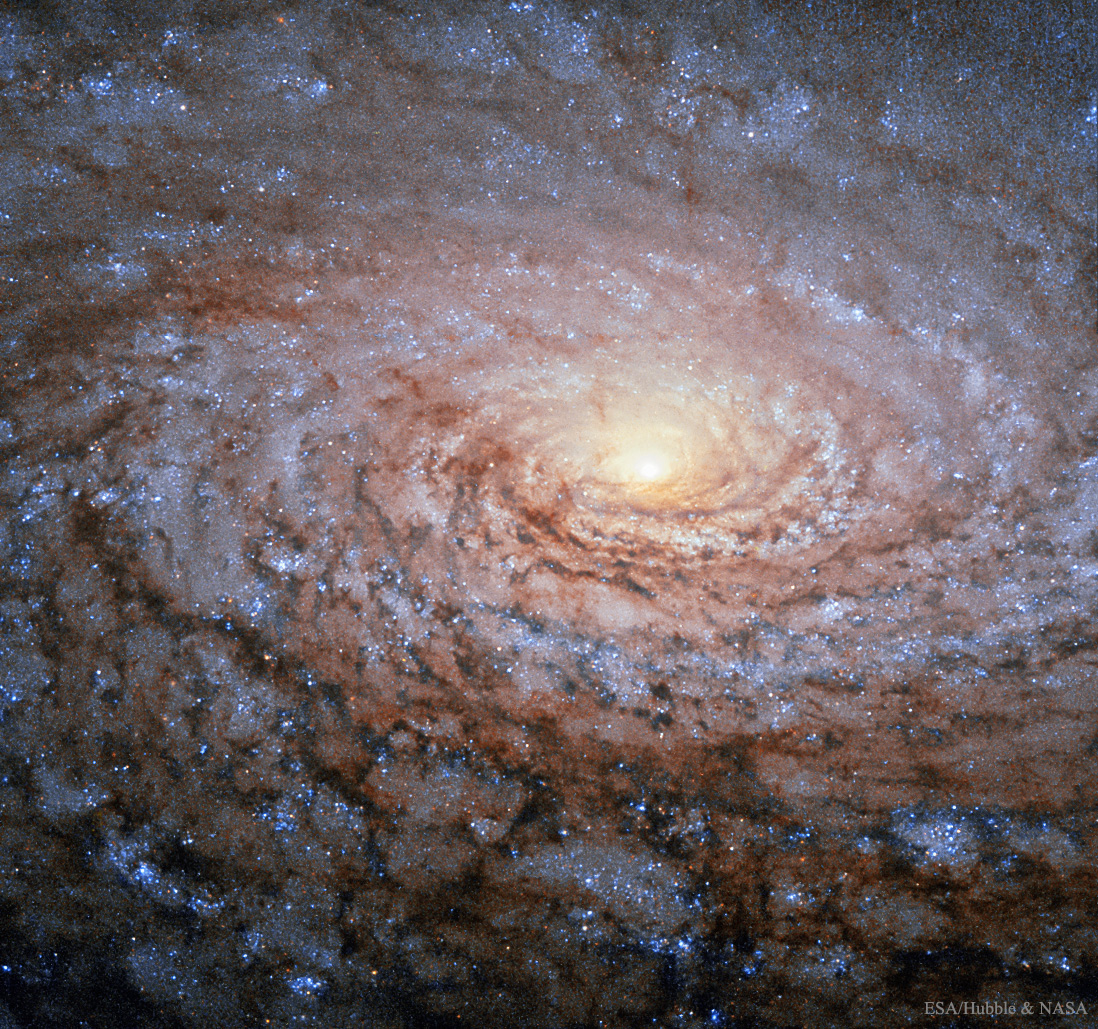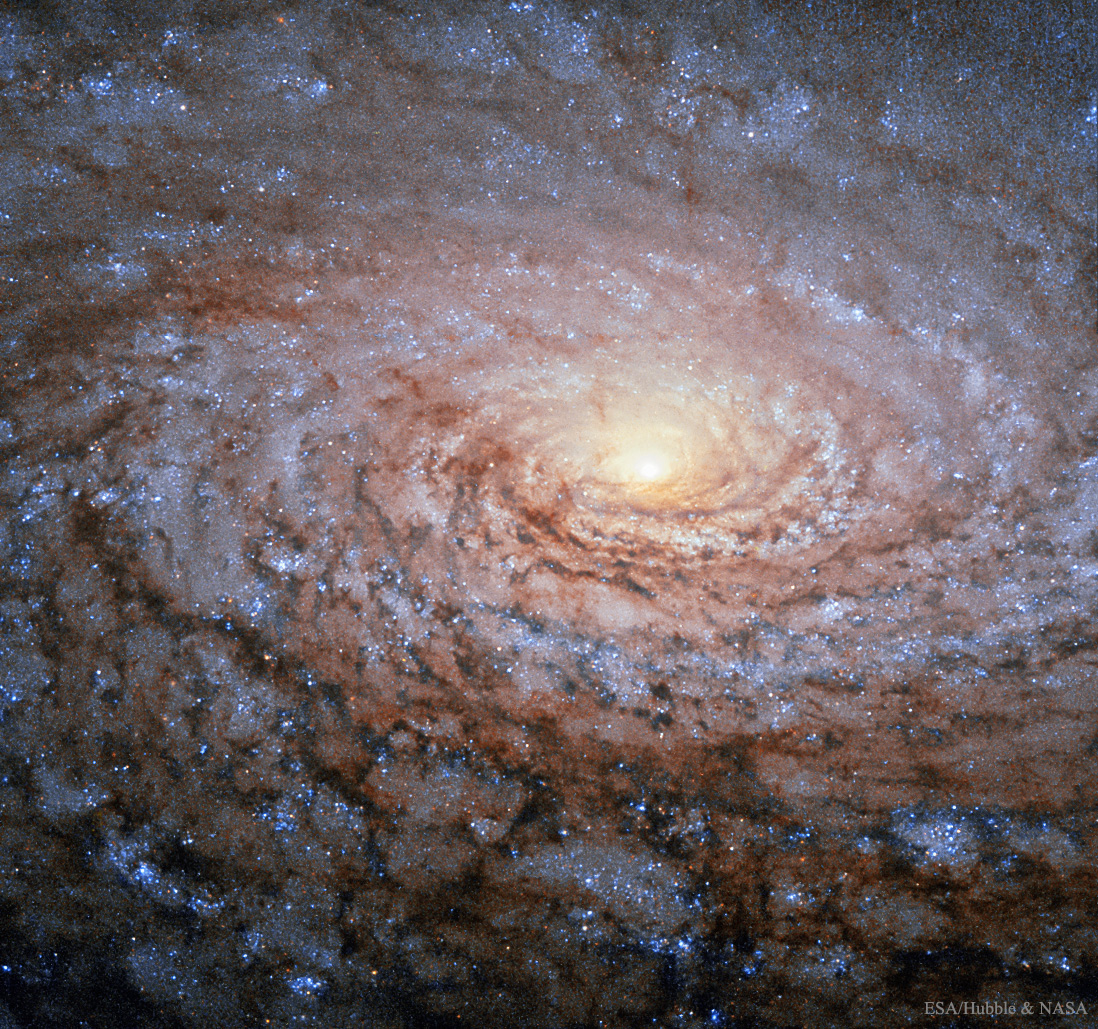
One of the bright spiral galaxies visible in the north sky is M63, the Sunflower Galaxy. M63, also catalogued as NGC 5055, can be found with a small telescope toward the constellation of Hunting Dogs (Canes Venatici). The featured picture from the Hubble Space Telescope exhibits the center of M63, complete with long winding spiral arms glowing blue from a few bright young stars, emission nebulae glowing red from hot ionized hydrogen gas, and dark dust in numerous filaments. M63 interacts gravitationally with M51 (the Whirlpool Galaxy) and several smaller galaxies. Light takes about 35 million years to reach us from M63, and about 60,000 years to cross the spiral galaxy. Stars in the outer regions of the Sunflower Galaxy rotate about the center at a speed so high that, given the matter seen and assuming normal gravity, they should fly off into space. The fact that the stars remain indicates the presence of sort of invisible, gravitationally-binding, dark matter. Free Download: APOD 2017 Calendar: NASA Images
Una de las galaxias espirales brillantes visibles en el cielo del norte es M63, la Galaxia de la Flor de Sol. M63, también catalogada como NGC 5055, puede observarse con un telescopio pequeño hacia la constelación de los Perros de Caza (Canes Venatici). La imagen destacada del Telescopio Espacial Hubble muestra el centro de M63, completo con brazos espirales largos y enredados que brillan en azul debido a algunas estrellas jóvenes brillantes, nebulosas emisoras que brillan en rojo debido al gas hidrógeno caliente ionizado, y polvo oscuro en numerosos filamentos. M63 interactúa gravitacionalmente con M51 (la Galaxia del Remolino) y varias galaxias más pequeñas. La luz tarda aproximadamente 35 millones de años en llegar a nosotros desde M63, y unos 60 000 años en atravesar la galaxia espiral. Las estrellas en las regiones externas de la Galaxia de la Flor de Sol giran alrededor del centro a una velocidad tan alta que, dado el material visible y asumiendo la gravedad normal, deberían salir disparadas al espacio. El hecho de que las estrellas permanezcan indica la presencia de una materia invisible, gravitacionalmente vinculante, denominada materia oscura.